


MCP vs API: What’s the Difference? Complete Comparison

Artificial Intelligence Team
Last Updated: Sep 08, 2026 Total Views: 92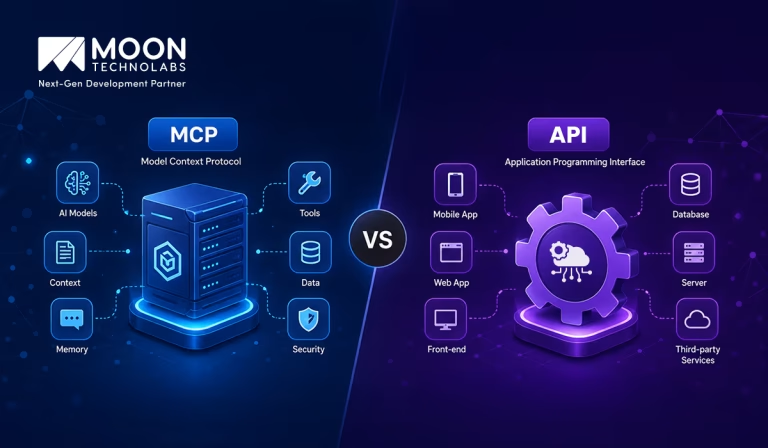
Table of Content


Blog Summary:
MCP Vs API is an important topic for developers building modern integrations. APIs provide structured access to specific services and data, while MCP offers a standardized way for AI models to interact with tools, resources, and applications. Understanding MCP and API helps developers choose the right approach for creating scalable, flexible, and AI-ready software integrations.
Table of Content
AI applications don’t work in isolation. They need to pull data from databases, interact with third-party tools, trigger actions, and access business systems. Traditionally, APIs have been the go-to way to make these connections. But as AI agents and tool-using models become more common, a new approach is gaining attention: the Model Context Protocol (MCP).
This raises a practical question: If APIs already connect applications to external services, why do we need MCP? The answer lies in how AI models discover, understand, and use those external capabilities. MCP agents provide a structured approach for AI applications to work with tools and context, while APIs remain the foundation for direct application-to-application communication.
In this guide, we’ll break down MCP vs API in simple terms, compare how they work, and explain where each approach fits when building modern AI-powered applications.
What is the Model Context Protocol (MCP)?
MCP is an open standard that helps AI models connect with external tools, applications, and data sources. It provides a common way for AI systems to access information and perform tasks without requiring separate integrations for every service.
MCP acts as a bridge between AI models and external systems, allowing applications to share context, retrieve data, and use tools securely. This makes AI applications more capable while reducing the complexity of building and maintaining multiple custom integrations.
For businesses, MCP can simplify AI integration and automation by establishing standardized connections between AI assistants and existing software, databases, APIs, and business tools.
Key Features of MCP
The following are the key features of MCP that define its functionality and enable effective integration, communication, and interaction across AI applications and external systems:
Dynamic Tool Discovery
MCP enables AI models to discover available tools and capabilities dynamically at runtime. Instead of relying on a fixed set of functions, an AI system can identify the tools it needs and use them as required for the task at hand. This makes AI applications more flexible, scalable, and easier to integrate with new services.
Context-Aware Interactions
MCP protocol allows AI systems to operate in relevant context when interacting with tools and data sources. Providing the right information at the right time helps models produce more accurate, meaningful, and task-specific responses. This improves the overall quality of AI-driven interactions.
Seamless Data and Resource Access
MCP provides a consistent framework for AI applications to access external data and resources. It can connect models with files, databases, APIs, applications, and other information sources without requiring a separate custom integration for every software system. This simplifies data access and improves interoperability.
Support for AI Agents and LLMs
MCP is designed to work with Large Language Models (LLMs) and AI agents that need to interact with external tools and systems. AI agents can use MCP to retrieve information, execute actions, and combine multiple capabilities to complete complex tasks. This makes it easier to build intelligent, autonomous, and tool-enabled AI applications.
Turn Your AI Integration Strategy Into Real Results
We help businesses implement connected AI ecosystems that work across tools, applications, APIs, and MCP-enabled workflows.
What is an API?
An API (Application Programming Interface) acts like a bridge between two different software systems. It allows one application to request specific data from another application or perform an action without needing to know how the other system works internally.
For example, when you order food through an app, the app may use APIs to communicate with the restaurant, process your payment, and track your delivery. Each API handles communication between the app and a different service.
In simple terms, an API helps different technologies work together smoothly. Developers use APIs to connect services, share data, and add useful features without building everything from the ground up.
Key Features of an API
The following are the key features of APIs that enable efficient communication, integration, and functionality across applications and systems:
Statelessness
An API is generally designed to be stateless, meaning each request contains all the information needed for the server to process it. The server does not need to remember previous requests from the client. This makes APIs easier to scale, maintain, and manage.
Authentication & Authorization
APIs use authentication to verify the identity of a user or application, while authorization determines what that user or application is allowed to access. Common methods include API keys, tokens, OAuth, and JWTs. These mechanisms help protect sensitive data and prevent unauthorized access.
Data Encryption
APIs use encryption to protect data in transit between the client and server. HTTPS, which uses TLS encryption, is commonly used to prevent attackers from intercepting or modifying sensitive information. Encryption helps ensure that data remains secure and private.
Status Codes
APIs use HTTP status codes to communicate the result of a request. These codes help clients understand whether an operation was successful or if an error occurred. For example, 200 indicates success; 201 indicates that a resource was created; 400 indicates a bad request; 401 indicates unauthorized access; 404 indicates that the requested resource was not found; and 500 indicates a server-side error.
MCP Vs API: The Quick Comparison
Here’s a quick comparison of MCP vs APIs to help you understand the differences and determine which approach best fits your needs:
| Aspect | MCP | API |
|---|---|---|
| Primary Purpose | Connect AI models to external tools, data, and services | Enable software applications to communicate with each other |
| Designed For | AI assistants and LLM-based applications | General software and system integrations |
| Communication Model | Standardized protocol between AI models and tools/resources | Request-response communication between applications/services |
| Context Handling | Provides AI with context, tools, resources, and capabilities | Typically provides structured data/results based on requests |
| Integration Approach | One standardized interface can connect an AI to multiple tools | Usually requires integration with each API individually |
| Use Cases | AI agents, tool calling, accessing files/databases, automation | Payments, authentication, weather data, social media, databases, etc. |
| Security | Can define controlled access to tools and resources for AI | Uses mechanisms such as API keys, OAuth, tokens, and permissions |
| Best For | Building AI-powered applications that need access to external tools and context | Connecting applications, services, and systems reliably |
Difference Between MCP and API
Here’s a detailed overview of MCP and APIs, making it easier to see how they compare and when each approach may be the right choice.
Communication and Data Exchange
An API defines a set of rules and endpoints that allow one application to communicate with another. It typically uses protocols such as HTTP/HTTPS and formats such as JSON or XML to send requests and receive responses. APIs are generally designed for specific operations, such as retrieving customer information, creating an order, or updating a record.
MCP is designed to connect AI models with external tools, applications, and data sources through a standardized protocol. Instead of requiring an AI application to implement a separate integration for every service, MCP provides a common way for AI models to interact with available resources and tools.
Tool Discovery and Integration
With traditional APIs, developers usually need to know the API’s endpoints, request formats, authentication requirements, and available operations. Integration is often built specifically for each API.
MCP supports standardized discovery of available tools and resources. An AI application can learn which capabilities are available on an MCP server and determine how to use them. This makes it easier to connect AI systems to multiple external services.
Context and State Management
APIs generally handle individual requests and responses. If an application needs to maintain context or state across multiple requests, that responsibility is usually handled by the application itself, databases, sessions, or tokens.
MCP is designed specifically for AI applications that need access to context, tools, and resources. It provides a standardized way for AI systems to interact with external context while the host app remains responsible for managing the model’s conversation and overall state.
Flexibility and Scalability
APIs are highly flexible and can be designed for almost any type of application or service. However, integrating many APIs can increase development and maintenance effort because each API may have different specifications and authentication mechanisms.
MCP provides a common integration layer for AI apps. Instead of creating custom integrations between an AI application and every individual service, developers can use MCP-compatible servers and clients. This can make it easier to add new tools and data sources as an AI system grows.
Security and Authentication
APIs commonly use authentication and authorization mechanisms such as API keys, OAuth, JWTs, and other access-control systems. Security is typically implemented according to the requirements of the specific API.
MCP also needs strong security controls because it can allow AI applications to access external tools and data. Authentication, authorization, user consent, access permissions, and protection of sensitive information are important when deploying MCP integrations. The exact security mechanism depends on the MCP implementation and the systems being connected.
MCP vs API: How Do They Work Together?
APIs allow applications to communicate with specific services, while MCP provides a unified interface for AI models to connect with tools, data, and external systems. In simple terms, an API defines how software can request and exchange data, whereas MCP helps AI assistants discover and use those capabilities consistently.
MCP and APIs can work together rather than replace each other. An MCP server can connect to existing APIs and expose their functions to an AI model through a standardized interface. This allows AI applications to interact with multiple services more easily, while organizations can continue using their existing APIs behind the scenes.
Together, MCP and APIs make AI integrations more flexible and scalable. APIs handle the underlying communication with services, while MCP serves as a bridge, enabling AI models to understand and use those services efficiently.
When Should You Use MCP or API?
Both APIs and MCP can connect applications to external systems, but they solve slightly different problems. The right choice depends on how you want your AI system or application to interact with tools, data, and services.
When APIs Are the Better Choice
APIs are usually the better option when you need direct, predictable, and programmatic access to a specific service.
Choose an API when:
- You are building a traditional application that needs to communicate with a backend service.
- You need precise control over requests, responses, authentication, and error handling.
- The integration is between two known systems with well-defined requirements.
- You need high performance and low overhead.
- You want a stable contract between your application and an external service.
- The same operations need to be called repeatedly through application code.
For example, if an e-commerce application needs to retrieve a customer’s order history from a database service, a REST or GraphQL API is often the simplest and most efficient solution.
In short: Use an API when your application already knows what service it needs and exactly how it wants to use it.
When MCP Is the Better Choice
MCP is particularly useful when AI models need to discover and interact with multiple tools or data sources in a consistent framework.
Choose MCP when:
- An AI assistant needs access to multiple external tools or services.
- You want an AI application to dynamically discover available tools.
- You are building an AI agent that may need to decide which tool to use based on the user’s request.
- You want to expose existing capabilities to different AI applications through a common interface.
- You need a structured approach to provide an AI model with tools, resources, and contextual information.
For example, an AI coding assistant could use MCP to access a project’s files, database, documentation, issue tracker, and development tools. Instead of building a separate custom integration for every AI client, an MCP server can expose these capabilities in a standardized format.
In short: Use MCP when you want AI models or agents to interact with tools and context in a standardized, discoverable way.
Connect AI, Applications, And Data Without The Complexity
We build connected AI workflows with robust integration solutions that seamlessly bring your applications, systems, and data together.
How Can Moon Technolabs Help With MCP and API Integration?
We help businesses integrate MCP and APIs into their applications to create connected, efficient, and scalable digital solutions tailored to specific business needs.
Our team can handle the complete integration process, from planning and development to testing and deployment, ensuring smooth communication between AI systems, applications, and existing platforms.
With a focus on reliability and performance, we at Moon Technolabs help businesses adopt MCP and API integrations that simplify workflows, improve functionality, and support long-term growth.
Conclusion
MCP and APIs both play an important role in modern application development, but they serve different purposes. Understanding their differences can help businesses choose the right approach based on their technical and business requirements.
As AI continues to evolve, integrating the right technologies can help organizations build smarter, more connected, and scalable solutions. If you’re planning to adopt AI into your business, partnering with an experienced AI development company can help turn your ideas into reliable, future-ready applications.
With the right strategy and expertise, MCP and API integration can become a strong foundation for building innovative digital solutions and enhancing your AI capabilities.
FAQs
01
Will MCP replace APIs?
No. MCP is not designed to replace APIs. Instead, it provides a standardized way for AI applications to interact with tools, data, and services. MCP servers can even use existing APIs behind the scenes, making them complementary technologies rather than competing ones.02
Is MCP just a REST API?
No. MCP is more than a REST API. While REST APIs expose application functionality through endpoints, MCP standardizes how AI applications discover and interact with tools, resources, and prompts. It is specifically designed to make integrations easier and more consistent for AI systems.03
What are the four types of APIs?
The four common API types are - Public APIs: Available to external developers, Private APIs: Used within an organization, Partner APIs: Shared with selected partners and Composite APIs: Combine multiple API calls into one interaction.04
Which language is best for building an MCP server?
There is no single best language. Python and TypeScript are popular choices because of their strong MCP ecosystem and developer-friendly tooling. Python works particularly well for AI and data applications, while TypeScript is a great choice for JavaScript and Node.js-based projects.05
How much does it cost to run an MCP server?
MCP itself does not charge a hosting or licensing fee. Your cost depends on infrastructure, traffic, databases, and external services. A small MCP server can run on an inexpensive cloud instance, while larger production deployments may require significantly more resources and higher monthly costs.



Explore the latest insights on Artificial Intelligence, including Generative AI, Agentic AI, natural language processing, computer vision, automation, and enterprise AI solutions. This category covers industry trends, practical applications, implementation strategies, and innovations that help businesses leverage AI for smarter decision-making and digital transformation. Stay updated with evolving AI technologies that are reshaping industries worldwide.
Submitting the form below will ensure a prompt response from us.
We refine our expertise to deliver innovative business solutions.





205 N Michigan Avenue, #810, Chicago, 60601, Illinois, United States
13500 Long Is Dr, Pflugerville, TX 78660, USA

C/105 Ganesh Meridian, S.G. Highway, Ahmedabad, GJ 380060


Ayse D.
Co-Founder France
“ I highly recommend Moon Technolabs as the quality of service is wonderful. We have hired this company to develop the product based on some complex & technical issues. We get the best quality services as compared with others in the market. Huge Thanks to Moon Technolabs as the team is always ready to give the solution all time.”

Justin G.
Founder & CEO USA
USA“ Moon Technolabs is a pioneer in the WebRTC based project as they have fixed complicated segments of the module by fulfilling different product lines by providing 24X7 customer support. We really recommended Moon Technolabs as they are able to develop products as per the module deadline and project timeline.”

Flavio S.
Founder & Managing Director Germany
“I am happy to recommend Moon Technolabs for their app development services. They successfully developed apps for me, and I am highly satisfied with the overall outcomes. The development team has swiftly addressed the issues with responsive and effective communication to understand the requirement quickly and actively resolve the back-and-forth problems that arose...”

Jay M.
Founder & CEOUSA“Moon Technolabs is the best company that provides advanced apps and websites development services in the USA and Europe. I am a newbie to develop my app with an external team. I am really happy to work with them as I am not that much mobile apps user. Here, the team and specially the CEO of Moon Technolabs helps me to let me know about the benefits of my app to generate revenue....”


Our Offices
India
C/105 Ganesh Meridian,S.G. Highway, Ahmedabad, GJ 380060USA
205 N Michigan Avenue, #810, Chicago, 60601, Illinois, United StatesContact Information


