


Why Custom LMS Software Development Is Essential for Modern Businesses

Marketing Team
Last Updated: Jul 16, 2026 Total Views: 87
Table of Content


Blog Summary:
Custom LMS software helps businesses create secure, scalable, and personalized learning platforms aligned with their unique objectives. This guide covers everything you need to know, including features, the development process, costs, future trends, tips for selecting the right development partner, and more.
Table of Content
Businesses nowadays face significant challenges in consistently training employees, customers, and partners. Most of them face major issues, including low learner engagement, fragmented learning systems, disconnected business applications, and limited customization.
As business needs evolve, off-the-shelf solutions become obsolete because they cannot support unique workflows and scalability. Organizations can overcome these challenges by opting for custom LMS software development. It helps them build a learning management solution that integrates easily with their existing systems and adapts to their business goals.
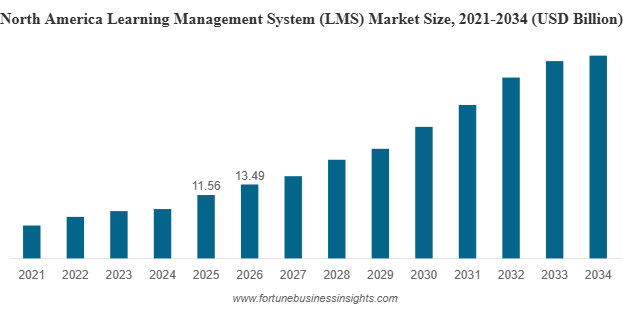
As more businesses are recognizing the advantages of LMS, demand is growing tremendously. Fortune Business Insights predicts that the global LMS market is likely to reach $104.04 billion by 2034, underscoring that investing in this is indeed a strategic move for businesses. In this guide, we will explore the complete process to build this solution.
What is Custom LMS Software Development?
Custom LMS software development is the process of building a learning management system tailored to an organization’s workflows, needs, users, and other requirements. It’s completely different from a generic LMS and includes only those features and functionalities that are useful for business.
This makes learning more convenient and easier to manage. The organization develops tailored LMS solutions for a range of purposes that are as follows:
- This solution is designed mainly to align with specific business objectives, operational processes, and learning strategies.
- It integrates with your existing enterprise system.
- It automates administrative tasks.
- It supports role-based access.
- It scales with the growth of the organization.
How Does the Custom LMS Software Development Process Work?
Creating a custom LMS involves multiple steps that turn your training objectives into a full-fledged learning platform. Let’s have a look at each step in detail:
Discovery and Requirement Analysis
A custom LMS software development process begins with identifying your core objectives. The development team works closely with important stakeholders to understand their learning goals, compliance, target users, existing systems, and more.
LMS Planning and System Architecture
After gathering your project requirements, the team actively plans the technical foundation of your LMS. They carefully select databases, the best tech stack, and system architecture. These decisions ensure the LMS can scale and integrate with many other tools.
UI/UX Design
The success of your LMS relies on how learners use it actively. which propels its adoption. For this, designers craft a mobile-friendly and intuitive interface with highly accessible features and easy navigation. To improve the user experience, they also include your brand’s logo, colors, typography, and other elements.
LMS Development and Module Implementation
Developers create features, including reporting dashboards, certifications, assessments, user management, gamification, third-party integrations, and social learning. They use an agile approach to develop the LMS in phases, which helps them gather regular feedback and make necessary improvements.
Testing and Quality Assurance
Before launching your software, QA professionals perform tests like performance, functional, cross-device, and security testing. It helps them discover and resolve bugs quickly, providing a secure learning experience.
Deployment, Training, and Maintenance
After successful testing, the team launches the final product in a live environment. Proper training is essential for instructors, admins, and learners to use the app effectively. Regular maintenance is necessary to make the platform reliable, secure, and better aligned with emerging business requirements.
Essential Features of a Custom LMS Solution
A large number of features doesn’t make an LMS solution successful. But how effective features work together and support learning matters a lot. The following are some of the essential features that a custom LMS software must have:
User Management and Role-based Access
Role-based access control allows instructors, learners, managers, and admins to access the data and content based on their roles. It enables your organization to scale training efficiently when combined with user management features such as department grouping, bulk enrollments, and hierarchy-based reporting.
Course Creation and Content Management
With flexible content authoring tools, instructors can create engaging courses using PDFs, videos, quizzes, SCORM packages, and interactive modules without requiring technical skills. A powerful content management system makes it convenient to reuse, update, and manage content.
Learning Paths and Certification Management
It goes without saying that not every learner requires the same training. Custom learning paths can organize courses by skill level, department, role, and more. They create a complete learning journey. When combined with automated certification management, it simplifies the tracking, issuance, and renewal of certificates and supports compliance.
Assessments and Online Examinations
Learning even without assessment is nothing but content consumption. Make sure your LMS software includes exams, built-in quizzes, online proctoring, question banks, and more. These help learners progress with accuracy. Auto-grading minimizes the overall administrative work, whereas detailed reports unveil knowledge gaps for both teams and individuals.
Progress Tracking and Performance Analytics
An LMS solution should include real-time dashboards that track quiz scores, time spent, course completion, learner engagement, and more. It allows teams to make an important decision. They also help learners who require the necessary support. These details reflect how training improves compliance, productivity, and workforce skills.
Gamification and Learner Engagement
When it comes to traditional training, it often fails to bring higher engagement. Gamification features such as points, badges, progress tracking, and leaderboards make learning highly interactive and motivating. These are pivotal to improving knowledge retention and course completion.
Virtual Classroom and Video Conferencing
As far as live interaction is concerned, it has great importance for instructor-led training. Virtual classrooms with screen sharing, live video, interactive whiteboards, breakout rooms, and more make online learning highly engaging. They are indeed best for employee onboarding, interactive training sessions, and soft skills development.
Mobile Learning and Offline Access
Today, the majority of the workforce relies heavily on mobile devices to make training easily accessible from any location. A mobile-friendly LMS allows learners to complete courses on tablets, smartphones, and other devices while working or traveling remotely. When it comes to offline access, it is of great importance, allowing users to download content and continue learning without an internet connection.
AI-Powered Personalized Learning
AI-powered personalized learning uses intelligent algorithms to deliver relevant content based on individual learning needs and skill gaps. By analyzing learner behavior, performance, and progress, AI in education helps recommend suitable courses, identify areas for improvement, provide targeted support, and create more effective and personalized learning experiences.
Third-party Integrations
An LMS solution works perfectly only when integrated properly with other business systems. HRMS integration can sync both employee and training data, whereas CRM supports customer and partner training. On the other hand, ERP systems redefine workflows, and payment gateways enable secure transactions for paid courses.
Build an LMS Aligned with Your Business Goal
Build a custom LMS that fits your training goals, business processes, and future growth. Our experts create secure, scalable, and feature-rich learning platforms.
How Much Does Custom LMS Software Development Cost?
The cost to develop custom LMS software is not fixed – it depends on many factors, such as complexity, scale, and feature requirements. Let’s have a complete breakdown to help you understand and thus manage your budget accordingly:
Cost for Small Businesses
If you are a startup seeking to develop a simple LMS with minimal features, such as user roles, course management, assessment, etc, development costs range from $10,000 to $30,000. These platforms are available with limited interactions, necessary features, and an easy-to-use interface.
Cost for Mid-Sized Companies
If you need advanced LMS features like gamification, personalized learning paths, analytics, and integration with existing CRM systems, it costs more, ranging from $30,000 to $80,000. The cost also depends on many other factors like supported content types, user roles, reporting capabilities, and more.
Enterprise LMS Development Cost
Enterprise-grade LMS platforms are the best option for large companies with multiple departments and users, AI-powered learning, robust security, and integrations with ERP, HRMS, and CRM systems. The cost of this solution ranges from $60,000 to $100,000.
Factors That Influence LMS Development Cost
Many factors directly influence the final LMS development cost. Some of them are as follows:
- Feature complexity
- Numbers of integrations
- Platform type
- UI/UX customization
- Team’s expertise and location
- Post-launch support
LMS Development Timeline
Timeline directly influences the cost of building LMS software. Building a basic app for a small business takes 6 to 10 weeks. Building a mid-sized app takes 3 to 6 months for developers. On the other hand, enterprise-grade apps require 6 to 12 months, or even longer, to develop.
Long-term Return on Investment (ROI)
Though a custom LMS costs more than a general solution, it indeed delivers an improved long-term value. It also maximizes efficiency by minimizing manual tasks. It improves course completion and reduces compliance risks with an outstanding user experience. Within 3 to 5 years, most organizations recognize that a custom LMS is more cost-effective than paying ongoing subscription fees.
Benefits of Custom LMS Software Development
Since custom LMS software is built around an organization’s specific needs and goals, it offers greater scalability, engagement, and a measurable learning ecosystem. Let’s take a look at some other benefits as follows:
Personalized Learning Experience
A custom LMS can align with how learners work rather than requiring them to follow a fixed system. It offers a complete learning path, personalized content, and recommendations according to skills, users’ roles, learning pace, and more. This makes training more interesting and effective.
Improved Employee Training and Onboarding
With structured onboarding, new hires learn easily and quickly through consistent training across multiple departments and locations. A custom LMS offers the same quality of training to everyone, rather than relying on informal guidance or scattered documents.
Better Learner Engagement and Knowledge Retention
Whether it’s gamification, quizzes, progress tracking, or videos, interactive features play a vital role in keeping learners engaged rather than only moving through lessons. Higher engagement improves knowledge retention, helping learners apply what they learn at work rather than forgetting the training after only a couple of weeks.
Centralized Learning Management
Another advantage of using a custom LMS is that it replaces email threads, spreadsheets, and disconnected tools. Instead of these, it brings learner tracking, course delivery, and reporting into a single platform. This centralized system makes training management easy and minimizes administrative work.
Enhanced Compliance and Certification Tracking
Whether it’s automated certification tracking or renewal reminders, they help organizations stay compliant by preventing expired certifications in regulated industries. Apart from this, reporting features and built-in audit trails make it convenient to prepare for audits and inspections.
Scalability for Business Growth
As your organization grows, the number of employees increases. It also necessitates expanding the number of locations, departments, and training requirements, among other areas. A custom LMS doesn’t have any restricted features or user limits like a ready-made solution.
Actionable Learning Analytics
With detailed analytics, an organization can convert learning data into meaningful user insights. It helps them identify skill gaps, measure ROI, and analyze training effectiveness, etc. It helps them make an informed decision related to their future training investments.
Reduced Training Costs Over Time
The fact can’t be denied that a custom LMS requires a higher initial investment. It minimizes overall recurring licensing costs per user and reduces reliance on third-party training providers. Over time, it allows businesses to save money, especially as they grow, and user-based subscriptions become more expensive.
Custom LMS Solutions for Different Industries
A ready-made LMS solution cannot meet training requirements, which vary by industry. Below, we will examine how this solution can meet the unique learning and training requirements of multiple industries.
Healthcare LMS
A healthcare business needs training software that can handle tasks such as credential tracking, compliance requirements, and continuing education units for medical staff. A custom solution can automate certification renewal processes, track completion of mandatory training, and more.
Corporate Training LMS
Businesses across multiple industries leverage corporate LMS solutions for leadership development, onboarding, and skills training. On the other hand, custom solutions offer analytics, scalability, and easy integration with HR systems, connecting training directly to performance metrics and workforce development objectives.
Education and eLearning LMS
Custom LMS platforms are an ideal choice for eLearning businesses, universities, and other educational institutions that require flexible, scalable learning solutions. Through eLearning software development, organizations can build platforms with advanced course delivery, monetization capabilities, learner progress tracking, and virtual classroom features. These solutions enable seamless content management, support diverse learning formats, and provide a better experience for both educators and learners.
Manufacturing Training LMS
Manufacturing organizations often require training employees on machine operation, workspace safety, and compliance with industry regulations. Since workers often spend most of their time in production facilities, a custom LMS solution provides offline learning, mobile access, and easy-to-understand video or visual content for highly effective training.
Retail and Sales Training LMS
Be it sales or retail teams, they leverage LMS platforms to improve customer service skills, product knowledge, and employee engagement with gamification. Fast, easy mobile access is necessary for these industries, as they have higher staff turnover and their teams work across multiple locations.
Finance and Compliance LMS
Financial institutions require a fully secure training platform to match strict regulatory needs. A custom LMS offers secure online assessments, compliance training, detailed audit logs, and certification tracking. These features are of great importance in simplifying regulatory reporting and enhancing record management.
Empower Your Workforce with Tailored LMS
Get a world-class custom LMS solution to improve training and engagement. We create a scalable learning platform that emerges with your organization’s needs.
Why Choose a Custom LMS Over an Off-the-Shelf LMS?
Selecting a custom LMS over an off-the-shelf LMS is decisive, especially for businesses with unique requirements and a long-term growth plan. It offers them a better value. Let’s have a look at some other reasons as follows:
Complete Customization
A ready-made LMS requires you to adjust your overall training process to match its fixed features. A custom LMS solution is developed to align with your learning content, unique workflows, and business structure. It offers you a complete platform that matches your organization rather than forcing you to work within a ready-made system.
Greater Flexibility and Scalability
LMS solutions come with user limits, and fixed features can’t scale over time. On the other hand, a custom solution can scale with your business, allowing you to add new features, users, and functionality without limitations imposed by vendor plans.
Seamless Integration with Existing Systems
With custom LMS development, organizations can integrate their existing CRM, HRMS, payment systems, ERP systems, and more. It also enables you to connect your business tools, eliminate data silos, minimize manual tasks, and enhance efficiency across your organization’s day-to-day operations.
Enhanced Security and Compliance
With custom LMS platforms, businesses gain the flexibility to create security protocols and compliance measures tailored to their industry’s regulatory requirements. It prevents you from relying on generic security standards that may not meet your industry’s needs.
Better User Experience and Branding
A custom LMS highlights your brand logo, colors, style, design, and more by maintaining consistency. It delivers the finest learning experience. On the other hand, a generic LMS solution has a common appearance and feel shared by many businesses.
Lower Long-term Ownership Cost
Though custom learning management system development incurs high upfront costs, it eliminates recurring per-user licensing fees charged by general solutions. Over time, this makes a custom LMS quite affordable and provides long-term value for fast-growing businesses.
How to Choose the Right Custom LMS Development Company?
Selecting the right development partner for your LMS project is a major decision, as it directly impacts the success of your future product. It also requires you to consider several factors. Some of them are as follows:
Industry Experience
You should always search for a custom learning management system development company with a strong track record of building LMS platforms. Make sure the team already has an adequate understanding of the industry-specific experience, whether in education, healthcare, or even corporate training.
Technical Expertise
Don’t forget to check the proficiency of your development team. Make sure they have expertise in using relevant technologies, cloud infrastructure, scalable backend architectures, security protocols, and API development. A team with extensive technical expertise delivers scalable LMS platforms that scale with user load.
UI/UX Design Capabilities
You should go through the design portfolio of your potential development partner. It helps you analyze whether they focus completely on their intuitive navigation, thoughtful user experience, and accessibility. Make sure they possess an impressive track record in UI/UX design.
Integration Experience
The LMS development company you hire should also have sufficient experience integrating specific tools your organization already uses. This is a must-have skill, as most LMS platforms require integration with CRM, HRMS, payment systems, and ERP.
Post-launch Support and Maintenance
Apart from the development experience, you should explore the company’s experience and expertise in offering post-launch support and maintenance. You need to discuss in detail whether they offer bug fixing, feature enhancements, security updates, etc., after deployment.
Portfolio and Client Testimonials
The next thing you can do is thoroughly review their client feedback and past projects to understand the real results rather than just relying on their claims. A good service provider should have multiple use cases and client testimonials that provide reliable insights into how an organization manages projects from discovery through delivery.
Transparent Pricing and Project Management
Finalize a service provider that offers transparent, clear pricing. They should offer a completely structured project management process with defined milestones and regular updates.
Future Trends in Custom LMS Software Development
With the emergence of new technologies and evolving user behavior, LMS software development trends are continually evolving. The following are some of the top trends you can keep in mind:
AI-powered Learning Experiences
Artificial Intelligence is now much more than just automation – it enables adaptive learning paths, automated skill gap analysis, and smart content recommendations. AI-powered LMS platforms have the potential to predict learners’ exact needs, which is necessary for personalized training journeys.
Microlearning and Bite-sized Courses
Today, learning content is changing rapidly as attention spans are becoming shorter day by day. So, a short 5-10 minute session is considered the best replacement for a long training session. It enables learners to grasp information through easy-to-follow paths that are suited to busy schedules.
Mobile-first Learning Platforms
Mobile access has become a primary requirement, especially in today’s growing culture of remote and hybrid work. Modern LMS platforms, combined with a mobile-first approach, enable learners to access training conveniently on tablets and smartphones, regardless of location or time.
Gamification and Interactive Learning
Gamification and interactive learning play a vital role in making training more interesting and thus engaging. While implementing these features, you need to think beyond badges and points and incorporate simulations, narrative-driven scenarios, and various competitive elements.
AR/VR-Based Training
AR/VR technologies play a crucial role in creating highly interactive and immersive training experiences. An AR/VR learning platform enables organizations to build realistic virtual environments where learners can safely practice complex or high-risk tasks. By providing hands-on simulations and experiential learning opportunities, these platforms help improve learner confidence, enhance practical skills, and increase training effectiveness.
Learning Analytics and Predictive Insights
With predictive analytics, organizations can identify employees who may face learning difficulties or even lose interest. It enables the learning and development team to provide timely support, maximize course completion rates, and improve learner management.
Cloud-based LMS Solutions
When it comes to cloud-based infrastructure, it’s considered to be the finest choice for LMS development. The main reason is that it offers lower maintenance, improved scalability, and easy access from any location. It also simplifies integrations, updates, and system management.
Social and Collaborative Learning
Whether it’s peer feedback, discussion forums, or group projects, they make learning more interactive. So, make sure your LMS solutions include these elements. This approach also enables learners to collaborate, understand concepts, and share their knowledge.
Generative AI in LMS
Generative AI has revolutionized learning content creation, generating a variety of engaging content for learners. Whether you wish to create quizzes, analyze training materials, or craft personalized learning content, it allows you to do everything easily. Advances in technology allow businesses to create, manage, and update courses quickly, with less time, effort, and cost.
Why Partner with Moon Technolabs for Custom LMS Development?
As a proficient custom LMS development company, we possess the required technical expertise to build a custom LMS solution powered by a scalable architecture. Our developers understand your business processes, goals, learners’ needs, and more to build future-ready, secure, and feature-driven solutions. We are committed to providing you with end-to-end LMS solutions tailored to match your unique requirements, right from strategy formulation and UI/UX design to development.
Why Businesses Choose Us for LMS Development
- Build an LMS tailored to match your specific business goals and training workflows.
- Craft an intuitive UI/UX design to foster learner engagement.
- Integration of your LMS with HRMS, CRM, ERP, and other systems to redefine training operations.
- Work with an agile development approach to accelerate time to market.
- Build a future-ready solution that scales as your workflow and training needs change.
Final Thoughts
Custom LMS software development is no longer only for large organizations – it has become a great investment for businesses seeking to offer scalable, effective training. A custom LMS provides complete flexibility that is not possible for a ready-made solution. So, if you are looking to build a software solution to improve skill development, employee training, and business growth, partner with us. We match your expectations by creating world-class LMS solutions.
FAQs
01
What is the difference between a custom LMS and a SaaS LMS?
Well, a custom LMS is developed based on your company’s specific training needs and provides complete scalability. On the other hand, a SaaS LMS is a subscription-based, ready-to-use platform with limited customization.02
Can an LMS be customized after deployment?
Yes, it’s possible to customize the LMS even after the deployment. You can add new features, update branding, and integrate third-party tools.03
Can a custom LMS support certifications and assessments?
Yes, a custom LMS supports both certifications and assessments by offering exams, customizable quizzes, skill-based evaluations, automated grading, certificate generation, dand etailed performance reports,04
Can a custom LMS be built for startups and SMBs?
Yes, a custom LMS can be created for both startups and SMBs with flexible pricing, scalable features, and cloud-based deployment.




Jayanti Katariya is the CEO of Moon Technolabs, a fast-growing IT solutions provider, with 18+ years of experience in the industry. Passionate about developing creative apps from a young age, he pursued an engineering degree to further this interest. Under his leadership, Moon Technolabs has helped numerous brands establish their online presence and he has also launched an invoicing software that assists businesses to streamline their financial operations.
Submitting the form below will ensure a prompt response from us.
We refine our expertise to deliver innovative business solutions.





205 N Michigan Avenue, #810, Chicago, 60601, Illinois, United States
13500 Long Is Dr, Pflugerville, TX 78660, USA

C/105 Ganesh Meridian, S.G. Highway, Ahmedabad, GJ 380060


Ayse D.
Co-Founder France
“ I highly recommend Moon Technolabs as the quality of service is wonderful. We have hired this company to develop the product based on some complex & technical issues. We get the best quality services as compared with others in the market. Huge Thanks to Moon Technolabs as the team is always ready to give the solution all time.”

Justin G.
Founder & CEO USA
USA“ Moon Technolabs is a pioneer in the WebRTC based project as they have fixed complicated segments of the module by fulfilling different product lines by providing 24X7 customer support. We really recommended Moon Technolabs as they are able to develop products as per the module deadline and project timeline.”

Flavio S.
Founder & Managing Director Germany
“I am happy to recommend Moon Technolabs for their app development services. They successfully developed apps for me, and I am highly satisfied with the overall outcomes. The development team has swiftly addressed the issues with responsive and effective communication to understand the requirement quickly and actively resolve the back-and-forth problems that arose...”

Jay M.
Founder & CEOUSA“Moon Technolabs is the best company that provides advanced apps and websites development services in the USA and Europe. I am a newbie to develop my app with an external team. I am really happy to work with them as I am not that much mobile apps user. Here, the team and specially the CEO of Moon Technolabs helps me to let me know about the benefits of my app to generate revenue....”


Our Offices
India
C/105 Ganesh Meridian,S.G. Highway, Ahmedabad, GJ 380060USA
205 N Michigan Avenue, #810, Chicago, 60601, Illinois, United StatesContact Information


