


How IoT in Retail Improves Customer Experience and Operations?

Jayanti Katariya
Last Updated: May 20, 2026 Total Views: 260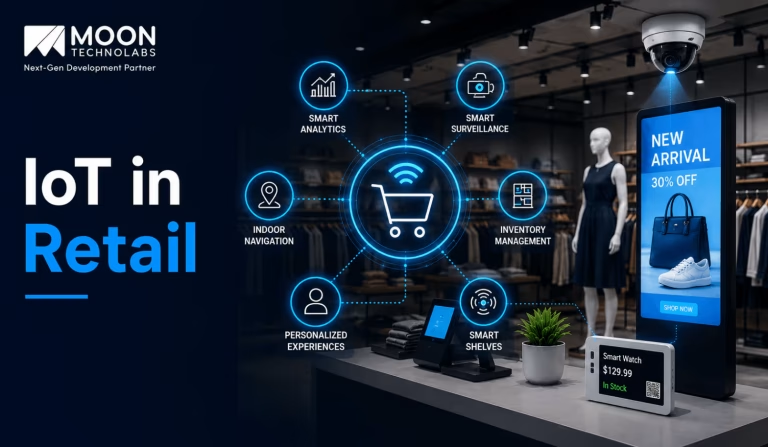
Table of Content


Blog Summary:
IoT has transformed retail operations in many ways, such as smart shelves, real-time inventory tracking, and personalized experiences. This blog covers everything about IoT in retail, including benefits, use cases, issues, challenges, implementation processes, and costs. Let’s explore now.
Table of Content
Retailers today are using IoT to deliver personalized offers through smartphones, automate inventory management with smart shelves, and streamline in-store operations. The growing adoption of IoT in retail is transforming how businesses interact with customers and manage their day-to-day processes.
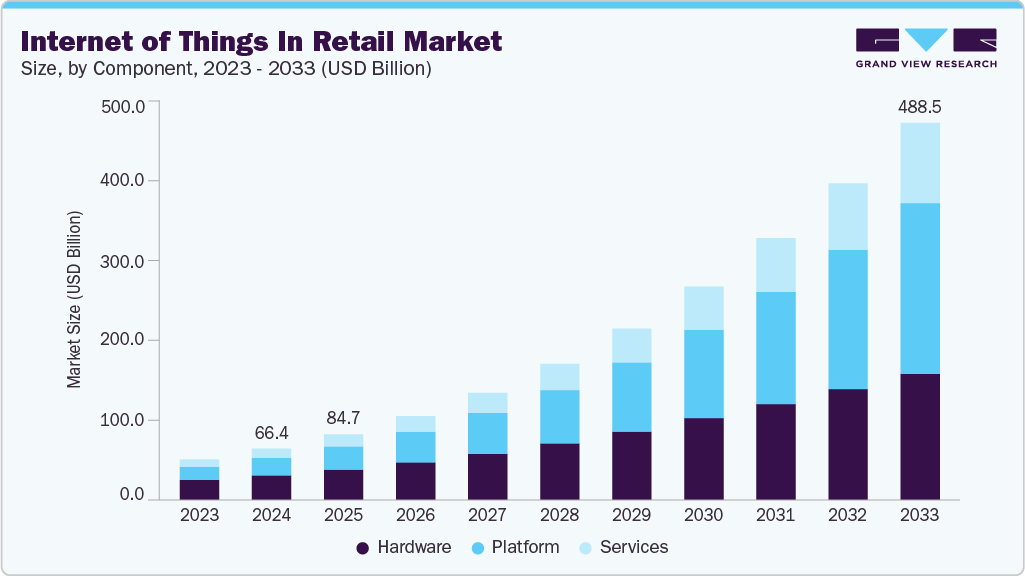
According to the latest stats by Grand View Research, the global IoT in retail market is expected to reach approximately $488.53 billion by 2033. The stats reflect widespread adoption of the Internet of Things in the retail industry.
IoT enables retailers to revolutionize their business operations in various ways, from inventory management to personalized marketing. It helps them make fast, data-driven decisions, ensuring their business’s success.
What is IoT in Retail?
IoT in retail is basically a network of different interconnected devices, systems, and sensors. These devices gather and exchange data to improve operations while redefining the customer shopping experience.
In fact, IoT minimizes the gap between digital and physical retail work, whether it’s smart shelves or connected payment terminals. This technology allows retailers to do the following important things:
- Check customer behavior
- Visualize foot traffic
- Analyze inventory levels
- Optimize energy consumption across different stores.
- Offer personalized promotions
- Provide a contactless and smooth checkout experience.
Benefits of IoT in Retail
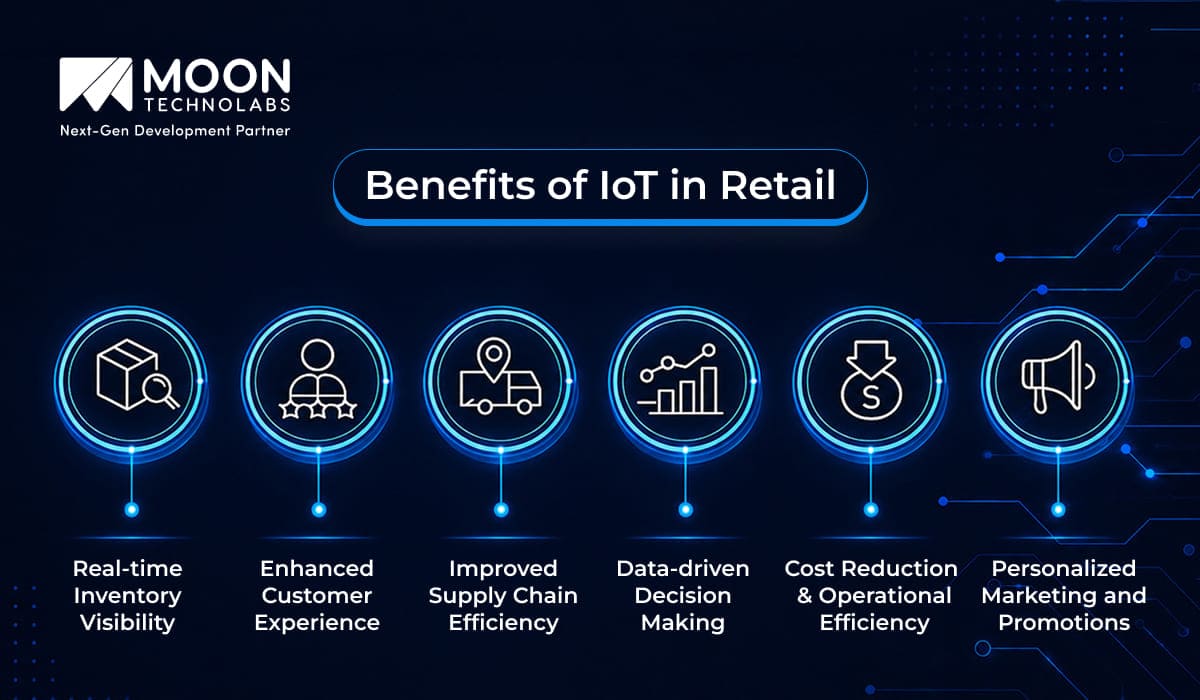
IoT brings a plethora of benefits to the retail sector, from personalized interactions to instant availability. We will describe each benefit in-depth below:
Real-time Inventory Visibility
With RFID tags and IoT-driven sensors, retailers gain an accurate, real-time view of their inventory across distribution centers, warehouses, store shelves, and more. It reflects a couple of out-of-stock situations, fast restocking decisions, and minimized overstock. Retailers seize opportunities to track product movement in real time, ensuring the right items are in the right place.
Enhanced Customer Experience
Shoppers nowadays seek a memorable experience rather than only quality products. IoT ensures interactive displays, smart fitting rooms, frictionless checkout systems, and more. Beacon technology guides customers through stores while connected devices minimize wait times at billing counters.
Improved Supply Chain Efficiency
IoT offers greater transparency to retail supply chains. Connected sensors monitor products in transit, whether tracking humidity, temperature, delivery timelines, or location.
Real-time visibility enables retailers to identify issues, prevent product spoilage, and ensure on-time delivery. A smart supply chain reflects stronger vendor relationships, fewer disruptions, satisfied customers, and more.
Data-driven Decision Making
In IoT, many devices are connected and generate valuable data. IoT platforms analyze and aggregate data to uncover patterns in peak shopping hours, customer behavior, product performance, and more.
It allows retail managers to make better decisions with real-time insights rather than relying on outdated reports. This is indeed a major shift towards data-based strategies, leading to improved staffing, smarter merchandising, and more effective operations.
Cost Reduction and Operational Efficiency
IoT has immense potential to minimize operational costs by automating routine tasks and optimizing resource usage. Smart energy management systems can adjust lighting and HVAC to minimize utility bills and optimize store occupancy.
Automated inventory tracking minimizes the necessity for labor-intensive stock audits. Predictive maintenance tools notify teams before equipment failure and also avoid expensive downtime.
Personalized Marketing and Promotions
IoT allows retailers to move beyond generic advertising and also offer personalized promotions. It helps them to analyze real-time data based on purchase history, customer preferences, and in-store movement. This standard of personalization not only boosts impulse purchases but also fosters lasting customer loyalty.
Use Cases of IoT in Retail
IoT is used in the retail sector for various purposes, transforming operations worldwide. Let’s explore some of the popular use cases of this technology in the retail sector:
Smart Shelves
Smart shelves boast weight sensors and RFID readers that enable automatic stock monitoring without human intervention. When any products go out of stock, the system sends low-inventory alerts directly to store managers. It ensures shelves are always filled with the required products.
Inventory Management
IoT-driven, RFID-based tracking gives retailers complete visibility into every product in their inventory, from arrival to sale. Besides, IoT optimizes warehouse operations by automating sorting, picking, and locating misplaced items, and streamlining processes. These minimize errors and save important time.
Customer Behavior Tracking
IoT sensors track how customers move inside the store, helping retailers identify which aisles get the most attention and which are often ignored. Apart from this, heatmaps and footfall tracking allow retailers to rearrange product placements, enhance store layouts, and allocate staff better, even during peak hours.
Personalized Shopping Experience
In IoT, connected systems offer highly relevant smart recommendations based on the customer’s purchasing and browsing history. Apart from this, location-based offers leverage beacon technology to send targeted promotions or discounts to a shopper’s smartphone the moment they reach a specific section or product nearby.
Connected Checkout Systems
Retailers often get frustrated with long checkout queues- IoT emerges as the right solution. IoT enables cashierless stores, such as Amazon Go, where cameras and sensors detect items customers select and charge them accordingly.
For traditional formats, IoT enables faster billing through contactless payments and smart POS systems, minimizing wait times.
Supply Chain Optimization
IoT has transformed supply chains into responsive, smart networks. With real-time shipment tracking, retailers gain complete visibility of products in transit, which minimizes both delays and losses.
Integrated forecasting allows retailers to predict any stock requirements before they occur. It minimizes overall waste and keeps shelves stocked perfectly.
We create robust retail IoT solutions to redefine your retail business. Let’s transform your business with automation, real-time insights, and personalized experiences.
Issues and Challenges of IoT Adoption in Retail
Though IoT offers many benefits to the retail sector, its adoption also involves many challenges. We will go through each of these challenges one by one to understand them better:
Data Security and Privacy Concerns
In an IoT system, a large number of devices are connected- every device is vulnerable to a cyberattack. Apart from security, privacy regulations such as GDPR and CCPA add a significant layer of complexity. Retailers need to ensure customer data is gathered, stored, and used in full compliance with emerging legal frameworks.
High Initial Implementation Cost
Deploying an IoT ecosystem requires an expensive upfront investment. It includes various costs, such as purchasing RFID systems, sensors, smart devices, and supporting software infrastructure.
These can be stringent, especially for small retailers with limited budgets. Apart from this, you also need to consider other costs, such as system installation, ongoing platform licensing fees, and staff training.
Integration with Existing Systems
Most retailers still operate on their old or legacy system, whether it’s ERP software, POS platforms, or inventory management tools. These are, of course, not compatible with IoT.
So, integrating these systems with IoT solutions is a complex, time-consuming process that entails high costs. Compatibility issues cause workflow disruptions, data silos, and failed implementations.
Data Management Complexity
IoT devices generate a large volume of data. So, it’s indeed quite challenging to store, manage, process, and improve meaningful insights from this data.
Without perfect analytic tools, architecture, and skilled personnel in place, retailers find it complex to manage the raw data. When you turn this data flood into actionable intelligence, it needs a perfect strategy and investment in modern analytics capabilities.
Maintenance and Scalability Challenges
Running the IoT ecosystem properly is an ongoing process. Devices need troubleshooting, regular firmware updates, and occasional hardware updates.
As retail businesses grow, you need to add new product lines, locations, and channels. It’s crucial to have a proactive maintenance strategy to keep your system running smoothly.
How to Implement IoT in Retail?
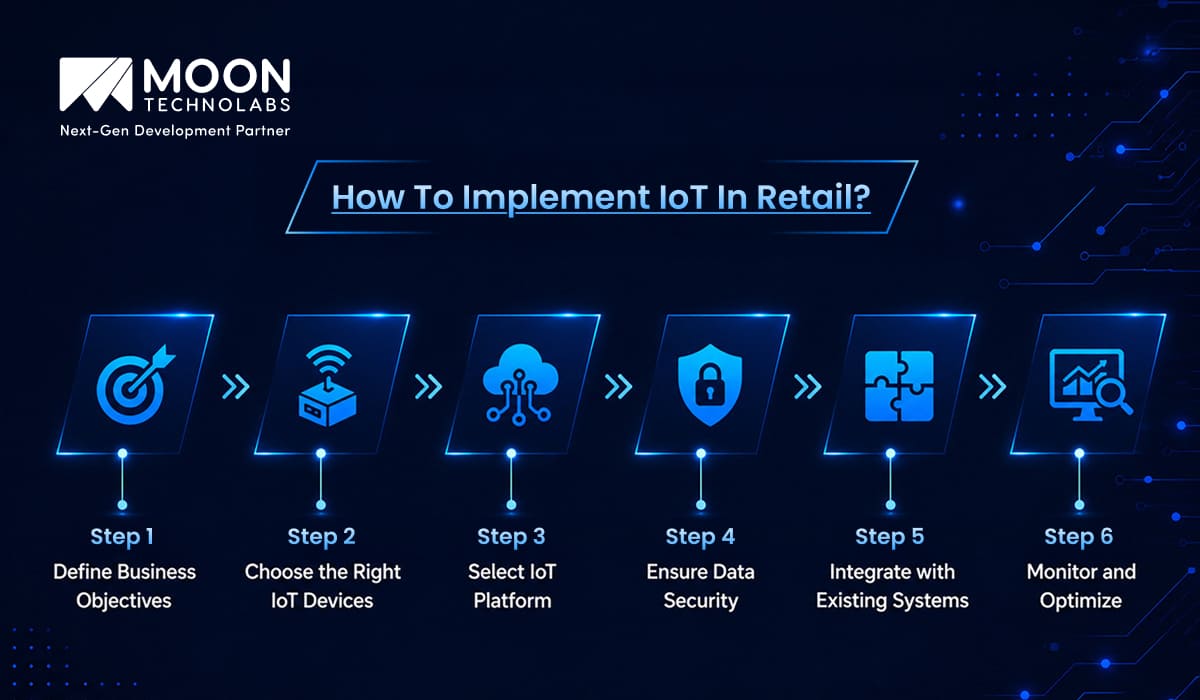
Implementing IoT in retail involves installing devices with a strategy that aligns with your core business objectives and smart retail technology. The entire process is carried out in several steps that are as follows:
Step 1: Define Business Objectives
You need to be clear about your actual purpose to implement the Internet of Things in retail. First, you need to identify the key use cases relevant to your business, whether to improve customer experience, minimize inventory shrinkage, or optimize energy usage.
Once you define clear use cases, you need to set measurable goals. A perfect objective keeps implementation highly focused and offers a complete benchmark for determining success.
Step 2: Choose the Right IoT Devices
It’s a fact that not every IoT device is created equally. So, you need to carefully determine which RFID sensors, beacons, and tags are required based on your specific operational requirements.
On the other hand, hardware compatibility matters a lot. Make sure your selected devices communicate smoothly with each other and also with your existing store infrastructure.
Step 3: Select IoT Platform
Since the IoT platform serves as the backbone of the IoT system, you need to select it carefully. You need to conduct a detailed comparison of cloud vs. on-premises solutions, focusing on both pros and cons.
Cloud platforms offer greater flexibility and scalability, whereas on-premises solutions offer greater control over sensitive data. Strong data-processing capabilities are essential, as the platform should efficiently handle large volumes of real-time data and deliver actionable insights.
Step 4: Ensure Data Security
Security is never meant to be compromised- it should be an integral part of your IoT system. Implementing powerful encryption and compliance measures effectively protects operational and customer data from theft.
It’s advisable to implement robust access control policies to ensure that only authorized personnel can access important data and systems. It minimizes the overall risk of internal and external threats.
Step 5: Integrate with Existing Systems
IoT delivers maximum benefits when it integrates seamlessly with your existing business tools. A smooth integration of ERP, CRM, and POS enables seamless data flow across departments.
It ensures a unique view of customers, operations, and inventory. You can make the entire integration process smoother while working with experienced integration specialists.
Step 6: Monitor and Optimize
The fact can’t be denied that implementing the internet of things in the retail industry is not a one-time project – it’s basically an ongoing process. As far as regular performance tracking is concerned, it effectively identifies data gaps, underperforming devices, inefficiencies, and other issues in the system.
Continuous improvement updates firmware, refines algorithms, expands capabilities, and more. These ensure that the IoT ecosystem aligns with the business and also delivers measurable value.
We help you upgrade your existing retail store with customized IoT solutions. We improve customer experiences, efficiency, and unlock real-time insights.
How Much Does it Cost to Implement IoT in Retail?
As for the cost of implementing IoT in retail stores, it depends on various factors. These include the complexity of the solution, scale of deployment, and technology stack selection. Let’s have a complete breakdown of the various cost components that retailers should budget for:
- IoT software licensing: Costs range from $2,000 to $40,000 annually, depending on data volume and features.
- IoT Hardware: Costs range from $1,000 to $20,000. It relies on device count and store size.
- System Integration: Its cost ranges from $3,000 to $60,000+. Besides, it depends on the complexity of your existing infrastructure.
- Staff Training and Change Management: Its cost ranges from $2,000 to $15,000+
- Data Security and Compliance Tools: Their cost ranges from $3,000 to $20,000 per year.
- Ongoing Maintenance and Support: It requires 15 to 20% of the overall implementation cost annually.
Conclusion
IoT is now a must-have in the retail sector for many reasons, not a choice, including smart inventory management, personalized customer experiences, and more. To harness the full potential of this technology for your business, you need to integrate it seamlessly with your existing system.
For this, you need to develop a solid strategy and connect with the right technology partner, like us. With adequate experience in IoT development, we perform the integration task using a holistic approach and a proven strategy to ensure it is carried out smoothly and successfully.
FAQs
01
What is IoT in retail?
IoT in retail involves the use of various connected devices, such as RFID tags, sensors, and smart shelves. They collect real-time data, improve customer experiences, automate operations, and optimize inventory management across digital and physical retail environments.02
What are examples of IoT in retail stores?
Well, the top examples of IoT in retail stores include RFID tags, smart shelves tracking inventory, beacons, automated checkout systems, connected cameras, and more.03
Is IoT expensive for small retail businesses?
Yes, IoT is expensive for small retail businesses. Its costs vary by platform, device, and scale. Meanwhile, you can manage costs through affordable sensors, a phased implementation, and cloud solutions. These make IoT accessible while offering long-term savings and higher efficiency gains.04
How does IoT improve retail operations?
IoT transforms retail operations in various ways, including automated stock replenishment, real-time inventory tracking, smarter store layouts, and personalized customer experiences. It improves supply chain visibility, minimizes operational costs, and enables retailers to make fast, data-driven decisions.




Jayanti Katariya is the CEO of Moon Technolabs, a fast-growing IT solutions provider, with 18+ years of experience in the industry. Passionate about developing creative apps from a young age, he pursued an engineering degree to further this interest. Under his leadership, Moon Technolabs has helped numerous brands establish their online presence and he has also launched an invoicing software that assists businesses to streamline their financial operations.
Submitting the form below will ensure a prompt response from us.
We refine our expertise to deliver innovative business solutions.




205 N Michigan Avenue, #810, Chicago, 60601, Illinois, United States
13500 Long Is Dr, Pflugerville, TX 78660, USA

C/105 Ganesh Meridian, S.G. Highway, Ahmedabad, GJ 380060




Ayse D.
Co-Founder France
“ I highly recommend Moon Technolabs as the quality of service is wonderful. We have hired this company to develop the product based on some complex & technical issues. We get the best quality services as compared with others in the market. Huge Thanks to Moon Technolabs as the team is always ready to give the solution all time.”

Justin G.
Founder & CEO USA
USA“ Moon Technolabs is a pioneer in the WebRTC based project as they have fixed complicated segments of the module by fulfilling different product lines by providing 24X7 customer support. We really recommended Moon Technolabs as they are able to develop products as per the module deadline and project timeline.”

Flavio S.
Founder & Managing Director Germany
“I am happy to recommend Moon Technolabs for their app development services. They successfully developed apps for me, and I am highly satisfied with the overall outcomes. The development team has swiftly addressed the issues with responsive and effective communication to understand the requirement quickly and actively resolve the back-and-forth problems that arose...”

Jay M.
Founder & CEOUSA“Moon Technolabs is the best company that provides advanced apps and websites development services in the USA and Europe. I am a newbie to develop my app with an external team. I am really happy to work with them as I am not that much mobile apps user. Here, the team and specially the CEO of Moon Technolabs helps me to let me know about the benefits of my app to generate revenue....”


Our Offices
India
C/105 Ganesh Meridian,S.G. Highway, Ahmedabad, GJ 380060USA
205 N Michigan Avenue, #810, Chicago, 60601, Illinois, United StatesContact Information


