


IoT Development Cost: Complete Breakdown, Factors, and Cost-Saving Strategies

Jayanti Katariya
Last Updated: Jul 02, 2026 Total Views: 246
Table of Content


Blog Summary:
IoT development costs depend on a combination of technical and operational factors, including device complexity, software architecture, cloud setup, security implementation, system integrations, and ongoing support. A clear understanding of these elements enables more accurate budgeting and better project planning. With the right approach and technology choices, businesses can optimize spending while delivering reliable, scalable, and secure IoT solutions.
Table of Content
The Internet of Things (IoT) is transforming business operations by connecting devices, enabling real-time visibility into data, and automating critical workflows across industries. However, building an IoT solution requires careful financial planning, and one of the first considerations is understanding the overall development cost.
IoT development costs are not fixed and depend on multiple factors, including hardware selection, software complexity, cloud infrastructure, security requirements, and third-party integrations. In this guide, we break down these key cost components and outline practical strategies to help you plan effectively, control expenses, and maximize return on investment.
IoT Market Size and Industry Trends
The IoT market continues to grow as organizations adopt connected technologies to improve efficiency, automate processes, and gain real-time insights. Advancements in AI, cloud computing, edge computing, and 5G connectivity are accelerating IoT adoption across industries.
Growth of the Global IoT Market
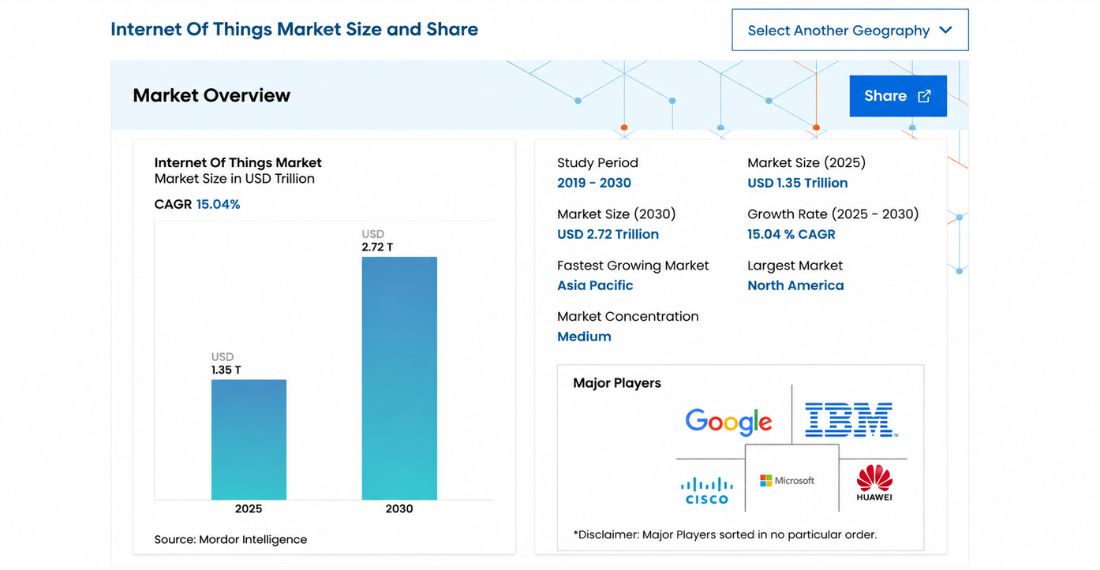
According to Mordor Intelligence, the global IoT market is valued at approximately $1.35 trillion and is expected to grow significantly, reaching an estimated $2.7–$3.3 trillion by the early 2030s.
Increasing Adoption of Smart Devices
Smart homes, wearables, and connected consumer devices are becoming increasingly common. The global IoT devices market is projected to reach $181.17 billion by 2030, fueled by affordable sensors and expanding internet connectivity.
Rise of Industrial IoT (IIoT) Solutions
IoT-enabled manufacturing and operations are being transformed by predictive maintenance, asset monitoring, and process optimization. The IIoT market is expected to grow from $483.16 billion in 2024 to $1.69 trillion by 2030.
Expansion of AI and Edge Computing in IoT
AI and edge computing are transforming IoT by enabling faster data processing and smarter decision-making. While AI helps analyze large volumes of data and automate actions, edge computing processes information closer to the source, reducing latency and improving system performance. Together, these technologies enhance the efficiency, scalability, and responsiveness of modern IoT solutions.
Demand for Connected Ecosystems Across Industries
Industries such as healthcare, retail, logistics, and manufacturing are investing in connected ecosystems that integrate devices, platforms, and data. According to McKinsey, IoT could generate up to $12.6 trillion in economic value annually by 2030.
Factors Influencing the Cost of IoT Development
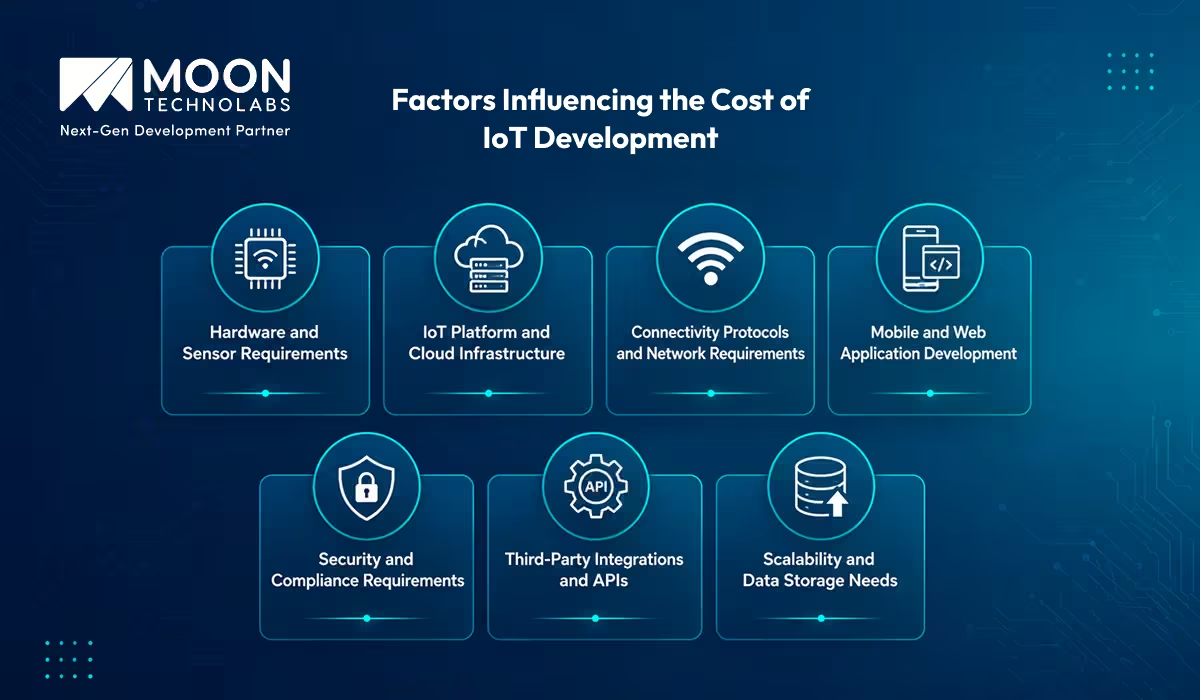
The total IoT development cost can vary significantly depending on technical complexity, infrastructure choices, and business requirements. Below are the key factors that influence overall software development costs:
Hardware and Sensor Requirements
Hardware is one of the most fundamental cost drivers in IoT projects. The type, quality, and number of sensors, microcontrollers, and devices directly impact the budget. Advanced sensors (e.g., for industrial monitoring, healthcare, or automotive use) are more expensive than basic components. Additionally, prototyping, testing, and hardware customization can further increase costs.
IoT Platform and Cloud Infrastructure
IoT solutions rely heavily on cloud platforms for data processing, device management, and analytics. Choosing platforms such as AWS IoT, Microsoft Azure IoT, or Google Cloud IoT affects pricing based on usage, storage, and computing power. Custom-built platforms typically require a higher initial investment but may reduce ongoing operational costs.
Connectivity Protocols and Network Requirements
Connectivity is essential for enabling communication between devices and systems. Protocols such as Wi-Fi, Bluetooth, Zigbee, LoRaWAN, and cellular (4G/5G) have different infrastructure and operational costs. Large-scale deployments requiring long-range or low-power networks often involve higher setup and maintenance expenses.
Mobile and Web Application Development
Most IoT systems require user-facing applications for monitoring and control. The complexity of mobile apps, web dashboards, and real-time analytics interfaces significantly influences development cost. Features like real-time alerts, data visualization, and remote device control add to the effort and expense.
Security and Compliance Requirements
Security is a critical concern in IoT systems due to the risk of data breaches and device vulnerabilities. Implementing encryption, secure authentication, and regular security updates increases development effort. Additionally, compliance with regulations such as GDPR or industry-specific standards can further raise costs.
You Might Also Like
Third-party Integrations and APIs
IoT solutions often integrate with external services such as payment gateways, ERP systems, AI/ML tools, or analytics platforms. Each device integration requires development, testing, and maintenance, contributing to the overall IoT project cost. The more complex the ecosystem, the higher the integration expense.
Scalability and Data Storage Needs
As the number of connected devices expands, so does the volume of data generated. Designing a scalable architecture that can handle large-scale data ingestion, processing, and storage is crucial. Cloud storage, big data processing frameworks, and load balancing solutions all add to long-term costs.
IoT Development Cost Breakdown
The below mentioned points outlines the key factors that influence IoT development costs, helping businesses estimate budgets and plan investments effectively, have a look:
Cost of IoT Hardware Development
Hardware development costs include PCB design, sensors, connectivity modules, prototyping, testing, and manufacturing. The complexity of the device and certification requirements significantly impact the overall expense.
Estimated Cost: $5,000–$50,000+
Cost of Embedded and Firmware Development
Firmware development covers programming microcontrollers, sensor integration, communication protocols, and device optimization. Costs increase with advanced features such as OTA updates and low-power functionality.
Estimated Cost: $10,000–$60,000+
Cost of Mobile and Web App Development
IoT-based apps enable users to monitor and control connected devices. IoT application development costs depend on platform support, UI/UX design, real-time monitoring features, and third-party integrations.
Estimated Cost: $15,000–$100,000+
Cost of Cloud Infrastructure and APIs
Cloud services handle device connectivity, data storage, analytics, and API management. Costs vary based on data volume, device count, and scalability requirements.
Estimated Cost: $5,000–$30,000+ (development) + ongoing hosting fees
Cost of Security Implementation
Security expenses include encryption, authentication, secure data transmission, access controls, and compliance measures to protect devices and user data.
Estimated Cost: $5,000–$25,000+
Cost of Testing and Quality Assurance
Testing ensures the reliability, performance, and security of IoT systems. This includes hardware, firmware, application, and connectivity testing before deployment.
Estimated Cost: $5,000–$20,000+
Cost of Maintenance and Support
Ongoing costs cover software updates, bug fixes, security patches, cloud management, and technical support to keep the IoT solution running efficiently.
Estimated Cost: 15–25% of the total development cost annually
We design secure, scalable IoT solutions with end-to-end support from experienced development professionals.
Custom-built IoT Solutions vs Ready-made Platforms – Cost Comparison
| Parameter | Custom-built IoT Solution | Ready-made IoT Platform |
|---|---|---|
| Initial Development Cost | High upfront investment due to custom hardware, software, and infrastructure development. | Lower initial cost with pre-built features and existing infrastructure. |
| Implementation Time | Longer development cycle, often several months, depending on complexity. | Faster deployment, often within weeks, due to ready-to-use components. |
| Customization | Fully tailored to specific business requirements and workflows. | Limited customization based on platform capabilities and vendor restrictions. |
| Scalability Cost | More cost-effective at scale, with infrastructure optimized for business needs. | Costs may increase significantly as device count, data volume, and users grow. |
| Maintenance & Updates | Requires dedicated resources for ongoing maintenance, updates, and security patches. | The vendor typically handles updates, maintenance, and platform improvements. |
| Integration Flexibility | Easily integrates with proprietary systems, legacy software, and unique workflows. | Integration options depend on available APIs and platform compatibility. |
| Long-Term Cost | Higher upfront cost but potentially lower total cost of ownership for large-scale deployments. | Lower initial investment, but recurring subscription and scaling fees can increase long-term expenses. |
Cost-saving Strategies for IoT Development
The following cost-saving strategies help businesses reduce IoT development expenses, improve efficiency, accelerate deployment, and maximize long-term value:
Build an MVP Before Full-scale Development
Start with an MVP that includes only the essential features needed to test your concept. This allows businesses to validate their idea, gather user feedback, and identify improvements before committing to a larger investment, reducing both risk and development costs.
Use Cross-platform Development Approaches
Cross-platform development enables a single codebase to run across multiple operating systems and devices. This reduces development time, simplifies maintenance, and lowers overall costs while ensuring a consistent user experience.
Leverage Cloud-based IoT Services
Cloud-based IoT platforms offer scalable infrastructure, data storage, analytics, and device management without the need for significant upfront hardware investments. Businesses can scale resources as needed and pay only for what they use, making it a cost-efficient solution.
Prioritize Core Features Initially
Rather than building every feature at once, focus on the functionalities that deliver the most value to users. A phased development approach helps control costs, accelerates IoT deployment, and enables future enhancements based on real user needs and market feedback.
Outsource Development to Experienced IoT Teams
Working with experienced IoT development teams can significantly reduce training, hiring, and operational expenses. Their specialized expertise helps streamline development, avoid costly errors, and accelerate time-to-market while maintaining high-quality standards.
Roadmap to Developing an IoT Solution Step by Step
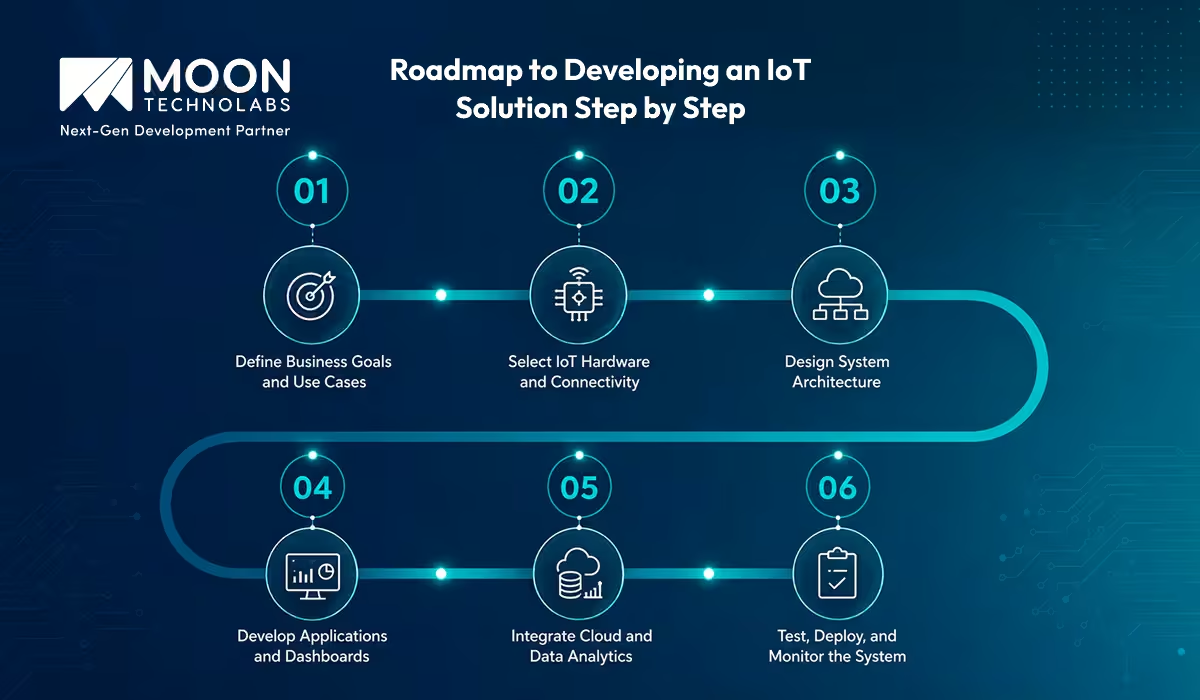
The Internet of Things (IoT) is transforming industries by connecting devices, collecting real-time data, and enabling intelligent decision-making. Developing a successful IoT solution requires careful planning, the right technology choices, and a structured implementation approach.
Below is a step-by-step roadmap to guide organizations through the IoT development process:
Define Business Goals and Use Cases
Every IoT project should begin with a clear understanding of the business challenge it aims to address. Whether the objective is to improve efficiency, reduce costs, enhance customer experiences, or enable predictive maintenance, defining specific use cases helps establish project requirements and expected outcomes.
Select IoT Hardware and Connectivity
Choose the appropriate sensors, devices, gateways, and communication technologies based on your use case. Connectivity options such as Wi-Fi, Bluetooth, LoRaWAN, NB-IoT, and 5G should be selected based on factors such as coverage, bandwidth, power consumption, and scalability.
Design System Architecture
Develop a robust architecture that outlines how devices, networks, cloud platforms, and applications interact. A well-designed architecture ensures seamless data flow, scalability, and system reliability. Security measures such as encryption, authentication, and access controls should be incorporated from the outset.
Develop Applications and Dashboards
Create user-friendly web or mobile applications that allow users to monitor devices, view real-time data, and manage operations. Interactive dashboards, alerts, and automation features provide valuable insights and improve decision-making.
Integrate Cloud and Data Analytics
Cloud platforms enable secure storage, processing, and management of IoT data. Integrating analytics tools, AI, and machine learning capabilities helps organizations uncover trends, predict issues, and gain actionable insights from connected devices.
Test, Deploy, and Monitor the System
Before deployment, conduct thorough testing to verify performance, connectivity, security, and scalability. After launch, continuous monitoring and regular maintenance help ensure optimal system performance and long-term reliability.
Our IoT development experts can help you identify the right hardware, connectivity, cloud infrastructure, and security measures to build a cost-effective and scalable IoT solution.
Future Trends Impacting IoT Development Costs
As IoT technology evolves, several emerging trends are influencing both development expenses and long-term returns. Understanding these trends helps businesses plan smarter investments and build future-ready solutions:
AI-powered IoT Automation
AI integration into IoT systems is increasing nowadays to automate data analysis, decision-making, and operations. While AI implementation can raise initial development costs, it helps reduce long-term expenses through predictive maintenance, process automation, and improved efficiency.
Edge Computing Adoption
Edge computing enables data processing closer to IoT devices rather than relying solely on cloud servers. This reduces latency, improves real-time performance, and lowers bandwidth usage. Although additional infrastructure may be required, businesses can benefit from reduced cloud and data transfer costs.
5G-enabled IoT Ecosystems
The emergence of 5G networks is enabling faster, more reliable IoT connectivity. Businesses now need to invest in upgraded hardware and network capabilities, but 5G supports advanced applications such as industrial automation, smart cities, and connected vehicles.
Digital Twins and Predictive Analytics
Digital twins create virtual models of physical objects using real-time IoT data. When combined with predictive analytics, it helps optimize performance, reduce downtime, and improve decision-making. While IoT implementation can increase project costs, the long-term operational benefits are substantial.
Increased Focus on IoT Security
As cyber threats increase, security is becoming a larger part of IoT development budgets. Investments in encryption, device authentication, and threat monitoring are necessary to safeguard data, ensure compliance, and maintain system reliability.
Why Choose Moon Technolabs for IoT Development?
Moon Technolabs is a reliable technology partner for businesses seeking innovative IoT solutions. Our team offers end-to-end IoT software development services, covering device connectivity, firmware, cloud integration, and user-friendly applications. We focus on building scalable, secure, and high-performing IoT ecosystems tailored to your business goals.
With a strong emphasis on quality, transparency, and timely delivery, we help businesses bring IoT products to market efficiently. We also provide clear project planning and valuable insights into app development cost, helping you make informed decisions while maximizing your return on investment.
Conclusion
IoT development costs depend on several factors, including hardware, software, cloud infrastructure, security, integrations, and maintenance. By clearly defining project requirements and choosing the right development approach, businesses can control costs while building scalable and reliable solutions.
Partnering with experts can streamline development and reduce risks. When you hire IoT developers and leverage IoT app development services, you can build secure, future-ready IoT solutions that deliver lasting business value.
FAQs
01
How much does IoT development cost?
IoT platform development costs can range from about $20,000 for a basic solution to over $500,000 for a complex enterprise platform. Costs depend on factors such as the number of connected devices, hardware, software complexity, cloud infrastructure, security, and integrations. Custom hardware, advanced analytics, and large-scale deployments generally require higher investment.02
What factors affect IoT development cost the most?
The most significant factors affecting IoT app development costs include hardware design, firmware development, cloud architecture, application development, security requirements, and system integrations. Project scope, scalability expectations, and regulatory compliance can also have a major impact on the overall budget. The more sophisticated and customized the solution, the greater the development cost.03
How long does it take to build an IoT solution?
The development timeline for an IoT solution typically ranges from 2–3 months for a proof of concept, 4–6 months for an MVP, and 6–12+ months for enterprise-grade solutions with custom hardware, testing, certifications, and complex integrations.04
Which industries invest the most in IoT development?
Manufacturing, healthcare, transportation, logistics, retail, agriculture, and automotive industries are among the largest investors in IoT development. These sectors use IoT technologies to improve operational efficiency, monitor assets in real time, automate processes, enhance customer experiences, and gain valuable insights from connected devices and data.05
How can businesses reduce IoT development costs?
Businesses can reduce IoT development costs by starting with an MVP, using existing hardware and cloud platforms, and leveraging proven frameworks. Clear requirements, careful planning, and a scalable architecture help avoid costly changes, while experienced IoT developers can speed up development and reduce risks.




Jayanti Katariya is the CEO of Moon Technolabs, a fast-growing IT solutions provider, with 18+ years of experience in the industry. Passionate about developing creative apps from a young age, he pursued an engineering degree to further this interest. Under his leadership, Moon Technolabs has helped numerous brands establish their online presence and he has also launched an invoicing software that assists businesses to streamline their financial operations.
Submitting the form below will ensure a prompt response from us.
We refine our expertise to deliver innovative business solutions.





205 N Michigan Avenue, #810, Chicago, 60601, Illinois, United States
13500 Long Is Dr, Pflugerville, TX 78660, USA

C/105 Ganesh Meridian, S.G. Highway, Ahmedabad, GJ 380060


Ayse D.
Co-Founder France
“ I highly recommend Moon Technolabs as the quality of service is wonderful. We have hired this company to develop the product based on some complex & technical issues. We get the best quality services as compared with others in the market. Huge Thanks to Moon Technolabs as the team is always ready to give the solution all time.”

Justin G.
Founder & CEO USA
USA“ Moon Technolabs is a pioneer in the WebRTC based project as they have fixed complicated segments of the module by fulfilling different product lines by providing 24X7 customer support. We really recommended Moon Technolabs as they are able to develop products as per the module deadline and project timeline.”

Flavio S.
Founder & Managing Director Germany
“I am happy to recommend Moon Technolabs for their app development services. They successfully developed apps for me, and I am highly satisfied with the overall outcomes. The development team has swiftly addressed the issues with responsive and effective communication to understand the requirement quickly and actively resolve the back-and-forth problems that arose...”

Jay M.
Founder & CEOUSA“Moon Technolabs is the best company that provides advanced apps and websites development services in the USA and Europe. I am a newbie to develop my app with an external team. I am really happy to work with them as I am not that much mobile apps user. Here, the team and specially the CEO of Moon Technolabs helps me to let me know about the benefits of my app to generate revenue....”


Our Offices
India
C/105 Ganesh Meridian,S.G. Highway, Ahmedabad, GJ 380060USA
205 N Michigan Avenue, #810, Chicago, 60601, Illinois, United StatesContact Information


