


How to Build an MVP in 100 Hours: A Step-by-Step Guide

Software Development Team
Last Updated: Sep 18, 2026 Total Views: 88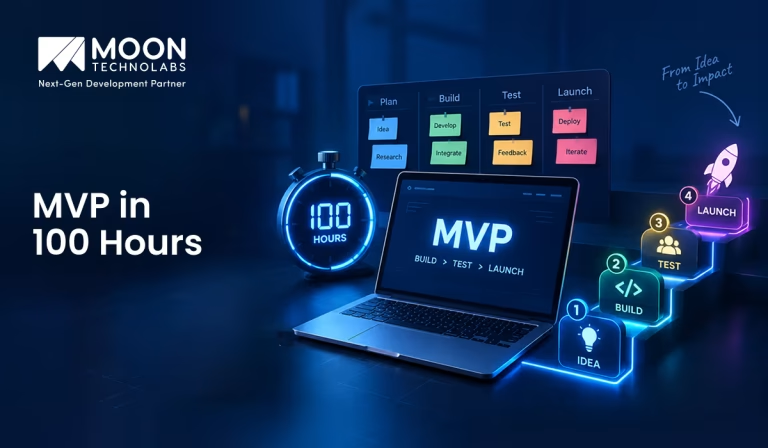
Table of Content


Blog Summary:
Building an MVP in 100 hours is possible with focused planning, rapid execution, and clear priorities. This guide explains how to validate your idea, define essential features, create a practical development plan, choose the right tools, build efficiently, test with users, and launch quickly. Learn how to avoid unnecessary complexity and turn your concept into a functional product.
Table of Content
Most MVPs don’t fail because teams can’t build them. They fail because teams spend too much time building the wrong things.
A 100-hour deadline changes the approach. You need to validate the problem, define the smallest meaningful user flow, make deliberate technology choices, and eliminate anything that doesn’t contribute to the first real-world test.
In this guide, we’ll show how to turn 100 hours into a structured build cycle, from idea and scope to development, deployment, and user feedback, without sacrificing the foundations that matter.
What Does it Take to Build an MVP in 100 Hours?
Building an MVP in 100 hours requires more than a compressed development schedule; it requires disciplined scope control. Focus on one core problem, one primary user journey, and the smallest feature set that delivers measurable value.
The development process typically involves rapid discovery, UX planning, architecture, implementation, testing, and deployment. Using proven frameworks, third-party APIs, managed infrastructure, and reusable components can significantly reduce development time without compromising the core experience.
The biggest constraint is not the 100-hour deadline, but deciding where those hours create the most product value. Every feature should support the MVP’s validation goal, while non-essential functionality, complex integrations, and premature optimization should be deferred until real user feedback justifies them.
The 100-hour MVP Framework at a Glance
Here’s a quick overview of the 100-hour MVP framework, breaking down each stage of the process and the time you can allocate to it. Refer to the table below for a clear, structured view of how to move from idea validation to building, testing, and launching your MVP:
| MVP Phase | Hours | Key Action |
|---|---|---|
| Validate Your Startup Idea | 10 hrs | Research the problem, target users, competitors, and validate demand. |
| Define Your MVP Scope | 10 hrs | Identify core features, prioritize requirements, and eliminate non-essential functionality. |
| Plan the Product | 10 hrs | Map user flows, create wireframes, define architecture, and finalize the tech stack. |
| Build the MVP | 45 hrs | Develop the core functionality and connect the critical end-to-end user journey. |
| Test and Refine | 10 hrs | Run functional and usability tests, fix critical issues, and refine the experience. |
| Prepare for Launch | 10 hrs | Set up production infrastructure, analytics, security, documentation, and launch assets. |
| Launch and Learn | 5 hrs | Release to initial users, monitor behavior, gather feedback, and capture learning. |
| Total | 100 hrs | From product hypothesis to a testable, production-ready MVP. |
Turn Your Product Vision Into A Working MVP
Collaborate with experienced developers to transform your product vision into a practical MVP designed for real-world testing and feedback.
How to Build an MVP in 100 Hours: 7 Key Phases
A 100-hour MVP works best when every phase has a defined outcome. The goal is to move from idea to a live, testable product while keeping scope, technical complexity, and rework under control.
Here are the key phases to build an MVP in 100 hours; have a look:
Phase 1 — Validate Your Startup Idea in 10 Hours
Start by defining the target user, problem, and expected outcome. Research competitors, existing alternatives, market gaps, and user pain points. Where possible, speak with potential users to determine whether the problem is frequent and significant enough to solve.
By the end of this phase, you should have a clear problem statement, target audience, competitive context, and product hypothesis.
Key output: A validated problem and a clear hypothesis to test.
Phase 2 — Define Your MVP Scope in 10 Hours
Identify the smallest feature set capable of delivering the product’s core value. Map the primary user journey and separate must-have functionality from features that can wait.
Use a simple rule: if removing a feature does not prevent users from experiencing the core value, move it to the backlog. This protects the remaining development hours from scope creep.
Key output: A prioritized feature list and defined core user journey.
Phase 3 — Plan the Product in 10 Hours
Turn the scope into a practical product and technical plan. Create key user flows, wireframes, and essential UI screens. At the same time, finalize the technology stack, architecture, database requirements, APIs, authentication, and deployment approach.
Identify technical risks early, particularly around third-party integrations and complex dependencies.
Key output: Approved designs, architecture, technology stack, and development plan.
Phase 4 — Build the MVP in 45 Hours
Use the largest portion of the timeline to build the core workflow. Get the primary user journey working end to end before investing time in secondary features.
Use proven frameworks, APIs, libraries, and managed services to reduce unnecessary development. Keep the architecture simple and maintainable, while covering essentials such as authentication, validation, error handling, and basic security.
Key output: A functional MVP that delivers the core user experience.
Phase 5 — Test and Refine in 10 Hours
Test the critical workflow from a real user’s perspective. Check functionality, usability, responsive behavior, integrations, authentication, data handling, and major performance issues.
Prioritize blockers and high-impact bugs over minor visual refinements. The goal is a stable product that users can actually use.
Key output: A tested release candidate with critical issues resolved.
Phase 6 — Prepare for Launch in 10 Hours
Move the MVP into production and verify the environment before launch. Configure hosting, domain, database, analytics, monitoring, authentication, backups, and essential security controls.
Run the complete user journey in production and, where possible, conduct a controlled soft launch before opening access more broadly.
Key output: A production-ready MVP with essential operational systems in place.
Phase 7 — Launch and Learn in 5 Hours
Get the MVP in front of a focused group of target users and start collecting evidence. Track metrics related to the original hypothesis, such as activation, conversion, engagement, or task completion.
Combine usage data with direct feedback to identify friction points and recurring needs. Use these findings, not assumptions, to determine what should be built next.
Key output: User feedback, product data, and a prioritized MVP roadmap for the next iteration.
How to Prevent Scope Creep During MVP Development?
Scope creep is one of the fastest ways to turn a 100-hour MVP into a much larger project. The solution is to establish clear boundaries before development starts and treat every new requirement as a trade-off against the existing scope.
See how to prevent scope creep during the MVP development process:
Set a Clear Feature Boundary
Define the core user journey and freeze features before development begins. Move any feature that doesn’t directly support the MVP’s primary validation goal to a post-launch backlog.
Use a Prioritization Framework
Classify requirements as Must Have, Should Have, Could Have, or Won’t Have. If a new feature becomes essential, replace a lower-priority feature instead of expanding the scope.
Track Hours, Not Just Features
Assign a fixed time budget to each development phase and review progress regularly. If a feature takes significantly longer than planned, reassess its complexity or defer it rather than letting it consume the remaining hours.
Maintain a “Not Now” List
Capture new ideas and feature requests in a separate backlog instead of adding them immediately. After launch, use user feedback and product data to determine which deferred features are worth building.
100-hour MVP Checklist
Here’s the 100-hour MVP checklist to help you plan each stage of development, prioritize essential tasks, and stay on track from idea validation to launch. Have a look and use it as a practical guide to make the most of your 100 hours:
Before Development
Start with a clearly defined problem, target audience, and measurable validation goal. Finalize the MVP’s core features, user flow, technology stack, and technical requirements before development starts. This prevents scope creep from consuming valuable build time.
During Development
Build the primary user journey first, then add only features that directly support the MVP’s objective. Use existing APIs, libraries, frameworks, and managed services where possible. Maintain clean version control, continuously test critical functionality, and track development against the 100-hour limit.
Before Launch
Run functional, usability, security, and performance checks across the core experience. Resolve critical bugs, configure production infrastructure, analytics, monitoring, authentication, and backups. Complete the entire user journey in the production environment before making the MVP available to users.
After Launch
Focus on learning rather than adding features immediately. Monitor product usage, conversion points, errors, and user drop-offs while collecting direct feedback from early adopters. Use these insights to validate assumptions, identify friction points, and prioritize the next development cycle.
Common Mistakes That Break the 100-hour Limit
The 100-hour constraint leaves little room for avoidable work. Several common mistakes can quickly push an MVP beyond its deadline:
- Overbuilding the MVP: Adding advanced features, multiple user roles, or complex workflows before validating the core product.
- Skipping validation: Spending most of the 100 hours coding without confirming that the problem is real and worth solving.
- Changing requirements mid-build: Frequent scope changes create rework and disrupt the development timeline.
- Overengineering the architecture: Designing for millions of users before having the first real users adds unnecessary complexity.
- Building everything from scratch: Custom integrations and infrastructure can consume hours that proven APIs, libraries, and managed services could save.
- Leaving testing until the end: Late-stage testing often exposes issues when there is no time left for proper fixes.
- Ignoring deployment until launch day: Production configuration, hosting, domains, analytics, and security can take longer than expected.
- Treating launch as the finish line: An MVP is built to generate evidence. Without user feedback and measurable data, the development effort produces little actionable learning.
Build, Validate, and Launch Your MVP With Confidence
Bring your product idea to life with expert developers who prioritize speed, scalability, user needs, and measurable results.
Why Choose Moon Technolabs for MVP Development?
Building an MVP within a 100-hour window requires tight coordination between product, design, and engineering. At Moon Technolabs, we translate your core product idea into a clear build plan, prioritizing the features that matter most for initial validation.
As a prominent custom software development company, we handle the complete development cycle, from UI/UX and technology selection to development, testing, deployment, and post-launch improvements. The approach emphasizes reusable technologies, practical architecture, and focused feature development to reduce unnecessary development time.
The objective is not simply to meet a deadline. It is to deliver a usable MVP that reaches real users, generates meaningful feedback, and provides a reliable foundation for deciding what to build next.
Conclusion
Building an MVP in 100 hours is achievable when every hour is tied to a clear product objective. The key is to validate the idea early, keep the scope focused, prioritize the core user journey, and avoid technical complexity that does not contribute to the first release.
A structured 100-hour approach helps turn an idea into a functional product while creating opportunities to test assumptions with real users. The insights gathered after launch can then guide feature priorities, technical improvements, and the next stage of development.
For businesses that need experienced technical support to move from concept to a market-ready product, MVP development services can provide the expertise, development resources, and execution framework needed to accelerate the process without losing focus on product validation.
FAQs
01
Can an MVP really be built in 100 hours?
Yes, as long as the product has a focused scope. A 100-hour MVP should target one core problem and a limited set of essential features rather than attempting to replicate a complete product.02
How much does it cost to build an MVP in 100 hours?
The cost depends on the development team's hourly rates, technology stack, product complexity, and location. The 100-hour estimate defines the development effort, while the final budget depends on the resources involved.03
How do you prioritize features for a time-limited MVP?
Prioritize features based on their impact on the core user experience and their ability to validate key assumptions. A simple Must Have, Should Have, Could Have, and Won’t Have framework can help keep scope in check.04
What should happen after a 100-hour MVP is launched?
Track user behavior, collect feedback, monitor technical issues, and compare results against the original validation goals. Use these insights to decide which features to improve, add, or remove.05
Can a complex SaaS product be built as an MVP in 100 hours?
A complete complex SaaS platform is unlikely to fit within 100 hours, but a focused version can. The MVP should demonstrate the primary workflow and validate the most important product assumptions before expanding functionality.06
How do you test an MVP before launching it?
Test the critical user journey for functionality, usability, performance, security, and compatibility. The goal is to identify launch-blocking issues while ensuring users can complete the MVP's primary task successfully.



The Software Development Team at Moon Technolabs includes experienced developers, solution architects, and technology consultants who contribute content on software engineering, application development, system architecture, and digital innovation. Their articles are based on real-world project experience and aim to help businesses make informed technology decisions.
Submitting the form below will ensure a prompt response from us.
We refine our expertise to deliver innovative business solutions.





205 N Michigan Avenue, #810, Chicago, 60601, Illinois, United States
13500 Long Is Dr, Pflugerville, TX 78660, USA

C/105 Ganesh Meridian, S.G. Highway, Ahmedabad, GJ 380060


Ayse D.
Co-Founder France
“ I highly recommend Moon Technolabs as the quality of service is wonderful. We have hired this company to develop the product based on some complex & technical issues. We get the best quality services as compared with others in the market. Huge Thanks to Moon Technolabs as the team is always ready to give the solution all time.”

Justin G.
Founder & CEO USA
USA“ Moon Technolabs is a pioneer in the WebRTC based project as they have fixed complicated segments of the module by fulfilling different product lines by providing 24X7 customer support. We really recommended Moon Technolabs as they are able to develop products as per the module deadline and project timeline.”

Flavio S.
Founder & Managing Director Germany
“I am happy to recommend Moon Technolabs for their app development services. They successfully developed apps for me, and I am highly satisfied with the overall outcomes. The development team has swiftly addressed the issues with responsive and effective communication to understand the requirement quickly and actively resolve the back-and-forth problems that arose...”

Jay M.
Founder & CEOUSA“Moon Technolabs is the best company that provides advanced apps and websites development services in the USA and Europe. I am a newbie to develop my app with an external team. I am really happy to work with them as I am not that much mobile apps user. Here, the team and specially the CEO of Moon Technolabs helps me to let me know about the benefits of my app to generate revenue....”


Our Offices
India
C/105 Ganesh Meridian,S.G. Highway, Ahmedabad, GJ 380060USA
205 N Michigan Avenue, #810, Chicago, 60601, Illinois, United StatesContact Information


