


Generative AI in Software Testing: Transforming QA and Test Automation

Jayanti Katariya
Last Updated: Apr 29, 2026 Total Views: 452
Table of Content


Blog Summary:
This blog explains the importance of generative AI in software testing and how it transforms QA with smart test creation, automation, and fast releases. It also explains top generative AI tools, benefits, support for different testing methods, integration process, challenges, etc.
Table of Content
Software nowadays has become more complex due to various reasons, such as frequent UI updates, complex architecture, fast release cycles, etc. All these make it difficult for QA teams to maintain large test suites under tight deadlines. These cause several repercussions, such as missed bugs, delayed releases, inconsistent software quality, higher costs, and more.
Generative AI in software testing emerged as a smart solution to overcome these challenges. With the use of this technology, the QA team automates test creation with improved accuracy and drives the QA processes. This has fostered the usage of generative AI tools in software testing to carry out the entire process smoothly.
Due to the rising adoption of generative AI products in the software testing process, its global market size is projected to expand at a CAGR of 22.05% (Precedence Research) between 2026 and 2035. The stats clearly reflect the importance of AI-powered software testing even in the future as well.
In this blog, we will explore detailed information regarding the usage of different generative AI tools, their uses, etc. Let’s explore now.
What is Generative AI in Software Testing?
Generative AI in software testing means leveraging AI models for various tasks, such as creating, optimizing, and implementing test cases. These activities require less human intervention.
Instead of following pre-defined scripts, it learns from data, understands app behavior, and adapts to different test scenarios. This makes testing smart, fast, and aligned properly with real user interactions.
Difference Between Rule-based Automation and Generative AI Testing
Rule-based automation is something that works mainly on predefined conditions and fixed scripts. It requires fast updates whenever the app changes. Generative AI testing tends to be adaptive and has the capability of creating new test cases and updating the existing ones. Besides, it also predicts any potential failures without any manual effort.
Key Components of Generative AI-powered Testing
Generative AI-driven testing includes various important components that allow QA teams to move directly from reactive testing to proactive quality assurance. Let’s explore some of these components as follows:
- Natural Language Processing (NLP): It converts requirements into test cases.
- Machine Learning (ML) Models: They are useful in identifying both anomalies and patterns.
- Data-driven Engines: They are perfect for continuous test optimization and coverage improvement.
Why Do You Need Gen AI in Software Testing?
Generative AI helps QA professionals overcome the level of complexity of traditional software, which leads to gaps in quality and unnecessary delays in its release schedule. Let’s understand why generative AI is necessary for software testing:
Increasing Complexity of Modern Applications
Testing has become more complex with the use of cloud-native architectures, microservices, API-based development, and more. Generative AI lets QA teams manage complexity better by discovering hidden risks, generative test scenarios, etc. These cover even the majority of layered app structures.
Frequent Changes in UI and Workflows
When it comes to user workflows and UI elements, these evolve most frequently in agile environments. And they make traditional test scripts irrelevant in no time. Generative AI provides a better solution for this issue by dynamically adjusting test cases. It ensures they remain quite relevant even as behavior and app interface change.
Growing Demand for Faster Release Cycles
Continuous integration and delivery have made a significant impact on software development. Generative AI contributes a lot to making the entire testing lifecycle fast through automating test creation and implementation. It ensures fast feedback loops and minimizes delays in the release pipeline.
Challenges in Managing Large Test Suites
Test suites tend to be bloated and complex for maintenance as the app scales. Generative AI makes the entire process smooth through prioritizing high-impact scenarios, discovering redundant tests, and keeping the test suite quite efficient even without compromising quality.
Need for Higher Test Coverage and Accuracy
It’s really tough to get comprehensive test coverage while maintaining accuracy. Generative AI improves both by generating multiple test cases, including edge scenarios, and refining them continuously according to past outcomes and real-time data.
6 Key Benefits of Generative AI in QA Teams
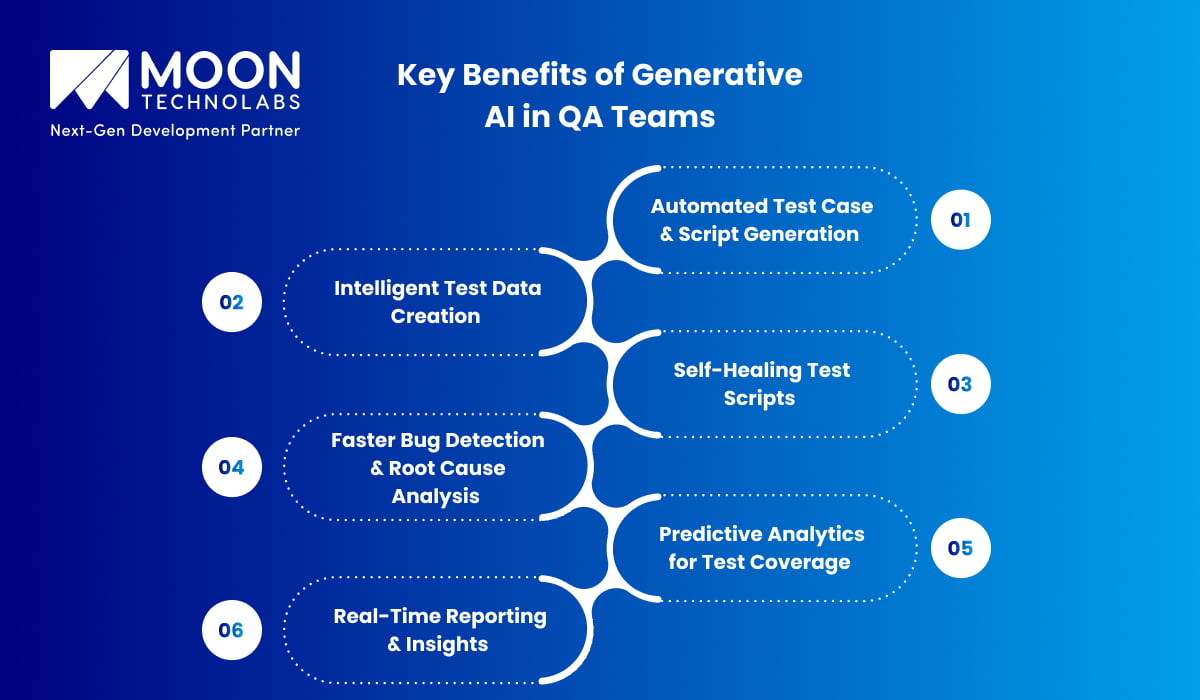
Generative AI has redefined how QA teams work by minimizing overall time on manual scripting. It lets the team focus completely on strategy, innovation, and providing an unmatched user experience. Let’s describe some other benefits as follows:
Automated Test Case and Script Generation
One of the major advantages of generative AI for QA teams is that it automates the process of scripting and generating test cases. It has an unmatched potential to interpret user stories, requirements, etc., to craft meaningful scenarios. It minimizes the entire manual effort while ensuring test coverage starts early in the development cycle.
Intelligent Test Data Creation
Generative AI has transformed the overall process of creating realistic and diverse test cases , and thus makes it less time-consuming. It produces dynamic datasets that can imitate even the real-world conditions. It offers a perfect validation of edge cases and thus enhances the reliability of test results even without depending on limited or static data inputs.
Self-healing Test Scripts That Adapt Automatically
Generative AI comes with self-healing capabilities. It allows test scripts to adjust automatically to various important modifications in different elements, such as layout, workflows, etc. It minimizes the overall test failures that arise due to superficial changes and thus minimizes the overall ongoing maintenance efforts.
Faster Bug Detection and Root Cause Analysis
With generative AI, QA teams gain the opportunity to identify the errors easily through analyzing different patterns, system behavior, and past test results. It not only detects the bugs but also lets you focus on their root causes as well.
It enables both development and QA teams to solve issues with higher efficiency. On the other hand, it also minimizes debugging time and enhances productivity.
Predictive Analytics for Better Test Coverage
Another major advantage of generative AI in software testing is that it works with a predictive approach for testing instead of solving problems as they take place. It analyzes both usage patterns and historical data to discover high-risk areas and also suggests where testing effort needs to be focused. It offers highly effective test coverage and smart prioritization.
Real-time Reporting and Quality Insights
Generative AI brings the possibility of continuous visibility into the entire testing process with the help of actionable insights and real-time processes. QA teams can easily monitor test performance, identify bottlenecks, and make informed decisions quickly. This level of transparency ensures that quality is maintained throughout the development lifecycle.
We transform your existing QA process with generative AI. Let’s automate your test creation, boost accuracy, and make the release process fast.
How Generative AI Supports Different Software Testing Methods?
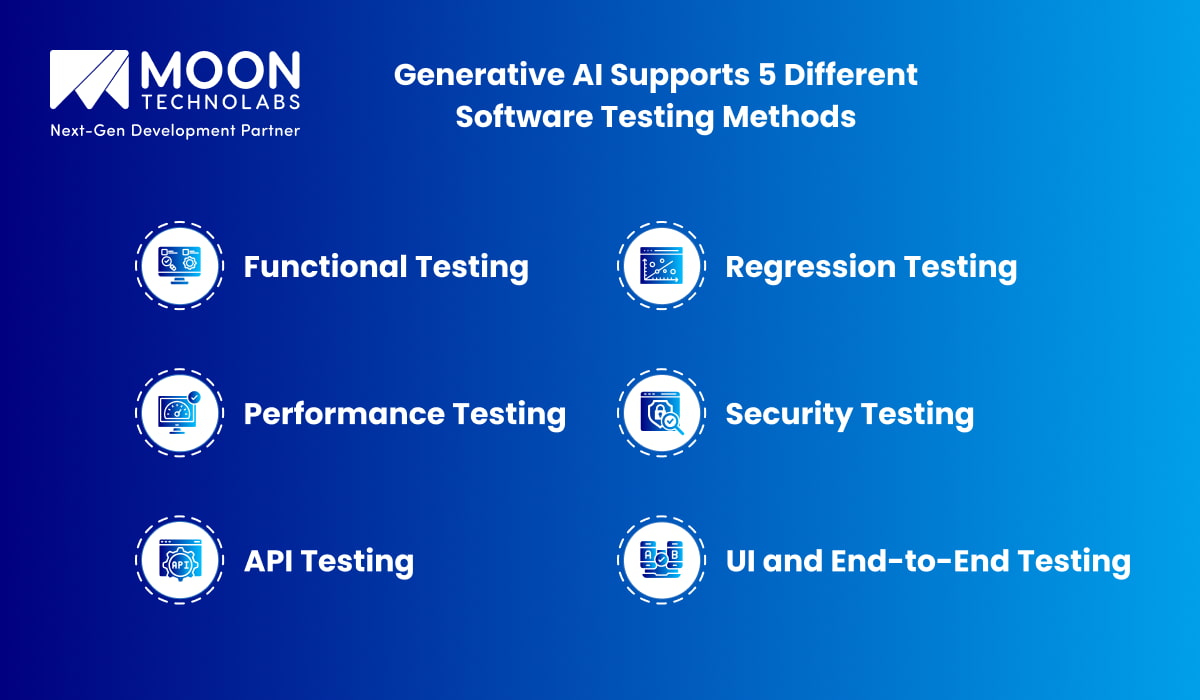
Generative AI improves different testing methods with speed, adaptability, and intelligence at every stage. Let’s find out how it supports different types of testing, which are as follows:
Functional Testing
Generative AI makes functional testing less complicated – it creates test cases automatically according to numerous factors such as user stories, application behavior, and requirements. It offers all important functionalities validated properly while uncovering edge cases that can be missed in manual testing.
Regression Testing
Regression testing is necessary with the most frequent updates in advanced apps. The entire process is indeed time-consuming. Generative AI works effectively in optimizing the entire process by focusing on impacted areas, relevant test cases, and updating scripts dynamically. It offers fast and reliable regression cycles.
Performance Testing
AI-based testing tools have the capability of simulating real-world user loads and producing performance scenarios smartly. Generative AI has the capability of predicting system behavior under stress, checking issues early, and suggesting improvements, etc., for maintaining optimal performance.
Security Testing
No matter what, security is one of the important concerns for software testing – generative AI addresses it better. It discovers vulnerabilities with anomaly detection, pattern recognition, etc. It simulates potential attack scenarios and discovers weak points in the system before their exploitation.
API Testing
Generative AI has the potential to streamline the entire testing process by automating everything, be it generating test requests, checking inconsistencies, and validating responses. It offers smooth communication between multiple system components.
UI and End-to-End Testing
Generative AI emphasizes user behavior and workflows to improve the user interface and end-to-end testing. It develops a complete, realistic journey, adapts quickly with UI changes, and ensures the entire app flow works smoothly.
How to Integrate Generative AI Into Your Software Testing Strategy?
For integrating generative AI in software testing, you don’t need to replace your existing QA processes. It involves transforming them with adaptability and intelligence. We will describe here various steps to do integration successfully:
Identify Suitable Testing Areas for AI
Your first step is to discover exactly those areas where generative AI impacts heavily. You need to understand that not every test requires AI intervention.
Therefore, you need to focus on areas such as regression testing, repetitive test case creation, data generation, etc. These are generally resource-intensive and get advantages of both learning capabilities and automation.
Select the Right Generative AI Testing Tools
The selection of the top generative AI testing tools requires successful implementation. You should always search for the platform that aligns perfectly with your selected tech stack and also supports integration with CI/CD pipelines. It should include capabilities such as self-healing scripts, intelligent analytics, and NLP-based test creation.
Train AI Models With Existing Test Data
Generative AI becomes most effective and purposeful when it gets trained on your past data. When you feed the same with defect logs, past test cases, and user behavior, these help the entire system understand patterns early while improving overall accuracy. The more relevant data it processes, the better results it delivers in generating important test scenarios.
Combine AI Testing With Human QA Oversight
AI has enormous potential in automating and optimizing various processes – it requires vast human expertise. QA professionals perform validation of AI-based outputs, manage complex scenarios, and ensure testing aligns perfectly with your core business objectives. This collaboration creates a reliable and balanced testing ecosystem.
Continuously Monitor and Optimize AI-driven Testing
One thing you need to understand is that integration is not just limited to implementation. It’s indispensable to analyze your AI performance continuously, check results, and refine your models over time. A regular optimization gives you a kind of surety that the system adapts better to new changes, maximizes accuracy, and delivers value consistently.
We help you upgrade your existing QA with leading generative AI tools. Let’s develop smart, fast, and reliable apps with improved quality.
Top Generative AI Tools for Software Testing
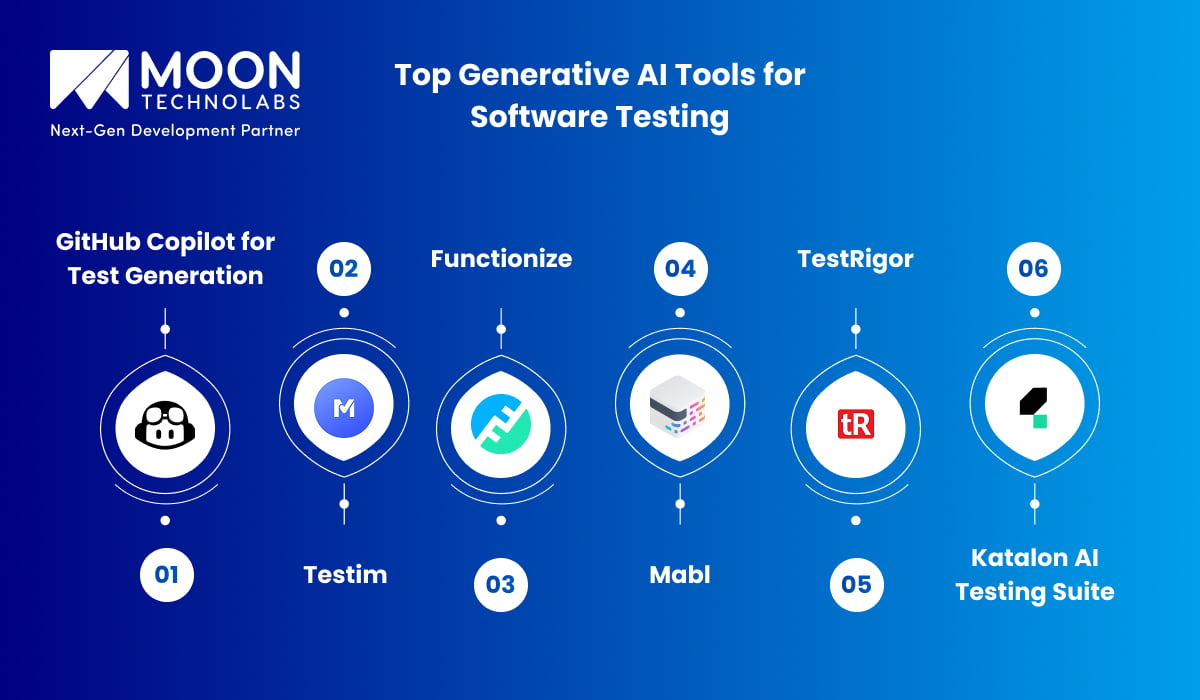
With the rapid adoption of generative AI in software testing, QA professionals get a plethora of options while selecting the right tool. We will take a look at some of these tools below:
GitHub Copilot for Test Generation
As one of the most widely used tools for code generation, GitHub Copilot also plays a leading role in test automation. It suggests to QA engineers about test cases, writing test scripts, and generating unit tests according to natural language prompts. It fosters the initial stage of test development.
Testim
Testim is another important tool that harnesses the potential of machine learning to build stable and fully maintainable automated tests. It leverages AI to identify UI elements and minimizes test flakiness, which makes it perfect for teams that deal most frequently with UI updates and also dynamic apps.
Functionize
Functionize mainly focuses on smart test creation with the use of natural language processes. It allows users to create, implement, and maintain tests with less coding. On the other hand, its AI engine continuously improves both performance and reliability.
Mabl
Mabl is the most useful tool for continuous testing in CI/CD environments. It combines machine learning with automated testing for the detection of UI changes, generates insights, and ensures app stability across releases.
TestRigor
TestRigor is known for its utmost capability of creating test cases in plain english. It makes the automation process quite simple by removing the necessity for complex coding and thus minimizes the maintenance overhead, which makes testing scalable and accessible.
Katalon AI Testing Suite
Katalon is another tool that software developers leverage extensively. It integrates AI potentials into its existing automation framework and includes a large number of features such as intelligent object recognition, self-healing tests, advanced analytics, and more. They help QA teams enhance both test coverage and efficiency.
Challenges of Using Generative AI in Software Testing
The fact can’t be denied that generative AI offers significant benefits to software testing, but its adoption also brings various challenges. We will describe these challenges along with their solutions:
Data Privacy and Security Risks
Generative AI systems mainly use data to learn and thus produce outputs accordingly. But, when the data is sensitive or the user’s personal data, it creates a risk of exposure and thus the biggest security challenge.
Solution: It’s crucial for an organization to ensure foolproof data governance, secure data pipelines, and ensure compliance with regulations for the prevention of potential breaches.
Inaccurate or Biased Test Outputs
AI can produce reliable test cases only when the data and logic behind them are reliable. In several cases, models tend to produce incomplete, irrelevant, or even biased test scenarios. It causes huge gaps in testing or even false confidence in app quality when not reviewed properly.
Solution: You need to validate and analyze AI-based outputs, retain models with multiple datasets, and blend AI insights with vast human expertise to boost accuracy.
Dependence on High-quality Training Data
Generative AI can be effective only when the quality of the training data is high. Any outdated or even insufficient datasets tend to limit the potential of models to churn meaningful and accurate test cases. A continuous data refinement is necessary for maintaining great performance.
Solution: Update your training datasets continuously with real-world scenarios. You also need to maintain structured and clean data.
Integration Complexity With Existing QA Processes
Integration of generative AI into established QA workflows can really be tough. It requires changes in processes, tools, and team skill sets. Integration often causes inefficiencies, disruptions, or resistance from a team that is already familiar with traditional methods.
Solution: It’s a perfect idea to initiate with the pilot projects, select the right AI tools with support for easy integration. After this, you can maximize adoption while aligning with existing QA pipelines.
Need for Human Validation and Oversight
Even though generative AI is available with vast automation capabilities, it still can’t replace human expertise. QA professionals are required to validate outputs, handle complex scenarios, and interpret results that need a complete contextual understanding. Depending exclusively on AI without any important oversight can maximize the chance of errors.
Solution: You should work with a hybrid approach where AI manages numerous repetitive tasks, and QA professionals focus on core tasks.
You Might Also Like:
How Moon Technolabs Helps You Build AI-powered Testing Strategies?
As an experienced generative AI development company, we specialize in testing by leveraging the unmatched capability of generative AI. We work with a hands-on approach to implement AI testing. Our team works with you closely to craft tailored QA frameworks that integrate perfectly with generative AI smoothly into their existing workflows.
Our team promises a smooth transition even without any disruption in operations, right from consultation and model development to integration and optimization. We specialize in using AI, ML, and automation to develop tailored solutions that redefine testing accuracy, scalability, and speed.
We specialize in data preparation, ongoing support, and model fine-tuning. These are useful for businesses to achieve high-performing and reliable testing systems that evolve continuously with changing requirements.
A Final Word Before You Go
So, by now, you may have understood the role of generative AI in redefining the software testing process, right? It not only makes the testing process quick but also smarter. It allows the team to test and deliver quality software while maintaining higher efficiency.
Meanwhile, adopting AI-based testing is something that requires a strategic approach and professional assistance. Partner with an AI development company like us to get the right solutions.
FAQs
01
What are the best generative AI tools for software testing?
There are many generative AI tools for software testing. Some of the popular ones include GitHub Copilot, ChatGPT, Mabl, Testim, and others. They have the potential to automate scripts, generate test cases, detect UI changes, and improve test coverage, etc.02
How is generative AI testing different from traditional automation testing?
Well, generative AI testing is different from traditional automation testing in terms of creating test cases, learning from different data patterns, adapting to changing scenarios, and more. On the other hand, automation testing depends mainly on fixed inputs, predefined scripts, and predictable implementation paths.03
Can generative AI create test cases automatically?
Yes, generative AI creates test cases automatically through analyzing requirements, historical data, user stories, etc. It speeds up test design, enhances coverage, and minimizes manual effort.04
Does generative AI improve software testing accuracy?
Yes, generative AI enhances software testing accuracy by creating a range of test cases, minimizing human error, and detecting edge scenarios. Meanwhile, its effectiveness relies mainly on proper validation, quality data, and complete human oversight to avoid any misleading or even biased outputs.05
Can generative AI testing replace manual testers completely?
No, generative AI testing can’t replace manual testing completely, though it maximizes testing speed, efficiency, and coverage. Be it exploratory testing, human judgment, or contextual understanding, it remains crucial to validate even complex situations, real-world user experiences, and usability.




Jayanti Katariya is the CEO of Moon Technolabs, a fast-growing IT solutions provider, with 18+ years of experience in the industry. Passionate about developing creative apps from a young age, he pursued an engineering degree to further this interest. Under his leadership, Moon Technolabs has helped numerous brands establish their online presence and he has also launched an invoicing software that assists businesses to streamline their financial operations.
Submitting the form below will ensure a prompt response from us.
We refine our expertise to deliver innovative business solutions.





205 N Michigan Avenue, #810, Chicago, 60601, Illinois, United States
13500 Long Is Dr, Pflugerville, TX 78660, USA

C/105 Ganesh Meridian, S.G. Highway, Ahmedabad, GJ 380060


Ayse D.
Co-Founder France
“ I highly recommend Moon Technolabs as the quality of service is wonderful. We have hired this company to develop the product based on some complex & technical issues. We get the best quality services as compared with others in the market. Huge Thanks to Moon Technolabs as the team is always ready to give the solution all time.”

Justin G.
Founder & CEO USA
USA“ Moon Technolabs is a pioneer in the WebRTC based project as they have fixed complicated segments of the module by fulfilling different product lines by providing 24X7 customer support. We really recommended Moon Technolabs as they are able to develop products as per the module deadline and project timeline.”

Flavio S.
Founder & Managing Director Germany
“I am happy to recommend Moon Technolabs for their app development services. They successfully developed apps for me, and I am highly satisfied with the overall outcomes. The development team has swiftly addressed the issues with responsive and effective communication to understand the requirement quickly and actively resolve the back-and-forth problems that arose...”

Jay M.
Founder & CEOUSA“Moon Technolabs is the best company that provides advanced apps and websites development services in the USA and Europe. I am a newbie to develop my app with an external team. I am really happy to work with them as I am not that much mobile apps user. Here, the team and specially the CEO of Moon Technolabs helps me to let me know about the benefits of my app to generate revenue....”


Our Offices
India
C/105 Ganesh Meridian,S.G. Highway, Ahmedabad, GJ 380060USA
205 N Michigan Avenue, #810, Chicago, 60601, Illinois, United StatesContact Information


