


Enterprise DevOps Transformation Guide for Modern Enterprises

DevOps Team
Last Updated: Aug 06, 2026 Total Views: 87
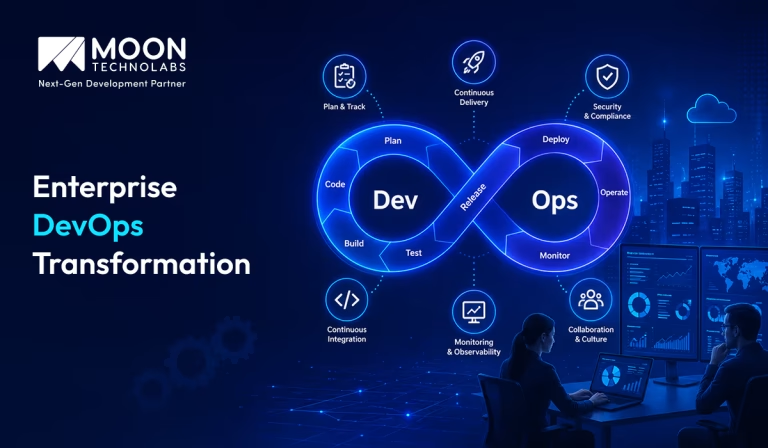
Table of Content


Blog Summary:
DevOps transformation is a must-have for businesses seeking improved efficiency, faster innovation, and greater agility to sustain themselves in a competitive market. This blog explores the complete execution process for an enterprise DevOps transformation, with the right practices, a structured roadmap, and top strategies. Keep reading the entire post to strengthen security, improve software delivery and collaboration, and build a complete DevOps ecosystem.
Table of Content
Businesses nowadays work with the primary goal of meeting evolving customer expectations. To implement it effectively , they operate under constant pressure to mitigate downtime and deliver new features quickly. But most of them struggle due to disconnected development and operations teams, legacy infrastructure, and higher operational costs,
These challenges become more severe with complex software ecosystems. So, enterprises require a collaborative, automated approach to revolutionize their development workflows and overcome these challenges. This is where they find the need for Enterprise DevOps transformation.
DevOps improves collaboration between the development and operations teams, automates repetitive workflows, and accelerates software delivery. This has increased its adoption rate among businesses and propelled the global market size, which is projected to grow from $24.30 billion in 2026 to $125.07 billion by 2034 at a CAGR of 22.73% (Fortune Business Insights).

In this blog, we will explore the importance of DevOps transformation for organizations.
What is Enterprise DevOps Transformation?
Enterprise DevOps transformation is the process of redefining how enterprises and large organizations develop, test, and deliver software solutions. It involves replacing separate development and operations teams with a culture of shared automation, responsibility, and continuous delivery.
Startups use DevOps for a single product team. But enterprises need it to manage multiple business units, legacy systems, stringent compliance requirements, and various applications simultaneously.
This is something that differentiates enterprise DevOps transformation from a general DevOps implementation. It involves:
- Transforming the overall organizational structure so operations, development, and security teams work collaboratively with shared responsibility rather than working in a single silo.
- Use of standardized tools and practices across a range of departments that may have operated independently for several years.
- Ensuring alignment of governance requirements and compliance early, rather than treating them as a final checkpoint.
- Gradual replacement of manual handoffs and approvals with consistent and automated workflows.
When you do it properly, the enterprise DevOps transformation improves processes, people, and technology together. It converts software delivery from a team-by-team, slow process into a fast, collaborative workflow.
Why DevOps Transformation Matters for Enterprises?
DevOps is much more than just a technical upgrade for enterprises —it has, in fact, become a business necessity for them. Today, customers expect fewer outages, faster releases, and regular improvements.
On the other hand, competitors with advanced delivery pipelines launch the latest features more quickly than those with slow, lengthy approval processes. With DevOps digital transformation, enterprises can minimize this overall gap by bringing people, technology, and processes together to deliver more reliable software fast.
Here are some other reasons why a large organization needs enterprise DevOps transformation:
- It minimizes risk through automated testing and deployment, thereby mitigating human error in complex environments.
- It ensures faster release cycles.
- It minimizes the cost of duplicated effort, redundant tools, and firefighting through streamlined workflows.
- It requires an active involvement of engineers.
- It ensures a competitive edge for organizations that adapt quickly to market shifts and thus stay ahead of those that rely heavily on legacy delivery models.
6 Benefits of DevOps Transformation
The benefits of a DevOps transformation extend beyond engineering teams. They impact how the enterprise functions, grows, and competes. We have outlined some of its most prominent benefits:
Faster Software Delivery
Faster software delivery is one of the major advantages of enterprise DevOps transformation. It minimizes the release cycle by automating the software build and deployment. It can be reduced from weeks to days or sometimes even hours.
In this approach, teams generally provide smaller updates continuously rather than combining changes into a single large release. It thus ensures that users receive the latest features, security updates, and bug fixes quickly, even without a lengthy manual approval process.
Improved Collaboration Across Teams
DevOps serves its core purpose of bringing different teams together and improving collaboration among them. These teams are mainly development, security, and operations teams.
They often work with a shared responsibility, tools, and common objectives without blaming each other when a problem arises. This cultural change indeed delivers greater value than any individual DevOps tool for enterprises with teams spanning multiple business units.
Enhanced Deployment Reliability
Manual deployment often leads to human error, especially in large enterprises where many connected devices work together. Automated pipelines with rollback features, built-in testing, and staged deployments can identify and resolve issues before they affect customers. It ensures fewer deployment failures and less downtime with every software release.
Increased Operational Efficiency
Since DevOps automates repetitive tasks such as running regression tests, setting up environments, and managing configurations, it reduces manual effort for engineers. Infrastructure as code and self-service platforms work effectively to minimize the time teams spend waiting for approvals, handling support requests, or resolving routine issues.
It helps the team to focus more on resolving real business issues. Over time, these improvements maximize both productivity and efficiency, enabling enterprises to complete more work without hiring additional staff.
Stronger Security with DevSecOps
Traditional security reviews often occur after the software development process is complete, leading to further delays and numerous last-minute changes. On the other hand, DevSecOps implements additional security checks in the CI/CD pipelines through automated scanning of code, configurations, and dependencies throughout the entire development process.
This approach makes it convenient for teams to discover security issues early. It also ensures a rapid and efficient software release cycle.
Better Scalability and Business Agility
Enterprises don’t operate in a fixed environment. They need changes, growth in user numbers, and the addition of several new business units over time. DevOps practices like automated scaling, containerization, and modular architectures help them scale their infrastructure to meet growing business requirements.
Transform Software Delivery with DevOps
We transform your software delivery process and automate your workflows. Let’s partner with us to create a secure and scalable DevOps ecosystem.
Enterprise DevOps Transformation Roadmap
When you plan to transition from your separate team to DevOps enterprise, do so with a clear, planned approach. Let’s understand a complete roadmap enterprises can follow:
Step 1: Assess your Current DevOps Maturity
Before you make any changes, you need first to have a clear understanding of your existing position. It means you need to have a detailed look at your existing tools, team structures, workflows, release processes, etc. It helps you find out gaps and delays and answer some important questions, including:
- Do you still have manual deployments?
- Do your team members work separately?
- What is the overall time required for moving from code commit to production?
Step 2: Define your Transformation Strategy
This step involves building a DevOps transformation strategy tailored to match specific business objectives rather than a generic template copied from other organizations. This includes several activities, such as defining ownership across teams, setting measurable objectives, selecting the right toolchain, and securing buy-in from leadership.
Step 3: Implement CI/CD and Automation
Enterprises initiate the automation of build, testing, and deployment to minimize manual tasks and human error. Continuous integration allows teams to test and integrate code changes daily, whereas continuous delivery automates the entire release process.
This step also involves implementing infrastructure-as-code and automated configuration management.
Step 4: Monitor Performance and Optimize
After the implementation of automation, the entire focus moves towards improving visibility. Enterprises require impeccable monitoring and observability tools to check deployment success rates, system health, and performance issues.
This data is crucial for resolving issues and supporting continuous improvement by helping teams understand what works, what delays releases, and where to focus their efforts next.
Step 5: Scale DevOps Across the Enterprise
A successful pilot project with just one team doesn’t include the enterprise transformation. So, the next crucial step is to implement the same successful methods, rules, and tools across multiple departments while allowing teams to make changes according to their own requirements.
This requires building internal development platforms that enable teams to access the required deployment tools and infrastructure fast, even without always starting from zero.
Top 10 Best Practices for Enterprise DevOps Transformation
Building a DevOps transformation strategy is just the first step. The real challenge is to implement it more effectively. We have described below how to do it successfully by implementing several best practices to achieve long-term success:
Automate Software Testing
Manual testing often fails to keep pace with continuous delivery in many large enterprises. Whether it’s automating integration, unit, or regression tests, these tools help verify every code change quickly and consistently, without relying on QA teams to manually test each case.
Automated testing doesn’t indicate the loss of relevance of human testers. It, in fact, helps them focus on complex scenarios, exploratory testing, and user experience issues that automation can miss. Enterprises that implement automated testing in the early stages of their DevOps transformation often experience fewer production errors and faster release cycles.
Manage Configurations Effectively
Configuration drift occurs, especially when multiple environments diverge over time due to manual changes. For instance, consider an app that runs better on developers’ devices but fails to run properly on the production server because its settings differ.
Enterprises must leverage configuration management tools and infrastructure-as-code practices to maintain consistency across all environments. It not only removes confusion but also allows teams to restore or copy an environment when issues arise.
Strengthen Continuous Integration
Continuous integration offers many real benefits when you follow it consistently. This reflects developers’ need to make code changes in small batches, with automated builds and tests that often run after every important update. Improper CI practices create major difficulties, and integration can become a major problem later.
Fast feedback is important for improving CI, helping teams find and resolve issues within a few seconds. Besides this, it also ensures the reliability, stability, and readiness of every change to the main branch. This is done to proceed to the next step of the software development process.
Adopt Progressive Delivery
With progressive delivery methods, enterprises can introduce changes gradually and test overall performance before a full launch. It prevents them from launching every new feature to all users at once.
In case of any issues, only a small percentage of users get affected, and teams find it convenient to reverse changes. This approach minimizes overall risk and the impact of deployment issues for enterprises that manage complex, high-traffic systems.
Enable Continuous Deployment
Continuous delivery is useful for preparing code for release. On the other hand, continuous deployment is a step beyond continuous delivery and automates the deployment of changes to production once they pass the necessary checks.
This requires a strong trust in automated monitoring and testing, which enables teams to adopt it later in their transformation journey. Once implemented properly, continuous deployment minimizes delays caused by fixed release schedules. It also helps teams to deliver updates to customers fast.
Improve System Observability
Monitoring helps you identify the actual problem, whereas observability helps you understand the reason behind it. So, you should focus on gathering metrics, logs, and traces rather than only checking whether systems are working fine.
These help to find the real cause of every issue. This remains highly relevant when it comes to microservices. In this, even minor issues may arise from another service running behind the scenes.
Track SRE Metrics
With Site Reliability Engineering (SRE), your teams can use data to enhance system performance and manage systems more effectively. It helps them use vital metrics such as error budgets, Service Level Objectives (SLOs), and Mean Time to Recovery (MTTR) to balance system reliability with fast software releases.
SRE prevents teams from making their entire decision based on guesswork. It enables them to use the above metrics to determine the right time to improve their system’s capabilities and release their update quickly.
Increase DevOps Visibility
DevOps transformation becomes slow, especially when decision-makers and engineering teams fail to see the same progress. In this case, your organization should leverage reports and dashboards that highlight vital DevOps metrics for everyone across the business, rather than keeping them within one team’s tools.
These metrics are mainly lead time, deployment frequency, failure rates, and more. This kind of shared visibility effectively builds trust and allows teams to detect and fix issues before they become much bigger.
Optimize Value Streams
Value stream mapping reflects every important step an idea goes through, from planning to final delivery to customers. It helps your teams identify delays, slow workflows, unnecessary approvals, and other issues they often miss.
In many organizations, it highlights that most delays are caused by poor coordination between teams and approval processes rather than by technology alone. Enterprises can eliminate unnecessary approvals, deliver products to customers fast, and automate routine tasks with the improved value stream.
Measure DevOps Performance
It’s pivotal to analyze DevOps performance regularly to understand whether your efforts are paying off. You should keep an eye on key DevOps metrics, including change lead time, deployment frequency, time to restore service, and change failure rate.
These metrics help you determine whether your teams are performing better over time. They also help your stakeholders understand whether they are getting a better return on their investment.
Get Tailored DevOps for Future-Ready Enterprises
With us, you can get customized DevOps solutions exclusively for your business. Partner with us to create a high-performing DevOps ecosystem.
Common Challenges in DevOps Adoption
Even with a clear roadmap for implementing the enterprise DevOps digital transformation, you will still encounter challenges. The following are some of these challenges and their respective solutions:
Resistance to Cultural Change
DevOps makes it necessary for teams to transform how they work over the years. But they often find it tough to get away from manual approval processes, separate responsibilities, and the old mindset.
Solution: You can start with a small team to achieve better results by leveraging the actual benefits of DevOps. You can use these early successes to get the required support from the rest of the company.
Legacy Infrastructure Limitations
Even many organizations still operate on legacy systems that were not designed for automation. Besides, these systems are too complex to integrate with advanced CI/CD pipelines, and rewriting them entirely carries too many risks.
Solution: You should avoid replacing everything at one go. Instead, you can modernize your system in multiple steps, such as containerizing the most suitable applications, adding APIs to legacy systems, and more.
Toolchain Integration Complexity
Over time, enterprises harness various tools to perform different tasks. We can take an example of a team that uses one CI/CD platform, whereas another team uses a different platform. When you connect all these tools, it creates many technical challenges for you.
Solution: To avoid these challenges, you can harness a comprehensive set of tools across teams whenever possible. It’s also important to connect remaining tools with APIs or integration platforms.
Skills and Talent Gaps
DevOps requires a comprehensive set of skills, including security, cloud platforms, automation, and teamwork. So, searching for experienced DevOps professionals is quite clumsy. Besides, an existing team often requires proper training to leverage cutting-edge tools.
Solution: It’s advisable to invest in a fully structured training program when selecting a DevOps team. You should work with top-rated DevOps transformation service providers to address skill gaps.
Governance and Compliance Requirements
Businesses in regulated industries such as healthcare, finance, and government can’t avoid compliance. They need to strike a perfect balance of fast software releases with complete approval steps, audit records, regulatory rules, etc.
Solution: All you need to do is include comprehensive compliance checks in the CI/CD pipelines rather than treating them as a final step. Whether it’s audit logs or automated policy rules, these tools allow enterprises to move fast while meeting regulatory requirements.
Ready to Transform Your Enterprise with DevOps?
Enterprise DevOps transformation is an ongoing process to revolutionize how your business creates, tests, delivers, and improves software. But doing the same without the right expertise leads to many errors and months of trial and error. It also leads to stalled pilot projects and mismatched tools.
This is where you need to think about an experienced professional partner like us. We provide DevOps transformation services with a core commitment to designing and implementing a better strategy for your business. We execute a strategy tailored to your compliance needs, existing infrastructure, business goals, and more.
Whether you have just begun your DevOps transformation journey or are seeking to scale your existing efforts, we are committed to serving you with the right guidance. You can expect support from our team at every stage of DevOps transformation. We serve you in the following ways:
- Our team conducts a thorough assessment of your existing DevOps maturity and identifies quick wins.
- Build CI/CD pipelines and automation matching your environment.
- Embed security and compliance into different stages of delivery.
- Provide ongoing support with the increasing needs and systems.
- Embedding security and compliance into every stage of delivery
- Scaling proven practices across teams and business units
- Providing ongoing support as your systems and needs evolve
A Final Word
Enterprise DevOps transformation is much more than just a technology upgrade — it’s basically a vital business strategy for organizations to restructure their software delivery process, improve security, enhance teamwork, and respond fast to their changing requirements.
A successful enterprise DevOps transformation requires a clear roadmap, the right strategy, and expert guidance to ensure effective execution. Partnering with an experienced DevOps transformation provider can help organizations navigate challenges, implement best practices, and achieve their business objectives. With the right expertise and support, enterprises can optimize operations, accelerate innovation, and build a scalable foundation for long-term growth.
FAQs
01
What are the 4 phases of DevOps?
Well, four important phases of DevOps include plan, develop, deliver, and operate. These crucial phases include the entire software lifecycle, from planning to coding and deployment.02
What are examples of transformation?
The most common examples of transformation include migrating legacy systems to the cloud, implementing AI and automation, and adopting DevOps practices.03
What are the 4 pillars of successful digital transformation?
The four pillars of successful digital transformation are technology, processes, skills, and people. These pillars allow your business to adapt to the latest technologies and optimize operations.04
What does enterprise transformation mean?
Enterprise transformation is a strategy built around redefining an organization’s operations, business models, technology, culture, and more. Its major purpose is to foster innovation and efficiency, to improve customer experiences, and to drive long-term growth.



The DevOps Team at Moon Technolabs consists of experienced engineers and cloud specialists who share insights on modern software delivery and infrastructure management. With expertise in AWS, Azure, CI/CD pipelines, containerization, and cloud-native architectures, the team contributes practical knowledge drawn from real-world projects. Their content focuses on automation, scalability, cloud cost optimization, and best practices that help businesses build reliable and efficient development ecosystems.
Submitting the form below will ensure a prompt response from us.
We refine our expertise to deliver innovative business solutions.





205 N Michigan Avenue, #810, Chicago, 60601, Illinois, United States
13500 Long Is Dr, Pflugerville, TX 78660, USA

C/105 Ganesh Meridian, S.G. Highway, Ahmedabad, GJ 380060


Ayse D.
Co-Founder France
“ I highly recommend Moon Technolabs as the quality of service is wonderful. We have hired this company to develop the product based on some complex & technical issues. We get the best quality services as compared with others in the market. Huge Thanks to Moon Technolabs as the team is always ready to give the solution all time.”

Justin G.
Founder & CEO USA
USA“ Moon Technolabs is a pioneer in the WebRTC based project as they have fixed complicated segments of the module by fulfilling different product lines by providing 24X7 customer support. We really recommended Moon Technolabs as they are able to develop products as per the module deadline and project timeline.”

Flavio S.
Founder & Managing Director Germany
“I am happy to recommend Moon Technolabs for their app development services. They successfully developed apps for me, and I am highly satisfied with the overall outcomes. The development team has swiftly addressed the issues with responsive and effective communication to understand the requirement quickly and actively resolve the back-and-forth problems that arose...”

Jay M.
Founder & CEOUSA“Moon Technolabs is the best company that provides advanced apps and websites development services in the USA and Europe. I am a newbie to develop my app with an external team. I am really happy to work with them as I am not that much mobile apps user. Here, the team and specially the CEO of Moon Technolabs helps me to let me know about the benefits of my app to generate revenue....”


Our Offices
India
C/105 Ganesh Meridian,S.G. Highway, Ahmedabad, GJ 380060USA
205 N Michigan Avenue, #810, Chicago, 60601, Illinois, United StatesContact Information


