


E-Scooter App Development: Your Ultimate Guide to E-Mobility Solution

Jayanti Katariya
Last Updated: November 21, 2025 Total Views: 3984
Table of Content


Blog Summary:
E-scooter app development merges innovative technology with urban mobility needs, featuring real-time tracking, secure payments, AI-driven maintenance, and dynamic pricing. Organizational success depends on robust planning, user-centric design, integration with smart city systems to adapt to evolving market demands and regulatory landscapes. This blog will explore the process, costs, and features of how businesses can develop their unique e-scooter app.
Table of Content
E-scooter apps offer a glimpse into the future, where people across various cities worldwide commute on roads, transforming the face of urban mobility and transportation. Whether your business serves busy professionals or common people traveling to pick up groceries, building an e-scooter app can save them from last-minute panic and spending precious time searching for a taxi.
The market for E-scooter App Development is experiencing significant growth due to the rapid expansion of e-scooter rental apps. According to Fortune Business Insights, the global e-scooter rental app market was valued at USD 17.73 billion in 2023 and is projected to reach an astonishing USD 50.15 billion by 2032.
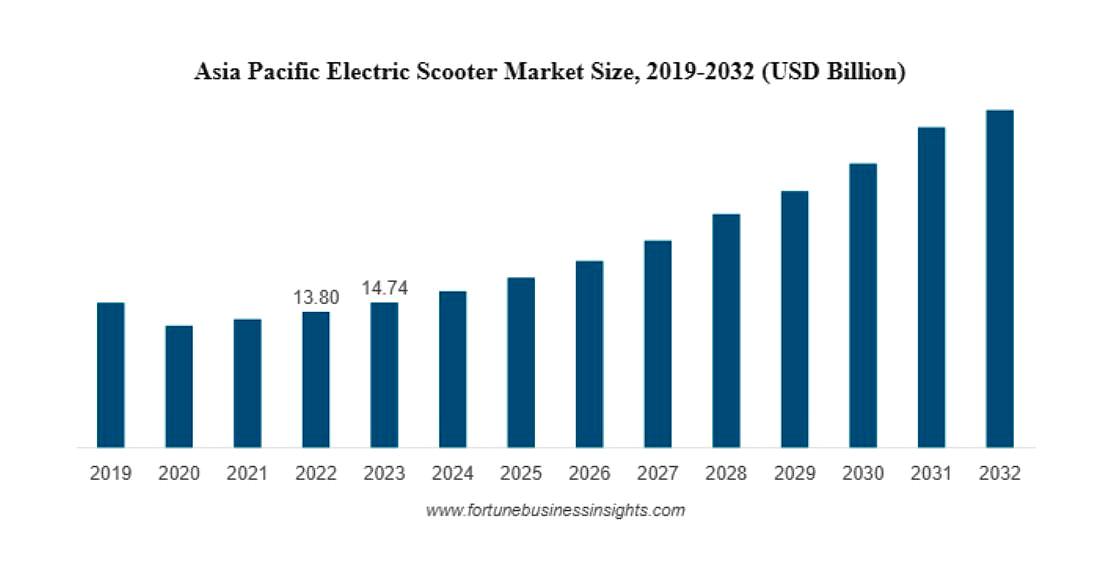
For investors, entrepreneurs, and city planners alike, the compound annual growth rate of 21.7% over the next decade is a clear indication of the massive business opportunities that these e-scooter apps represent. In this blog, we’ll dive deeper into the process of e-scooter app development, from its essential features to the associated costs.
What is an e-Scooter App?
E-scooter apps help people reach their destination on time when their train or bus is delayed or missed. They can instead open the e-scooter app and, within seconds, zip through the city streets on an electric scooter. The apps let them pay seamlessly and park the scooter with a simple QR code scan.
E-scooter apps are only one piece of the puzzle. Complementing this growth, if you own EV charging stations, EV Charging app solutions play a crucial role in supporting electric vehicle users, ensuring convenient access to charging infrastructure.
The e-scooter app is a complex digital ecosystem connecting three critical components:
- Users seeking quick transportation
- Fleet operators who manage thousands of vehicles
- Sophisticated real-time technology
All these components make e-scooter apps the digital brain behind the entire operation of finding, unlocking, riding, and paying for e-scooters through the app. A GPS tracking network, IoT-enabled smart locking, a real-time dashboard, secure payment gateways, and predictive analytics all work together to create a seamless user experience.
The Global Market Growth of e-Scooter Apps
The most striking aspect to notice is that 75% of e-scooter users prefer app-based rentals, as they are convenient and easy to use. Apart from that, Cognitive Market Research highlights that from 2025 to 2033, the global e-scooter sharing market is expected to see an annual growth rate of 17% making this segment lead the charge.
The business model of e-scooter apps typically operates on multiple revenue streams:
- The primary revenue stream is a pay-per-ride model that charges an unlock fee, as well as a per-minute rate. They both help them generate a gross profit of up to 30% per ride.
- Another successful revenue stream is the subscription model, which is usually implemented by successful operators for regular users.
- The third most important revenue stream is the group ride packages for tourists, as well as business-to-business (B2B) partners, including hotels, universities, and corporate entities.
The geographic landscape distribution of e-scooter app adoption also reveals patterns that indicate immense opportunities for both established and emerging businesses.
Scoop.market.us indicated that the e-scooter app is a dominant market player in the Asia-Pacific region, accounting for 45.5% of the market share in 2024. This ultimately resulted in the market generating a revenue of USD 1.07 billion in that year.
Similarly, China is another region that is expected to grow at an impressive rate of 23.7%, currently valued at USD 0.52 billion.
Statista highlights that North America, specifically the United States, is the largest revenue-generating region, with an expected revenue of USD 751 million by 2025. With shared micromobility services projected to increase tremendously, the American market is poised to demonstrate remarkable growth in the coming years.
Benefits of e-Scooter App Development
Each feature drives convenience, profitability, safety, or growth for both users and operators in the e-scooter ecosystem. Developing these features enables organizations to unlock convenience, sustainability, and growth by leveraging smart mobile apps that connect users with eco-friendly electric scooters.
Discover how we developed a similar smart EV charging mobile app, MoonEVFlex, that enhances the charging experience for electric vehicles by connecting to a vast network of charging stations.
Benefits to Users
| Features | Benefits |
|---|---|
| Seamless User Registration & Onboarding | Quick signup via phone/email/social accounts; enables fast access even on the go. |
| Locating Nearby E-Scooters with Real-Time GPS | Riders can instantly view available scooters and parking spots on a live map. |
| QR Code Scanning to Lock & Unlock Scooters | Enhances security by enabling only authorized users to unlock scooters. |
| Secure Payment Integration, Multiple Methods | Payments can be made easily before/after rides (wallet, card, cash, etc.), enhancing user convenience. |
| Ride History & Analytics | Users gain insight into all past trips, including distance, time, cost, and routes. |
| Push Notifications, Promotions, Service Updates | Real-time alerts about rides, payments, bookings, zones, or emergencies keep users informed, drive engagement, and increase retention. |
Benefits to Admins
| Features | Benefits |
|---|---|
| Comprehensive User Management | Enables quick response to rule violations, fraud, or complaints; improves retention through activity analysis. |
| Real-Time Fleet Monitoring | Optimize deployment, disable or recover lost/stolen scooters, manage charging/maintenance efficiently. |
| Payment Channels | View transaction history, set pricing/refund schemes. Ensures secure management of revenue, coupons, and bonuses. |
| Analytics & Reporting | The dashboard reveals riding statistics, engagement metrics, earnings, usage rates, and retention trends. |
Advanced Benefits for Users and Admins
| Features | Benefits |
|---|---|
| Creating Riding Zones with Geofencing | Enables enforcement of operational zones, alerts, speed restrictions, and prevents rides outside boundaries. |
| Smart Lock Integration with IoT | Biometrics (such as face, fingerprint, and eye scans) enhance protection against theft and unauthorized use. |
| Predictive Maintenance Algorithms | AI/ML algorithms analyze sensor data to predict wear/failure, enabling timely maintenance. |
| Multi-Language Support | Simplifies onboarding and regulatory compliance in diverse regions, increasing adoption. |
| Demand-Based Dynamic Pricing | Real-time algorithm adjusts ride prices based on demand, time, weather, and local events. |
Transform Urban Mobility With an E-scooter App
Let us help you discover how smart planning and AI-powered features can future-proof your e-scooter app while ensuring compliance and customer trust.
Build Your E-Scooter App
Key Features of an e-Scooter App
The success of an e-scooter app hinges on how well the features are implemented. They must be able to serve both the riders and operators effectively. While there are some basic features that every app must contain, there are some advanced features that become the foundation of the most successful apps:
Features for the Rider-facing Application
Seamless User Registration and Onboarding
Registration processes are generally simple and fast, making it easier for users to register even while outdoors and on the go. Onboarding includes safety instructions and local usage rules, along with interactive guides, to help first-time users avoid misuse and accidents.
Locating Nearby e-Scooters with Real-time GPS Location
With real-time GPS, riders can see available parking spots and scooters on a live map within the app display. Utilizing GPS and IoT integration with the scooter’s hardware, riders can also update their e-scooter’s location, battery status, and availability in the app.
QR Code Scanning to Lock and Unlock Scooters
QR code scanning enables a secure unlocking system, allowing users to scan and initiate the ride. It enhances security and reduces theft as only authorized app users can access the rides. Further, some systems also allow users to lock the e-scooter using the code once the ride ends.
Secure Payment Integration with Multiple Payment Methods
With in-app payment integration, users can make payments either before or after the ride, depending on the business model.
Integrated payments reduce drop-off rates since all payment methods, including mobile and e-wallet apps, cards, and in-app cash, can be accessed without friction. Integration with the backend ensures that payments are PCI compliant while protecting user financial data.
Ride History and Analytics
Ride history enables users to access all past rides and view detailed information, including distance traveled, time, costs, and routes. Users can also gain insights into their activity, expenses, and plans, as well as compare trips with personalized recommendations tailored to their riding patterns.
Push Notifications, Promotions, and Service Updates
Users can stay informed in real-time, which further contributes to user retention through in-app push notifications, alerts, reminders, booking confirmations, ride start and end notifications, payment receipts, promotions, updates on ride zones, and emergency notifications.
Features for the Admin-facing App
Comprehensive User Management
Admins can respond and take required action against rule violations, manage complaints, and handle any fraudulent activity. They can also analyze user activity in-depth and develop effective retention strategies.
Real-time Fleet Monitoring
Under real-time fleet management, administrators can obtain a comprehensive overview of all e-scooters, including their locations, battery levels, unique identifiers, and active status. They can also track scooters and disable them remotely if any of them is lost or stolen.
If your business is finding it difficult to handle the complex logistics of e-scooter apps, you can also build a fleet management software to simplify it.
Payment Channels
Admins can view the entire history of all financial transactions, which enables them to establish pricing schemes for various ride plans and manage refunds. Admins can facilitate secure money management with clear breakdowns for revenue, bonuses, and coupons.
Analytics and Reporting
The admin-facing app provides a comprehensive analytics dashboard featuring powerful data. It shows all ride-related statistics, engagement, revenue earned, vehicle usage, earnings, retention rates, and other measurable metrics. Admins can visualize all operational insights to make decision-making easier, set benchmarks for performance, and identify trends or issues.
Advanced Features
Creating Special Riding Zones for the Users with Geofencing Technology
With geofencing capabilities, admins can track both operational and non-operational riding zones, receiving automated alerts whenever an e-scooter enters or leaves the zone. It also allows them to set and enforce rules for speed limits and disable rides outside riding zones.
Integrating Smart Locks with IoT Integration
Another advanced feature is the integration of IoT modules, enabling users and operators to remotely manage smart locking and unlocking, location tracking, and battery updates. Smart locks usually include biometric options to improve user protection, prevent theft and unauthorized app access.
Implementing Algorithms for Predictive Maintenance
One of these advanced features is the implementation of AI algorithms in combination with machine learning to analyze real-time data gathered from embedded IoT systems. These algorithms predict the optimal maintenance strategies for e-scooters based on patterns of battery health, motor performance, mileage, and temperature.
Support for Multiple Languages to Enter International Markets
To enter international markets, e-scooter apps need to be integrated with multi-language support for all the user interface elements. They typically utilize translation management and auto language detection systems to enable users to see the content in their preferred language by detecting the language of the browser/device.
Demand-based Dynamic Pricing
Dynamic pricing algorithms analyze the real-time demand, location, weather, local events, usage history, and time of day to adjust prices accordingly. For example, in low-demand situations, prices will drop to provide more incentive for ridership and balance the supply to maximize profits.
Step-by-Step Process of e-Scooter App Development
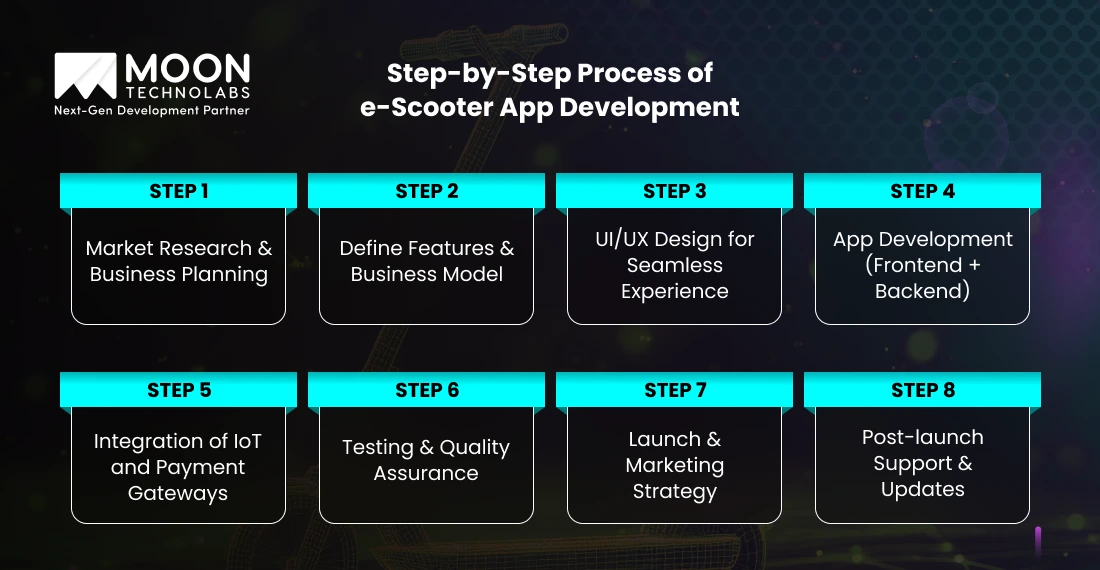
The following steps show a sequenced approach that ensures your e-scooter app is thoroughly researched, skillfully developed, rigorously tested, and strategically positioned for long-term market success.
Step 1: Market Research & Business Planning
Conduct in-depth market research to understand user behaviors, preferences, analyze competitors, business models, pain points, and the regulatory environments in target locations. Then define a unique value proposition to establish clear, realistic business objectives and budget allocations, creating a blueprint for your project.
Step 2: Define Features & Business Model
This step involves listing your app’s core and advanced features, as well as determining your revenue model. Then, evaluate roles for users, administrators, and operators to cover all interaction flows and prioritize features to avoid scope creep, ensuring clarity in development and delivery.
Step 3: UI/UX Design for Seamless Experience
The third step is to map user flows and intuitive navigation for each feature, and then build wireframes based on them to visualize the layout and branding. Furthermore, it is advisable to test designs with a pilot group to gather feedback on usability, accessibility, and adaptability.
Step 4: App Development (Frontend + Backend)
Next comes developing frontend and backend components. For the frontend, focus on responsive cross-platform layouts and interactive elements such as maps and profiles. For a robust backend, secure APIs to link frontend tasks, and set up reliable databases for storing data.
Step 5: Integration of IoT and Payment Gateways
In the fifth step, integrate e-scooters with custom IoT solutions and secure unlocking/locking mechanisms via QR code or Bluetooth to track rides, monitor battery, and status in real-time.
Additionally, integrate trusted payment gateways that support all relevant payment options, ensuring full PCI compliance and secure handling of sensitive data.
Step 6: Testing & Quality Assurance
The testing stage involves multiple stages of testing, including functional, usability, security, and performance testing. Furthermore, teams should also test cross-device compatibility and high-traffic scenarios to resolve any issues before launch.
Step 7: Launch & Marketing Strategy
Under this step, organizations start preparing engaging listings and visuals for app stores before soft launching or rolling out the beta version. Then, multi-channel marketing campaigns are conducted to track user feedback and analytics, allowing for proactive issue resolution.
Step 8: Post-launch Support & Updates
The final step involves providing customer support through chat and other channels, as well as releasing regular updates to enhance features and security. Based on engagement and retention metrics, organizations can plan for scaling and adapting UI for new technologies.
Want to Fast-track Your E-scooter App Launch?
Our professionals design apps that incorporate advanced safety, smart geofencing, and global compliance, giving you peace of mind and a market edge.
Connect with Our Experts
Challenges in e-Scooter App Development
Despite the tremendous opportunities that the e-scooter app development market provides, it faces several significant challenges that require strategic planning and technical expertise. Let’s explore a few of them in detail:
Regulatory Compliance
Regulatory compliance represents one of the most complex hurdles in this sector. As cities worldwide implement varying rules regarding speed limits, parking restrictions, operational zones, and safety requirements, it becomes increasingly difficult to adhere to them.
Technical Challenges
These include ensuring real-time GPS accuracy across different network conditions, maintaining reliable data synchronization between apps and scooters, implementing robust security measures for user data and payments, and building scalable infrastructure that can handle rapid user growth.
Operational Challenges
These challenges are related to the operations of e-scooter apps, including maintaining the fleet, managing batteries, responding to fluctuations in demand based on weather conditions, and preventing theft. They require meticulous planning and logistics, and are often the difference between profitable and unprofitable operations.
Market-related Challenges
These include competition-related challenges from established players like Lime and Bird, as well as entering urban locations where the market is already facing saturation. Other challenges include variations in demand throughout the year and managing public perception.
Cost to Develop an App Like Lime
Now that we have explored the benefits, features, process, and challenges of developing an e-scooter app, it’s equally important to understand the financial requirements to make informed decisions. Let’s dive deeper:
The development costs for creating an app like Lime vary significantly based on complexity, features, and the implementation approach. Let’s understand the bifurcation between basic, medium, and enterprise-level app development:
- A basic MVP (Minimum Viable Product) typically ranges from $8,000 to $15,000. It includes all the essential features, such as user registration, GPS tracking, QR code scanning, and basic payment integration.
- A medium-complex app will typically feature advanced functionalities such as real-time analytics, dynamic pricing, and comprehensive admin dashboards, with a cost range of $15,000 to $25,000.
- For enterprise-level applications integrated with IoT, advanced AI, multi-city support, and sophisticated fleet management capabilities, these costs can range from $35,000 to USD 85,500.
Here’s a tentative breakdown:
| Planning and requirement analysis | USD 500 – USD 1,000 |
| UI/UX design | USD 1,000 – USD 2,000 |
| Frontend development | USD 2,000 – USD 4,000 |
| backend development | USD 2,000 – USD 4,000 |
| database development | USD 500 – USD 1,000 |
| API integration | USD 500 – USD 1,000 |
| Additional costs (maintenance, hosting, third parties, acquisition, marketing) | 15-20% of the development cost annually |
Here are some other real-world success stories that provide compelling evidence of the e-scooter app market’s potential.
- BeRider in Prague implemented dynamic pricing and a reservation fee system, projecting a 12% increase in yearly earnings while improving overall scooter utilization.
- LA Mobility Scooter Rentals showcases the potential for smaller-scale operations, generating USD 5,000 per month with minimal initial investment through effective digital marketing and targeted service areas.
How Moon Technolabs Can Help You Build an e-Scooter App?
Is your business poised to capitalize on the evolving e-scooter app market by delivering AI-powered, scalable solutions?
At Moon Technolabs, as the biggest advocates of embracing the latest technology, we empower businesses that want to do the same. Our expertise covers AI-driven demand forecasting, predictive maintenance, and advanced safety integrations, ensuring apps are future-ready and compliant.
We are a leading e-scooter app development company providing end-to-end development from ideation to post-launch. With seamless integrations, multilingual support, and sustainability features, our experts follow a collaborative approach and robust technology stack.
Book a call with us today to partner for launching and growing successful e-scooter app ventures.
Conclusion
As urban mobility rapidly transforms, e-scooter apps stand at the forefront by blending cutting-edge technology with sustainability and convenience. Entrepreneurs venturing into this sector must craft a well-researched strategy, prioritize intuitive design, and implement robust tech to remain competitive.
With ongoing advancements in IoT, real-time analytics, and cross-platform support, those who leverage these future-focused trends and focus on exceptional user experience will lead the way.
FAQs
01
How do e-scooter apps make money?
E-scooter apps make money through various forms of user payments. The most common among these forms is pay-per-ride, a shared rental model that allows users to unlock a scooter and pay per minute or distance. Other revenue streams include subscription models, fleet leasing, in-app advertising, and local business partnerships.02
How much time does it take to develop an e-scooter app?
Developing an e-scooter app typically takes 3 to 5 months to complete, assuming a basic version is desired. For a complex app version with additional features, the development time may range from 6 to 8 months. App complexity, the number of features, team expertise, and the chosen platform will significantly influence the timelines.03
Can I integrate IoT devices into an e-scooter app?
Yes, you can integrate IoT devices into an e-scooter app to introduce features such as real-time tracking, remote locking, and battery monitoring. You would need an e-scooter app development partner to guide you through the integration process of hardware IoT controllers on the scooter, which enables communication with the backend server and app for data transmission and device control.04
What is the optimal technology stack for developing an e-scooter app?
For developing an e-scooter app, the optimal technology stack is cross-platform frameworks like React Native or Flutter for the front-end. For backend servers and logic, frameworks such as Node.js and Python with Django are the best. For databases, PostgreSQL and MongoDB are recommended, along with cloud services like AWS and Google Cloud.




Jayanti Katariya is the CEO of Moon Technolabs, a fast-growing IT solutions provider, with 18+ years of experience in the industry. Passionate about developing creative apps from a young age, he pursued an engineering degree to further this interest. Under his leadership, Moon Technolabs has helped numerous brands establish their online presence and he has also launched an invoicing software that assists businesses to streamline their financial operations.
Submitting the form below will ensure a prompt response from us.
We refine our expertise to deliver innovative business solutions.





205 N Michigan Avenue, #810, Chicago, 60601, Illinois, United States
13500 Long Is Dr, Pflugerville, TX 78660, USA

C/105 Ganesh Meridian, S.G. Highway, Ahmedabad, GJ 380060


Ayse D.
Co-Founder France
“ I highly recommend Moon Technolabs as the quality of service is wonderful. We have hired this company to develop the product based on some complex & technical issues. We get the best quality services as compared with others in the market. Huge Thanks to Moon Technolabs as the team is always ready to give the solution all time.”

Justin G.
Founder & CEO USA
USA“ Moon Technolabs is a pioneer in the WebRTC based project as they have fixed complicated segments of the module by fulfilling different product lines by providing 24X7 customer support. We really recommended Moon Technolabs as they are able to develop products as per the module deadline and project timeline.”

Flavio S.
Founder & Managing Director Germany
“I am happy to recommend Moon Technolabs for their app development services. They successfully developed apps for me, and I am highly satisfied with the overall outcomes. The development team has swiftly addressed the issues with responsive and effective communication to understand the requirement quickly and actively resolve the back-and-forth problems that arose...”

Jay M.
Founder & CEOUSA“Moon Technolabs is the best company that provides advanced apps and websites development services in the USA and Europe. I am a newbie to develop my app with an external team. I am really happy to work with them as I am not that much mobile apps user. Here, the team and specially the CEO of Moon Technolabs helps me to let me know about the benefits of my app to generate revenue....”


Our Offices
India
C/105 Ganesh Meridian,S.G. Highway, Ahmedabad, GJ 380060USA
205 N Michigan Avenue, #810, Chicago, 60601, Illinois, United StatesContact Information


