


Data Drift vs Concept Drift: Key Differences, & Use Cases

Jayanti Katariya
Last Updated: Apr 29, 2026 Total Views: 275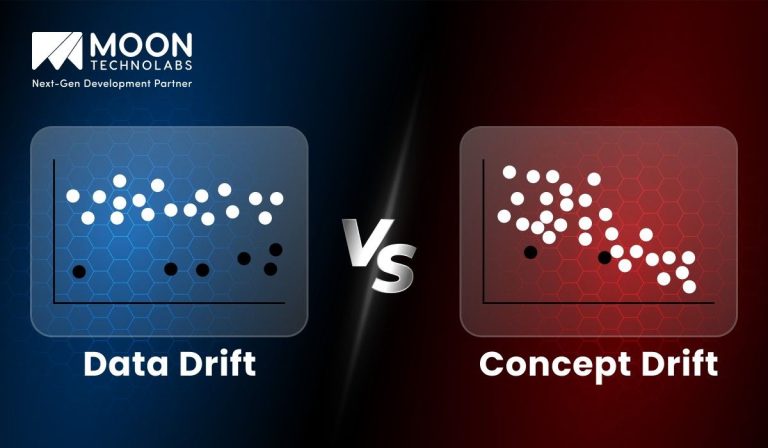
Table of Content


Blog Summary:
Understanding Data Drift Vs Concept Drift is crucial for maintaining reliable machine learning models in real-world environments. As data and patterns evolve, ignoring these shifts can lead to poor predictions and business risks. In this blog, we’ll explore the key differences between data drift vs concept drift, their use cases, detection methods, and how to choose the right strategy for robust model performance.
Table of Content
Machine learning models don’t operate in a vacuum; they exist in dynamic environments where user behavior shifts, markets evolve, and real-world patterns rarely stay constant. A model that performs flawlessly at launch can gradually lose accuracy over time, often without any clear warning signs. This makes it crucial for organizations to not only build high-performing models but also actively monitor them in production.
Understanding how and why models change, detecting subtle shifts in data or behavior, and adapting strategies accordingly are essential steps to ensure sustained accuracy and reliability. Without this ongoing vigilance, even the most sophisticated models can quickly become outdated and less effective in real-world applications.
What is Data Drift?
Data Drift is the change in the statistical properties of data over time, which can negatively affect the performance of machine learning models. It occurs when the distribution of input data in real-world use differs from that of the training data, leading to a mismatch that makes predictions less accurate or unreliable.
Data Drift can happen due to evolving user behavior, seasonal patterns, market shifts, or changes in data collection methods. It may appear as shifts in feature distributions, missing values, or new data patterns. Regular monitoring and detection techniques are essential to identify these changes early, allowing teams to retrain or adjust models so they continue to perform effectively in changing environments, an important practice for any AI development company building reliable machine learning solutions.
Key Benefits of Monitoring Data Drift
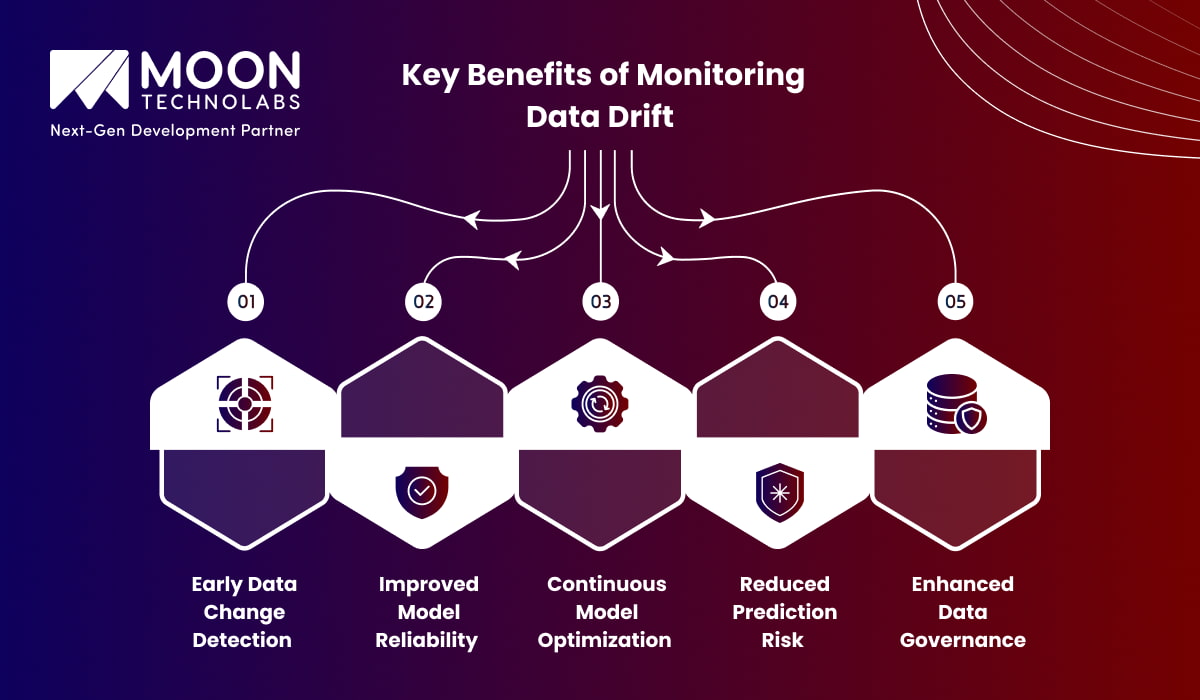
Monitoring data drift is essential for ensuring that machine learning models continue to perform well as real-world data evolves. Over time, changes in data patterns can reduce model accuracy. By continuously tracking these changes, organizations can take timely action to keep models aligned with current data.
Enables Early Detection of Data Changes
Data drift monitoring helps identify shifts in input data at an early stage. This allows teams to respond proactively, whether by retraining models or adjusting parameters, before performance issues become significant.
Improves Model Reliability
Consistent monitoring increases trust in model outputs. When organizations actively track data drift, they can ensure that models behave predictably and deliver reliable results even in changing environments.
Supports Continuous Model Optimization
By analyzing drift patterns and performance metrics, teams can continuously refine and improve their models. This enables a proactive approach to optimization rather than waiting for performance to decline.
Reduces Risk of Incorrect Predictions
Unmonitored data drift can lead to outdated or biased predictions. Regular monitoring minimizes this risk by ensuring models remain relevant and aligned with the latest data trends.
Enhances Data Governance
Data drift monitoring provides greater visibility into data quality and consistency. This supports stronger governance practices, helping organizations maintain compliance, transparency, and better control over their data assets.
Use Cases of Data Drift
Data drift occurs when the statistical properties of input data change over time, causing machine learning models to lose accuracy. Monitoring and handling drift is critical to maintain model performance in real-world applications. Below are key use cases where data drift plays an important role:
Customer Behavior Changes in E-commerce
Customer behavior in e-commerce changes due to trends, seasons, and economic factors. Models trained on past data may become less accurate, making it important to monitor data drift to maintain relevant predictions and personalization.
Fraud Detection Systems
Fraud patterns evolve as attackers change their strategies. This causes data drift, which can reduce the effectiveness of detection models if not updated regularly.
Recommendation Engines
User preferences and content trends shift over time, leading to data drift. Without monitoring, recommendation systems may provide outdated or irrelevant suggestions.
Marketing Campaign Optimization
Customer responses to marketing campaigns change due to market trends and competition. Data drift can reduce campaign effectiveness, necessitating continuous updates.
Demand Forecasting Models
Demand patterns change due to seasonality, trends, and external factors, causing data drift. This can make forecasts inaccurate, leading to overstocking or shortages. Regular monitoring helps maintain accuracy.
Healthcare Data Monitoring
In healthcare, changes in patient data and medical practices can cause drift. Regular monitoring ensures models remain accurate and reliable for decision-making.
We help you continuously monitor, detect, and fix data and concept drift so your AI models stay accurate, reliable, and aligned with real-world changes over time.
What is Concept Drift?
Concept Drift is when the underlying relationship between input data and the target output changes over time, meaning the same data can produce different results than before. Unlike data drift, where only the current data distribution shifts, model drift affects how the model interprets that data, making previously learned patterns less valid.
Concept Drift is common in real-world scenarios where conditions evolve, such as customer behavior, financial markets, or fraud patterns. It can be sudden, gradual, or recurring, and if not handled properly, it can reduce model accuracy. Detecting it early and retraining multiple models with updated data helps maintain reliable and relevant predictions.
Key Benefits of Handling Concept Drift
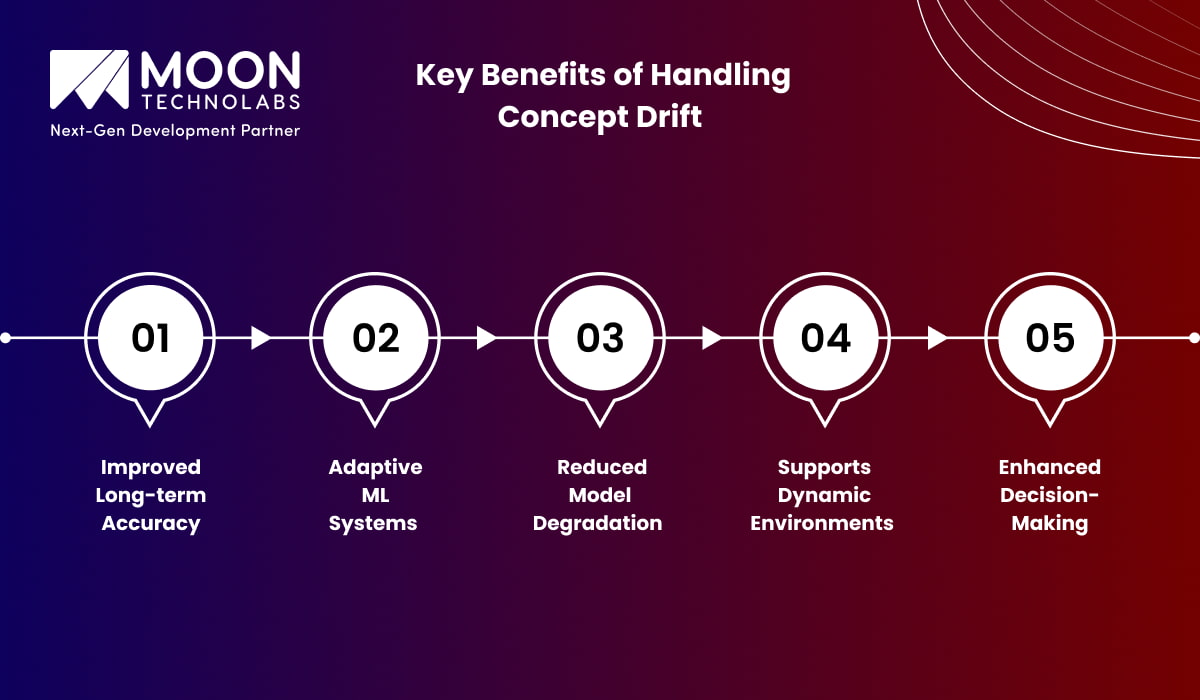
Concept drift refers to changes in data patterns over time, which can make models outdated if not addressed. By handling concept drift, machine learning models stay aligned with current data trends, ensuring they remain useful and accurate in real-world scenarios.
Improves Long-term Prediction Accuracy
When models are updated to reflect new data, they can maintain higher accuracy over time. This prevents the drop in performance that typically occurs when models rely on outdated patterns.
Enables Adaptive Machine Learning Systems
Handling concept drift allows systems to become adaptive. These systems can automatically detect changes in incoming data and adjust their behavior, making them suitable for real-time and evolving environments.
Reduces Model Degradation Over Time
All models degrade if left unchanged while data evolves. Managing concept drift helps slow or prevent this degradation, ensuring consistent performance and reliability.
Supports Dynamic Business Environments
Businesses operate in constantly changing environments. Addressing concept drift enables organizations to quickly adapt to market shifts, customer behavior changes, and new trends.
Enhances Decision-making
Accurate and up-to-date models provide better insights. This leads to more informed decision-making, helping organizations act confidently based on reliable data.
Use Cases of Concept Drift
Concept drift occurs when the statistical properties of data change over time, causing machine learning models to lose accuracy. It is especially relevant in dynamic environments where patterns evolve. Below are key use cases where concept drift plays a critical role:
Financial Market Prediction
Financial markets are highly volatile and influenced by economic events, policies, and global trends. Models trained on historical data may quickly become outdated as market conditions change. Concept drift handling helps update models to adapt to new trends, ensuring more reliable predictions for trading and investment decisions.
Spam Detection Systems
Spam emails continuously evolve as attackers modify their tactics to bypass filters. Words, formats, and patterns used in spam messages change over time. Concept drift techniques allow spam detection systems to adapt to these changes, maintaining high accuracy in identifying unwanted emails.
Credit Scoring Models
Customer financial behavior and economic conditions can shift over time. Concept drift-aware models help financial institutions adjust their scoring systems to reflect current realities, reducing risk and improving lending decisions.
Stock Price Forecasting
Stock prices are influenced by numerous unpredictable factors such as news, investor sentiment, and geopolitical events. As these factors change, the underlying data patterns shift. Concept drift handling ensures forecasting models stay relevant by continuously learning from recent data.
User Behavior Analysis
User preferences and behavior on websites or apps evolve due to trends, seasons, or new features. Recommendation systems and personalization models must adapt to these changes. Concept drift techniques help maintain accurate predictions of user interests and improve user experience.
IoT Sensor Data Analysis
IoT devices generate continuous streams of data from sensors in environments such as manufacturing, healthcare, and smart homes. Sensor behavior may change due to wear and tear, environmental conditions, or calibration issues. Concept drift detection helps identify such changes and ensures models continue to provide accurate insights and anomaly detection.
Data Drift vs Concept Drift: A Detailed Comparison
Here is the detailed comparison between Data Drift and Concept Drift, highlighting how they differ in cause, impact, and handling in machine learning systems:
| Aspect | Data Drift | Concept Drift |
|---|---|---|
| Definition and Core Difference | Refers to changes in the input data distribution over time while the relationship between input and output remains the same. | Refers to changes in the relationship between input features and the target variable, meaning the underlying concept the model learned has changed. |
| Impact on Model Performance | May gradually degrade performance if new data differ significantly from the training data, even if the underlying patterns remain valid. | Often causes significant, sudden drops in performance because the model’s learned patterns are no longer valid. |
| Detection Techniques | Statistical tests such as the Kolmogorov-Smirnov test, the Chi-square test, the population stability index (PSI), and the distribution comparison methods. | Monitoring prediction accuracy, tracking error rates, using drift detection methods like DDM (Drift Detection Method), EDDM, or ADWIN. |
| Adaptation and Mitigation Strategies | Retrain models on updated data and apply data normalization, resampling, or feature-engineering adjustments. | Continuous learning, frequent retraining, online learning models, or adaptive algorithms that adjust to changing relationships. |
| Use Case Differences | Common in scenarios such as seasonal trends, changes in user behavior, or variations in sensor data. | Seen in dynamic environments like fraud detection, market prediction, or customer preferences shifting over time. |
| Monitoring Complexity | Easier to detect because it involves observable shifts in data distributions. | More complex to detect because it requires identifying changes in underlying relationships, not just data. |
When to Choose Data Drift Monitoring?
Data drift monitoring becomes essential when the data your system relies on is no longer consistent with what it was originally trained on or designed for. In such situations, even a well-performing model can start producing unreliable or biased outputs. Below are key scenarios where implementing data drift monitoring is especially important:
Stable Models With Changing Input Data
Even if your model remains unchanged, the data flowing into it may evolve over time. For example, customer behavior, market conditions, or seasonal trends can shift. Monitoring data drift helps detect these subtle changes early, ensuring that the model continues to perform as expected without needing constant retraining.
Data-driven Applications With Frequent Updates
Applications that continuously ingest new data, such as recommendation systems or fraud detection platforms, are particularly vulnerable to drift. Frequent updates can introduce inconsistencies or shifts in data distribution. Data drift monitoring ensures that any deviation is quickly identified and addressed before it impacts system performance.
Systems Requiring Real-Time Data Validation
In systems where decisions must be made instantly, like real-time analytics or automated trading, data quality is critical. Drift monitoring acts as a safeguard by validating incoming data streams in real time, helping prevent incorrect decisions caused by anomalous or unexpected inputs.
Predictive Models Dependent on Input Features
Models that rely heavily on specific input features are sensitive to changes in those features. If the distribution or importance of these features shifts, the model’s predictions can degrade. Monitoring ensures that such feature-level changes are detected and corrected promptly.
Environments With High Data Variability
Industries such as e-commerce, healthcare, and finance often deal with highly dynamic data. External factors like user preferences, regulations, or economic conditions can cause rapid changes. In such environments, data drift monitoring is crucial for maintaining model accuracy and reliability over time.
When to Handle Concept Drift?
Concept drift occurs when the statistical properties of data change over time, causing machine learning models to lose accuracy. Recognizing when to address concept drift is critical for maintaining reliable and effective systems. Below are key scenarios where handling concept drift becomes essential:
Dynamic Business Environments
In fast-changing industries such as e-commerce, finance, and marketing, customer behavior, market trends, and external factors evolve rapidly. Models trained on past data may no longer reflect current realities. Handling concept drift ensures that predictions remain aligned with the latest patterns and business conditions.
Changing Target Variables Over Time
When the relationship between input features and the target variable shifts, models can become outdated. For example, customer preferences or risk factors may change due to new regulations, economic shifts, or societal trends. Detecting and adapting to these changes helps maintain model relevance and accuracy.
Models Requiring Continuous Learning
Certain systems, such as recommendation engines, fraud detection systems, and real-time analytics platforms, operate in continuously evolving environments. These models benefit from ongoing updates and retraining to incorporate new data, making the handling of concept drift a necessary component of their lifecycle.
High-impact Decision-making Systems
In applications where decisions have significant consequences, such as healthcare diagnostics, financial risk assessment, or autonomous systems, model accuracy is critical. Even small performance degradations due to concept drift can lead to serious outcomes, making early detection and correction essential.
Long-Term Predictive Applications
Models deployed for long durations without retraining are particularly vulnerable to drift. Over time, even stable environments can experience gradual changes. Regular monitoring and periodic updates help ensure that long-term predictions remain valid and trustworthy.
We help you detect drift early, understand its impact, and take corrective action – so your models maintain peak performance, accuracy, and reliability over time.
Final Verdict
Both data drift and concept drift are critical challenges that can significantly impact the performance of machine learning models over time. While data drift involves changes in the distribution of input data, concept drift reflects shifts in the underlying relationship between inputs and outputs. Understanding their differences, identifying the right detection methods, and applying appropriate mitigation strategies are essential for building robust and reliable systems. Choosing how to address each type depends on the specific use case, data dynamics, and model requirements, making them a vital consideration in any machine learning development lifecycle.
FAQs
01
What is the main difference between data drift and concept drift?
Data drift refers to changes in the input data distribution over time, while concept drift occurs when the relationship between input data and target outcomes changes. In short, data drift affects “what the model sees,” whereas concept drift affects “how the model interprets it.”02
How do you detect data drift in machine learning models?
Data drift is detected by comparing current data with historical training data using statistical tests such as the KS test, KL divergence, or PSI. Monitoring feature distributions, summary statistics, and visualization tools (e.g., histograms) also helps identify shifts in data patterns over time.03
What are common techniques to handle concept drift?
Common techniques include retraining models with recent data, using online learning, sliding windows, or ensemble methods that adapt over time. Drift detection algorithms such as DDM or ADWIN can trigger updates when performance degrades due to changes in relationships.04
Can data drift and concept drift occur at the same time?
Yes, both can occur simultaneously. Changes in the distribution of input data may coincide with shifts in the relationship between features and the target. This makes detection and mitigation more complex, requiring combined monitoring of data statistics and model performance.05
How often should drift monitoring be performed?
Drift monitoring frequency depends on the application. Critical systems (e.g., finance, healthcare) may require real-time or daily monitoring, while others can use weekly or monthly checks. Continuous monitoring with automated alerts is ideal for maintaining model reliability.




Jayanti Katariya is the CEO of Moon Technolabs, a fast-growing IT solutions provider, with 18+ years of experience in the industry. Passionate about developing creative apps from a young age, he pursued an engineering degree to further this interest. Under his leadership, Moon Technolabs has helped numerous brands establish their online presence and he has also launched an invoicing software that assists businesses to streamline their financial operations.
Submitting the form below will ensure a prompt response from us.
We refine our expertise to deliver innovative business solutions.





205 N Michigan Avenue, #810, Chicago, 60601, Illinois, United States
13500 Long Is Dr, Pflugerville, TX 78660, USA

C/105 Ganesh Meridian, S.G. Highway, Ahmedabad, GJ 380060


Ayse D.
Co-Founder France
“ I highly recommend Moon Technolabs as the quality of service is wonderful. We have hired this company to develop the product based on some complex & technical issues. We get the best quality services as compared with others in the market. Huge Thanks to Moon Technolabs as the team is always ready to give the solution all time.”

Justin G.
Founder & CEO USA
USA“ Moon Technolabs is a pioneer in the WebRTC based project as they have fixed complicated segments of the module by fulfilling different product lines by providing 24X7 customer support. We really recommended Moon Technolabs as they are able to develop products as per the module deadline and project timeline.”

Flavio S.
Founder & Managing Director Germany
“I am happy to recommend Moon Technolabs for their app development services. They successfully developed apps for me, and I am highly satisfied with the overall outcomes. The development team has swiftly addressed the issues with responsive and effective communication to understand the requirement quickly and actively resolve the back-and-forth problems that arose...”

Jay M.
Founder & CEOUSA“Moon Technolabs is the best company that provides advanced apps and websites development services in the USA and Europe. I am a newbie to develop my app with an external team. I am really happy to work with them as I am not that much mobile apps user. Here, the team and specially the CEO of Moon Technolabs helps me to let me know about the benefits of my app to generate revenue....”


Our Offices
India
C/105 Ganesh Meridian,S.G. Highway, Ahmedabad, GJ 380060USA
205 N Michigan Avenue, #810, Chicago, 60601, Illinois, United StatesContact Information


