


Crowdfunding Platform Development: A Complete Business Guide

Software Development Team
Last Updated: Jul 22, 2026 Total Views: 91
Table of Content


Blog Summary:
Crowdfunding platform development enables businesses to connect entrepreneurs with investors to achieve fundraising objectives. This blog explores the entire development process for this platform, including development stages, platform features, costs, technology stack, market trends, monetization strategies, and more.
Table of Content
Many innovative ideas fail not because they lack potential, but because they struggle to secure the funding needed to bring them to life. Another reason is that traditional fundraising methods are often restrictive, slow, and difficult to access. This prompts nonprofits, startups, and businesses to seek digital alternatives.
This is where Crowdfunding Platform Development emerges as the right solution. It allows businesses to connect directly with investors and backers worldwide. Meanwhile, developing this platform is much more than just creating an app or website.
It requires an intuitive user experience, powerful security, regulatory compliance, and smooth payment processing. This blog helps you explore everything related to the fundraising platform’s development process.
What is a Crowdfunding Platform?
A crowdfunding platform is an online marketplace that connects businesses seeking funding for a product, project, cause, etc., with individuals seeking to fund them. Fund providers generally contribute a small amount of money, but together they achieve their funding objective.
Contributors may receive equity, rewards, loan repayment, or just the satisfaction of supporting a cause. On the other hand, the platform is responsible for managing verification, payments, and communication between both parties.
Key Considerations for Crowdfunding Platform Development
Building a crowdfunding platform requires sound decisions across technical, business, and legal areas. Besides, it also involves the following important practices:
Choosing the Right Business Model
You need to decide whether the platform can support donation-based, reward-based, lending, or equity campaigns. It defines various aspects, such as payment schedules, fee models, and levels of regulatory impact, that are involved in the entire process.
Selecting the Technology Stack
Tech stack selection involves choosing both the frontend and the backend. For backend development, you can use React or Next.js, and the tech stack typically includes Python, Node.js, or Ruby on Rails (RoR).
Ensuring Security and Regulatory Compliance
To make your crowdfunding platform highly secure, implement cutting-edge security features such as secure payment processing, KYC/AML verification, and robust data protection practices. A lending model requires full compliance with lending laws.
Building a Scalable Platform Architecture
Whether it’s repeatable payment processes, an event-driven ledger, or reliable webhook handling, they keep the entire system accurate as transaction volume increases. On the other hand, modular services ensure that crucial features such as notifications, search, and analytics scale independently as the platform expands.
Must-have Features of a Crowdfunding Platform
Features are vital factors that significantly contribute to a crowdfunding platform’s success by building trust and increasing conversions. The following are some of those features:
User Registration and KYC Verification
A smooth onboarding process lets creators and donors register hassle-free and in less time, whereas identity verification is essential to check their authenticity. It prevents fraud and is necessary for any lending model in which confirming investor eligibility is essential.
Campaign Creation and Management
A crowdfunding platform should include a user-friendly campaign creation tool for creators, allowing them to add all important details and save their progress. The tool should also allow them to check how the added details appear before final publication.
Secure Payment Gateway Integration
Your crowdfunding platform must include reliable payment gateways, such as Braintree and Stripe, to process donations securely. These payment gateways also allow your app to manage payouts and refunds automatically.
Investor and Backer Dashboard
A single dashboard allows backers to check their contribution history, pledges, manage payment methods, and receive necessary updates on campaigns. It also keeps them updated and confident about how their money is used.
Real-time Fundraising Analytics
With real-time fundraising analytics, creators can easily check backer counts, funds raised, conversion rates, traffic sources, and more. It helps them improve their overall campaign strategy and marketing efforts.
Notifications and Communication Tools
Whether it’s in-app notifications or automated emails, it keeps supporters well informed about every detail of the campaign, including updates, progress, and deadlines. Besides, built-in messaging allows creators to respond to questions rapidly.
Admin Panel and Reporting
An admin panel with built-in reporting allows administrators to thoroughly review their entire campaign and approve it. They can also check for suspicious activity, manage financial records, handle disputes, and use dashboards.
How Do Crowdfunding Platforms Work?
Crowdfunding platforms follow a simple fundraising process to connect campaign creators with potential supporters. Each stage is designed with the core purpose of maintaining security, transparency, and a smooth user experience:
Campaign Creation
The first step is for the creators to set up a campaign page by including important details such as the deadline, funding objective, rewards, etc. To make their campaign compelling, they use videos, images, and an interesting story.
Project Verification
The platform reviews the entire campaign to ensure it complies with policy. And it confirms regulatory eligibility based on numerous factors, including the creator’s identity and the model’s type.
Fund Collection Process
Once the campaign is published, backers donate money via the payment gateway integrated with the platform. Whether the payment will be collected immediately or held until the funding objectives are achieved depends entirely on the funding model.
Payment Distribution
Once a campaign is successful, the collected funds are paid to the creator, except for processing and platform fees. A portion is sometimes also held back to cover potential refunds or chargebacks.
Campaign Monitoring and Reporting
During the entire campaign, both platforms and creators analyze real-time data, including supporter growth, funds raised, and traffic sources. Admins are responsible for checking, resolving disputes, and generating reports for any financial records.
How to Monetize a Crowdfunding Platform?
Crowdfunding platforms are monetized in several ways. You need to select the right one based on your target audience and business model. The following are some of the monetization strategies you can consider implementing.
Platform Service Fees
Many crowdfunding platforms earn revenue by charging a percentage of the funds raised. The platform charge varies between 5% and 8%. The platform earns money through this stream only when creators achieve their major goal of fundraising.
Transaction Fees
Transaction fees and platform fees are completely different. Payment processing fees are charged primarily to cover the full cost of handling bank transfers, credit card payments, fund payouts, and other services through payment gateway providers.
Featured Campaign Listings
Creators generally pay to highlight their campaigns on category pages, the homepage, search results, and similar placements. It enables more people to find the campaign even in its early days while securing the attention and support it requires.
Premium Membership Plans
A crowdfunding platform offers subscription tiers that provide creators with access to cutting-edge tools, including marketing support, detailed analytics, and priority customer service. These churn out recurring and predictable revenue.
Advertising and Sponsorships
A platform that attracts more traffic generally earns revenue by showing ads. Meanwhile, they need to do so carefully to maintain overall trust among backers and ensure campaigns remain highly credible and authentic.
Crowdfunding Platform Market Overview
Crowdfunding is considered most useful for fundraising by nonprofits, startups, businesses, and creators who want to avoid traditional financing. With the growth of digital technologies and online investing, the crowdfunding market worldwide is also expanding rapidly.
Global Crowdfunding Market Growth
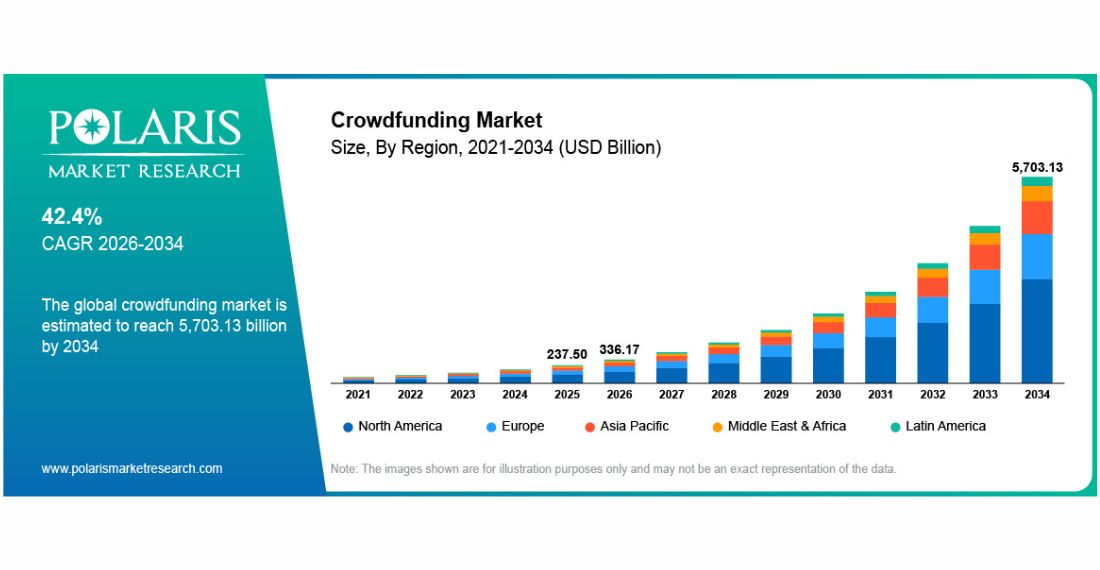
The global crowdfunding market is growing rapidly worldwide. Polaris Market Research reports that the industry is expected to grow at a CAGR of 42.4% from 2026 to 2034. At present, North America leads the market, whereas the Asia-Pacific is projected to witness the fastest growth in the coming years.
Emerging Fundraising Trends
Crowdfunding marketing evolves with models that combine better equity, rewards, investment trading options, etc. A large number of institutional investors enter the market, increasing the average investment amount. Many campaigns are launched with mobile-friendly platforms, whereas digital payment methods are a better choice for contributors.
Industries Driving Crowdfunding Adoption
Donation-based campaigns for social causes have gained vast popularity. But many other industries also drive significant funds, whether it’s small businesses, real estate, or technology. Meanwhile, peer-to-peer lending platforms account for the largest share of crowdfunding activity.
Future Market Opportunities
Regulatory changes are making cross-border participation easier for investors. Meanwhile, tokenized assets and AI in FinTech are redefining the future of crowdfunding platforms through improved analytics, automation, and smarter decision-making.+
Build Your Scalable Crowdfunding Solution
We help you convert your fundraising ideas into scalable, secure, and feature-rich crowdfunding platforms. Let’s launch a solution built for sustainable growth.
Top Crowdfunding Platforms in the Market
The crowdfunding industry market size is driven by many leading platforms that cater to a variety of fundraising models and target audiences. We have outlined some of the popular ones below:
Kickstarter
As one of the most popular reward-based platforms, Kickstarter uses an all-or-nothing funding model. It mainly supports creating projects such as designs, firms, technology projects, and games, in which backers earn rewards.
Indiegogo
Indiegogo offers greater flexibility than Kickstarter by providing both all-or-nothing and keep-what-you-raise funding options. It supports a range of categories, including tech products.
GoFundMe
As one of the trusted donation-based platforms, GoFundMe helps people raise money for personal causes, including emergencies, medical bills, and community needs. It doesn’t support rewards, product sales, equity-based fundraising, or similar activities.
SeedInvest
SeedInvest is one of the oldest and most established leaders in US equity crowdfunding. In 2023, this platform was acquired by StartEngine, and it has operated under the same brand since then.
Crowdcube
Crowdcube is another well-known equity platform based in Europe and the UK — it allows investors to buy shares in both startups and enterprises. It works similarly to Republic and SeedInvest.
Republic
Republic offers investors the opportunity to explore and invest in different sectors, whether accredited or non-accredited. This platform supports token, equity, and real estate crowdfunding.
Stages of Crowdfunding Platform Development
Building a crowdfunding platform requires a clear development approach while focusing on security, user experience, scalability, and compliance. The entire development process involves several steps that are as follows:
Market Research and Requirement Analysis
The entire development process starts with analyzing the competitor landscape, crowdfunding model, audience needs, etc. It involves defining campaign type, regulatory scope, fee structure, features, etc.
UI/UX Design
Designers perform wireframing and prototyping to build trust. They implement a smooth checkout process and work perfectly on mobile devices. They craft pages to encourage more donations.
Backend and Frontend Development
Developers create the core features of platforms, including user accounts, campaign management, and admin panels. They build a front end with an intuitive user interface and a backend to manage business logic, data, APIs, etc and integrate certain core features too.
Payment Gateway and Third-party Integrations
Developers integrate third-party services and payment gateways into the app to process payments, payouts, and refunds smoothly. They also implement analytics tools, email notifications, and KYC/AML verifications.
Testing and Quality Assurance
Thorough testing involves checking for security vulnerabilities, functional accuracy, payment reliability, and other aspects, since financial errors are more costly than typical software bugs. It also includes load testing for traffic surges during campaign journeys.
Deployment and Maintenance
The platform requires regular monitoring, payment tracking, and security updates. Maintenance serves its core purpose of handling increased user volume as the platform grows, improving features, and adapting to changing regulations in response to feedback.
Launch a Secure Fundraising Platform
We help you create a scalable, secure crowdfunding platform that accelerates fundraising. Let us launch your high-performing solutions.
How Long Does it Take to Develop a Crowdfunding Platform?
The development timeline for a crowdfunding platform depends on several factors, such as integrations, feature set, and complexity. Some of these factors are as follows:
MVP Development Timeline
A minimum viable product (MVP) includes only core functionality, such as basic payment processing, campaign creation, and simple user accounts. So, its development timeline ranges from 3 to 5 months.
Full-scale Platform Development Timeline
A feature-rich platform with multi-currency support, analytics, and cutting-edge tools generally takes 6 to 9 months to develop. Lending or equity platforms take an even longer duration due to legal and compliance requirements.
Factors Affecting Development Time
Many factors affect the timeline of a crowdfunding platform, including the payment process, model, custom development, and team size. Apart from this, multi-country compliance and advanced features maximize the development time of such platforms.
Cost of Crowdfunding Platform Development
The cost of developing a crowdfunding platform depends on many factors. These include feature requirements, platform complexity, and the development team’s location. Let’s explore more about cost based on the following factors:
Cost Based on Platform Complexity
Developing a basic MVP with the necessary features costs between $30,000 and $50,000. Developing a mid-complexity platform costs approximately $50,000 to $120,000. On the other hand, a full-scale platform with advanced features costs up to $250,000.
Cost Based on Features
Basic features like campaign management and basic payments are inexpensive to develop. But it can be expensive when you integrate features like verification, KYC/AML, and real-time analytics dashboards.
Cost Based on Technology Stack
Open-source stacks are less costly in licensing terms but require skilled developers. Whether it’s enterprise-grade security software, proprietary tools, or premium third-party services, these options maximize both upfront and ongoing costs.
Cost Based on Development Team Location
Hourly rates vary based on regions. Let’s take a look at developers from different regions and their charges:
| Regions | Charges (hourly) |
|---|---|
| Western Europe and North America | $100 to $200+ |
| Eastern Europe | $40 to $80 |
| South Asia | $20 to $50 |
Benefits of Crowdfunding Platform Development
A crowdfunding platform offers vast opportunities to expand your market reach and unlock long-term business growth through improved operational efficiency. The following are some other benefits.
Access to Global Investors
A robust platform enables startups and creators to maximize their reach among investors and backers worldwide. This access is beneficial for businesses in those areas where traditional funding is limited.
Faster Fundraising Process
Unlike investor funding, crowdfunding platforms allow businesses to raise money rapidly by reaching a large number of potential backers. It prevents them from approaching one by one.
Multiple Revenue Streams
Another advantage of crowdfunding platforms is that they generate revenue from several sources, including transaction fees, success fees, and sponsorships. It also minimizes reliance on campaign volume.
Enhanced Transparency
Be it backer numbers, real-time funding progress, transparent platform fees, or campaign updates, a solid crowdfunding platform displays it all. It improves a platform’s transparency and, in turn, its reliability.
Scalable Business Growth
A platform with a powerful architecture can easily expand into several new countries, industries, and crowdfunding models, including equity crowdfunding. It helps businesses grow step by step without having to rebuild the platform from scratch.
Why Choose Moon Technolabs for Crowdfunding Platform Development?
We specialize in building secure, feature-rich platforms tailored to your unique business model. Our developers create custom apps that deliver an outstanding user experience, right from donation to equity solutions.
We are committed to offering long-term business growth. With vast experience in fintech software development, we deliver high-performing solutions that meet the demands of emerging markets.
Why Partner With Us?
- We build scalable and cloud-ready architecture.
- We craft tailored platforms based on your specific business objectives.
- We integrate advanced payment gateways.
- We do third-party integrations.
- We provide end-to-end development and post-launch support.
- Compliance-based development
Final Thoughts
Building a successful crowdfunding platform is much more than just coding. It requires a perfect business model, regulatory compliance, an airtight payment infrastructure, and features. These earn trust as well.
You can minimize the complexity of the development process with careful planning and by partnering with an experienced provider of custom software development services that can assist you throughout the entire journey.
FAQs
01
How much does crowdfunding platform development cost?
Well, the cost of developing a crowdfunding platform ranges from $30,000 to $2,00,000. It depends on features, platform type, security requirements, payment integration, etc.02
How long does it take to build a crowdfunding platform?
Development of a crowdfunding platform generally takes 3 to 9 months. It also depends on factors such as custom integrations, feature complexity, and payment gateway setup.03
Which crowdfunding model is best for startups?
Reward-based crowdfunding is the best model for startups primarily focused on product launch, whereas equity crowdfunding attracts investors for growth. The best platform depends on your startup's goals.04
What security features should a crowdfunding platform include?
A crowdfunding platform should include a range of security features. These include multi-factor authentication, end-to-end encryption, KYC/AML verification, secure payment gateways, fraud detection, and more.05
Can a crowdfunding platform support multiple currencies and payment gateways?
Yes, a crowdfunding platform supports various currencies and payment gateways. It integrates multiple payment gateways seamlessly, improving user convenience.



The Software Development Team at Moon Technolabs includes experienced developers, solution architects, and technology consultants who contribute content on software engineering, application development, system architecture, and digital innovation. Their articles are based on real-world project experience and aim to help businesses make informed technology decisions.
Submitting the form below will ensure a prompt response from us.
We refine our expertise to deliver innovative business solutions.





205 N Michigan Avenue, #810, Chicago, 60601, Illinois, United States
13500 Long Is Dr, Pflugerville, TX 78660, USA

C/105 Ganesh Meridian, S.G. Highway, Ahmedabad, GJ 380060


Ayse D.
Co-Founder France
“ I highly recommend Moon Technolabs as the quality of service is wonderful. We have hired this company to develop the product based on some complex & technical issues. We get the best quality services as compared with others in the market. Huge Thanks to Moon Technolabs as the team is always ready to give the solution all time.”

Justin G.
Founder & CEO USA
USA“ Moon Technolabs is a pioneer in the WebRTC based project as they have fixed complicated segments of the module by fulfilling different product lines by providing 24X7 customer support. We really recommended Moon Technolabs as they are able to develop products as per the module deadline and project timeline.”

Flavio S.
Founder & Managing Director Germany
“I am happy to recommend Moon Technolabs for their app development services. They successfully developed apps for me, and I am highly satisfied with the overall outcomes. The development team has swiftly addressed the issues with responsive and effective communication to understand the requirement quickly and actively resolve the back-and-forth problems that arose...”

Jay M.
Founder & CEOUSA“Moon Technolabs is the best company that provides advanced apps and websites development services in the USA and Europe. I am a newbie to develop my app with an external team. I am really happy to work with them as I am not that much mobile apps user. Here, the team and specially the CEO of Moon Technolabs helps me to let me know about the benefits of my app to generate revenue....”


Our Offices
India
C/105 Ganesh Meridian,S.G. Highway, Ahmedabad, GJ 380060USA
205 N Michigan Avenue, #810, Chicago, 60601, Illinois, United StatesContact Information


