


Top 8 Benefits of Serverless Computing: Challenges & Best Practices

Jayanti Katariya
Last Updated: April 29, 2026 Total Views: 350
Table of Content


Blog Summary:
Serverless computing lets you build and scale applications without managing infrastructure. It enables cost savings, faster development and automatic scaling. You might face challenges like vendor lock-ins and debugging complexity. By understanding the use cases, benefits, architecture types and best practices, you can make informed decisions and adopt serverless effectively to support business growth.
Table of Content
You are under constant pressure to build faster, scale better, and keep infrastructure costs under control. But your current tech setup seems too heavy. There are numerous servers to manage. Most of your productive hours are spent on maintenance instead of building real features.
That’s where serverless computing helps. It promises flexibility with lower costs and faster deployment. There are no servers to manage, and you pay for what you use.
Before you decide, you must know if it fits all your technology needs. In this blog, we will help you break down what serverless means for your business, how it fits, the risks involved, and the benefits you can expect. By the end of it, you will be able to make a confident architecture decision.
What is Serverless Computing?
Serverless computing is a cloud-based model. Here you can run applications without managing the servers. Cloud providers are responsible for managing the infrastructure, scaling, and maintenance. You just need to write and deploy your code.
Examples of these services include AWS Lambda and Google Cloud Functions. Let’s see how it works. When a user uploads an image, your code processes it automatically. You don’t need to set up or manage servers to complete the process. Similarly, when your user submits a form on the website, the function runs instantly to handle it.
Serverless infrastructure runs the code only when it is needed. It can scale on demand, and you end up paying for the services you actually use, not idle servers. Consequently, you don’t need to manage the resources or handle traffic spikes. This computing approach lets you focus on building features instead of handling infrastructure.
If you want to move forward faster while keeping the operational overhead low, serverless computing is the best approach. It is a flexible way to build and run your applications.
Why are Businesses Adopting Serverless Computing?
Are you wondering why so many businesses are shifting to serverless computing? The answer is simple. This approach solves some of the biggest problems teams face, such as cost, speed, and complexity. Moreover, it gives you a cleaner and more efficient way to build and run applications without facing infrastructure challenges.
Let’s understand how:
- It removes the need to manage servers. You don’t need to worry about provisioning, scaling, or even maintaining infrastructure. This saves time and reduces operational efforts, especially when your team is small and has limited bandwidth. Your developers can focus on writing code and integrating features instead of troubleshooting backend issues.
- You can move faster with the serverless computing approach. It lets you deploy code fast and release updates without going through lengthy setup processes. You shorten the time to market. It can help you respond effectively to shifting user needs and business demands.
- Cost is another major reason most businesses are making this switch. You pay for the services you use. This ensures there are no idle servers running in the background, consuming your budget. As a result, you can control spending, forecast the costs, and eliminate wasted infrastructure expenses.
- Serverless computing also handles scaling automatically. Whether you are experiencing low traffic or sudden spikes, the system will adjust in real-time without manual efforts. You don’t need to predict usage patterns or overprovision resources to prepare for peak loads.
- Lastly, it gives your team flexibility to innovate with confidence. You can test new ideas and launch faster with less risk. This approach is aligned with modern development practices. It lets your team stay productive and competitive in a fast-moving market.
Types of Serverless Architectures
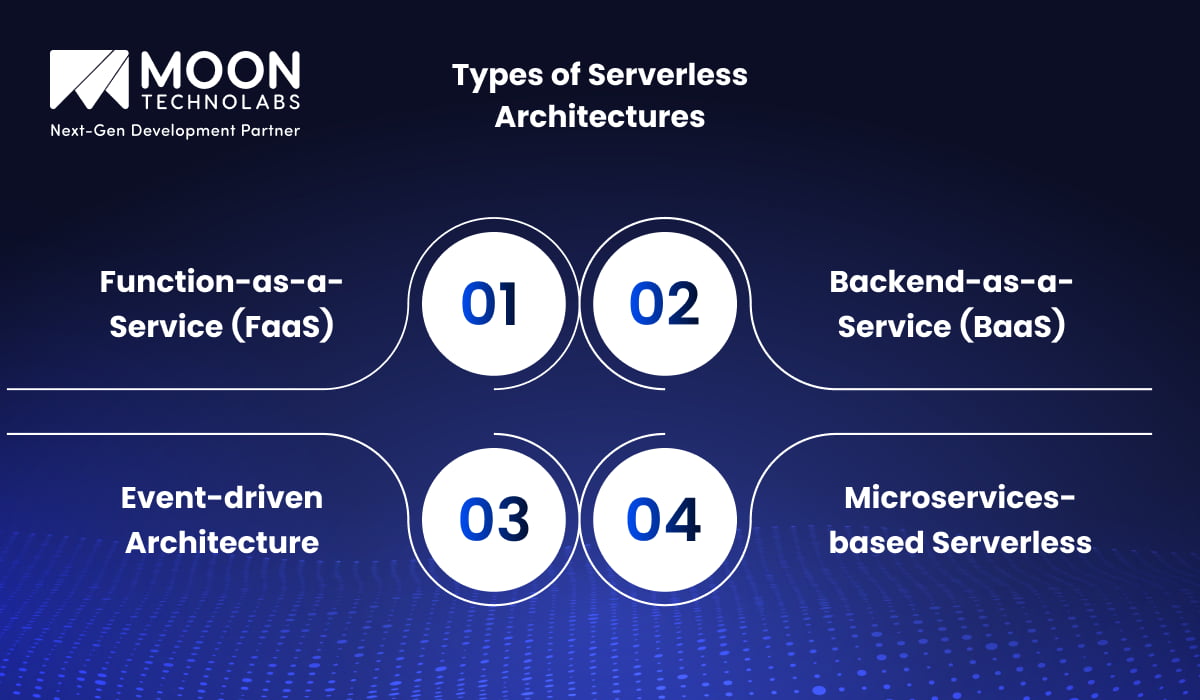
As you plan your move to serverless, understanding different architecture types becomes crucial. Each approach solves a particular problem you might face. It will also help you design scalable, efficient and easy-to-manage systems.
Function-as-a-Service (FaaS)
Function-as-a-Service is a popular and most used serverless model. In this approach, you write a small and single-purpose function that runs only when an event triggers it. It could be an API call or file upload. Your code executes only when needed, helping you avoid unnecessary expenses.
With this approach, you can simplify scaling; each function runs independently on demand. Consequently, this translates into faster deployments and reduced infrastructure issues. It also enhances your ability to build features quickly without managing complex environments or multiple servers.
Backend-as-a-Service (BaaS)
With Backend-as-a-Service serverless architecture, you get pre-built backend services like database, storage, API, and authentication. Instead of building and managing these components yourself, you can connect the application to these managed services directly.
It significantly reduces development time and the efforts involved. This service is useful when you aim to focus on user experience instead of backend logic. It eliminates repetitive tasks, offers quicker launch, and streamlines development processes. You don’t need to worry about scaling or maintaining backend infrastructure components manually with this service.
Event-driven Architecture
An event-driven architecture will respond to specific actions or triggers within your system automatically. For example, when a user signs up or makes a payment, it is treated as an event. This will trigger the corresponding function to execute immediately.
This architecture type will allow your application to react in real-time without constant monitoring. It’s highly efficient for workflows that depend on actions and their responses. You can use this serverless type to build responsive and scalable systems. These systems are also capable of handling unpredictable workloads without increasing the infrastructure complexity.
Microservices-based Serverless
In this serverless architecture type, your application is broken down into smaller and independent services. Each service is responsible for a specific function. You can deploy, update, and even scale these services independently without letting them impact your entire system.
This approach improves flexibility, making it easier for you to manage applications as your business grows. It also supports faster development cycles, as teams can work on separate services simultaneously.
It offers better control, faster updates, and a scalable system that evolves with your business without making it difficult for you to manage or scale.
Selecting the right architecture mix will depend on your product’s needs, traffic patterns observed, and internal team capabilities. By combining different approaches, you build a more flexible, scalable, and future-proof system.
Explore how serverless architecture can reduce costs, improve scalability and speed up development for your business with the right strategies.
Top 8 Business Benefits of Serverless Computing
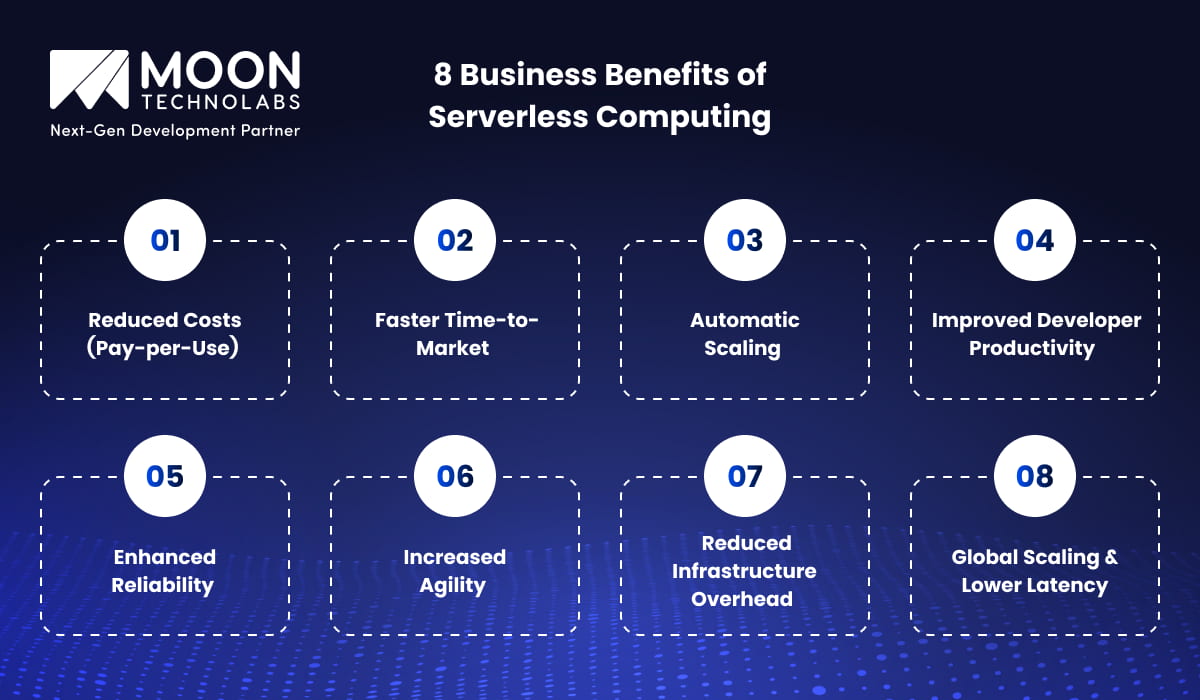
Serverless computing isn’t just about removing servers from your infrastructure overhead. It impacts how you build, scale and even manage your applications. Here are the key business benefits that make serverless a great choice for you:
Reduced Operational Costs (Pay-per-Use)
One of the biggest advantages of adopting serverless computing is cost savings. With serverless, you pay for the actual infrastructure usage. You won’t find idle servers consuming resources in the background with this computing approach.
That makes spending predictable and efficient for your business. This model works best for variable traffic. You don’t need to over-provision or spend unnecessarily on matching the infrastructure. With time, it can lower your operational costs while enabling better performance and scalability.
Faster Time-to-Market (Accelerated Development)
Serverless makes you move faster. As you aren’t managing infrastructure, your team can focus on writing and deploying the code. This will reduce development cycles and accelerate releases. You can test new features, push changes, and even update the app without any delay.
For businesses, this means improving time-to-market and staying ahead of their competition. Faster product delivery also lets you respond to user feedback efficiently. It also improves your users’ experience continuously.
Automatic and Elastic Scaling
Scaling is automatic in a serverless setup. The platform dynamically adapts to demand fluctuations, scaling resources up or down in real time without manual intervention. This means you don’t need to plan for the capacity or configure scaling rules manually.
This approach offers consistent performance at all times, removing the stress of handling peak loads while avoiding downtime risks. Your application can grow seamlessly as demand evolves without planning for additional infrastructure or investing in constant monitoring.
Improved Developer Productivity
By adopting serverless, you focus on building features for the application instead of managing servers. It eliminates repetitive tasks like provisioning, patching and managing infrastructure. Using this computing approach, you can improve the team’s productivity and focus on priority needs.
It simplifies workflows, making development fast and efficient. As there are fewer distractions and operational overheads involved, your team can deliver higher code quality. This helps you bring new ideas to life quickly and consistently over time.
Enhanced Fault Tolerance and Reliability
Serverless is designed to be more resilient. If one function fails, it won’t impact the entire system. That’s because tasks are handled as small and independent units, improving fault tolerance. The cloud providers also manage availability and infrastructure reliability with this approach.
You experience fewer outages and a stable application. It also helps you maintain user trust and ensure your system performs well even when unexpected issues occur in specific components and workloads.
Increased Agility and Innovation
With this approach, you gain the flexibility to experiment and innovate. You can build, test, and even launch new features without heavy planning or infrastructure setup, lowering the barrier to try new ideas. If an idea works, you can scale it quickly. If not, you can adjust the infrastructure without facing losses.
It helps you build a culture of innovation, allowing you to adapt faster to the evolving needs and customer expectations.
Reduced Infrastructure Management Overhead
You need both time and resources to manage infrastructure. Serverless removes the burden of management. You don’t need to handle server maintenance, updates, or even monitoring as the cloud provider takes care of it.
This allows your team to focus on strategic tasks instead of operational aspects. It also reduces the need for you to hire dedicated infrastructure management roles. It makes your operations leaner and more efficient.
Global Scaling and Reduced Latency
Serverless platforms are built with global cloud networks. It allows your application to run closer to users across regions. That’s why you can deliver faster response times with exceptional
user experiences. Scaling globally becomes easier without the need to set up multiple servers or regions manually. It lets you reach a wider audience while maintaining performance and reliability.
We convert your unique idea into a high-grade mental health software. Partner with us to allow our developers to create a scalable, secure, and engaging app.
Industry Use Cases of Serverless Computing
Serverless computing is no longer another abstract concept. It is being used across industries to solve real business problems efficiently. Here are common use cases that deliver strong value:
Real-time Data Processing Pipelines
If your application handles continuous data, serverless can process it instantly. For instance, user activity or payments can trigger specific functions in real time. This helps analyze data faster and act on insights without building complex data systems from scratch.
Media Processing
Serverless can simplify workflows for applications that deal with images, videos, and audio files. Whenever any user uploads a file with images or videos, the serverless app can resize, compress, and convert it as needed. You don’t need separate servers for this task. Everything runs only when needed, saving you both time and cost.
API and Web App Backends
You can also use this approach to build APIs and backend systems for your application. Each user request triggers the function that is used to process data and send responses. This will make your application scalable and efficient. You will find this useful when traffic is unpredictable or growing.
AI/ML Inference
In the case of Machine Learning, serverless lets you run models only when you need them. Whether you are running a recommendations or a predictions engine, it lets you process requests instantly. You don’t need to keep the entire infrastructure running.
Scheduled Tasks and Automation
You can automate tasks like reports and backups, even notifications, easily with serverless architecture. It lets you schedule all these application features without managing servers. Eventually, it makes operations simple and reliable.
5 Common Serverless Computing Challenges & Risks
Serverless offers clear benefits. However, you must also note the challenges before adopting this infrastructure. Knowing these risks early helps you plan better, avoiding unexpected issues as your system grows:
Vendor Lock-in Risks
When you work with a specific cloud provider, your application becomes dependent on them for tools and services. Switching to another provider can be difficult, time-consuming, and costly. This will limit your flexibility if pricing or performance needs change with time.
Cold Start Latency
Serverless functions don’t run continuously. If a function has been idle for a while, it may take time to start once triggered. This delay is known as a cold start. In the case of user-facing apps, even small delays can impact their experience and cause performance issues.
Monitoring & Debugging Issues
Serverless systems are distributed across multiple functions and services. Tracking errors and performance can become complex eventually. You don’t have complete visibility into the system. This can slow down debugging and issue resolution for your team.
Security Concerns
Cloud providers will manage infrastructure security, and you are responsible for the application’s security. Misconfigured permissions with weak access controls can increase risks. That’s why you must manage the roles, access, and data protection to avoid vulnerabilities.
Integration Complexity
Serverless apps depend on multiple services that work together. Ensuring a smooth connection between these services can become complex. You must manage integrations and dependencies through careful planning as your system grows to maintain stability and performance.
5 Best Practices for Successful Serverless Adoption
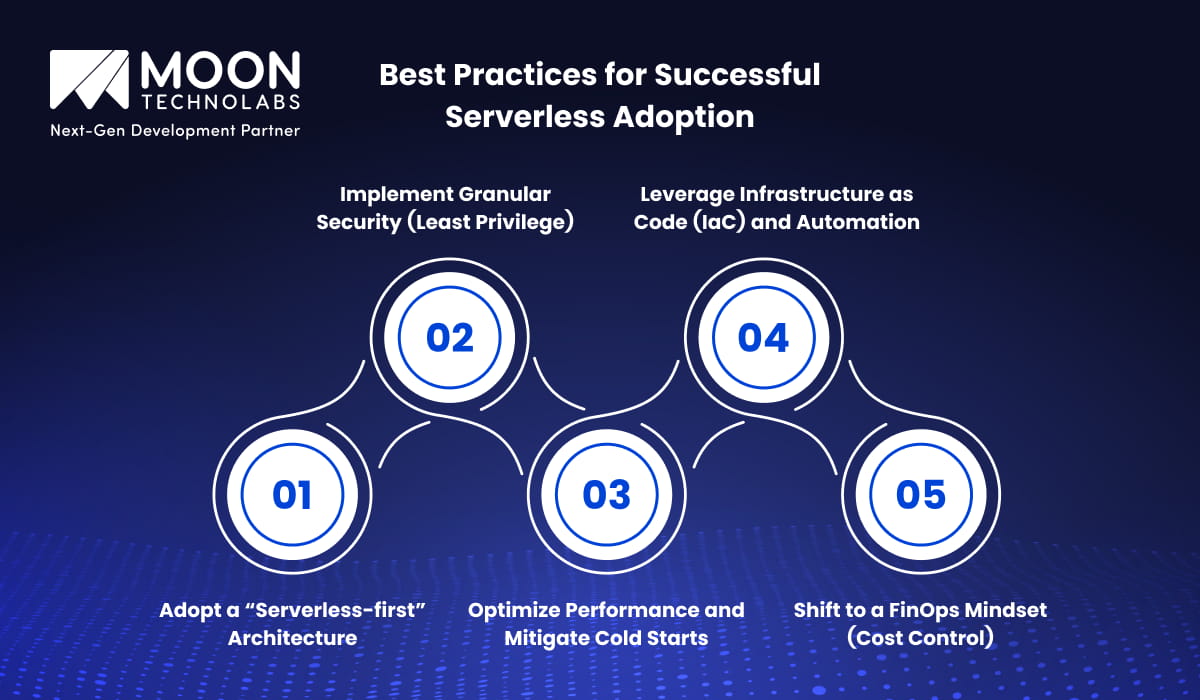
The real value you gain from serverless depends on how you implement it. A few smart decisions in the early stages can help avoid issues, improve performance, and offer cost control:
Adopt a “Serverless-first” Architecture
Start by thinking serverless from the start. You should begin by designing an application that aligns with the serverless principles. Break down your features into small functions, and use managed services wherever possible. You can benefit from the architecture’s scalability and simplicity with this approach.
Implement Granular Security (Least Privilege)
Security should be your priority. You should give each function the permission it needs to perform the specific task assigned. Avoid offering broad access rights. This way, you can reduce risks and limit damage in case something goes wrong. With a controlled setup, you can keep the systems safe.
Optimize Performance and Mitigate Cold Starts
Plan for performance early in the setup and development. Keep your functions lightweight and efficient while reducing dependencies and optimizing execution time. For critical workflows, you must use strategies like keeping functions warm and choosing the right runtime to avoid a cold start.
Leverage Infrastructure as Code (IaC) and Automation
Managing serverless manually can be quite complex. You can use infrastructure-as-a-code tools to define and manage your setup. It will also automate deployments and updates, making your system consistent and reducing errors.
Shift to a FinOps Mindset (Cost Control)
The pricing of serverless architecture depends on your usage. That’s why you should monitor and optimize costs regularly. Track each function’s usage, unused resources, and the budgets. This will help you stay efficient even when scaling the application, letting you gain long-term value.
Wrap Up
Serverless computing is a powerful way to build, scale, and manage your applications with no complexity. However, the real advantage comes when you apply it thoughtfully. From choosing the right architecture and following the best practices to understanding the risks, you should be aware of them while implementing.
If you are planning to move to serverless or optimize your current setup, the right guidance can make the difference. Moon Technolabs can help you with that. With our experience in building scalable and cloud-native app solutions, our team can guide you through strategy, architecture and implementation.
Connect with our teams to build a system that supports your long-term goals.
FAQs
01
Is serverless better than Kubernetes?
Serverless may not always be better than Kubernetes. The choice between the two will depend on your needs. Serverless is best for simple and event-driven workloads. Kubernetes is best for complex, long-running and customizable applications.02
What is an example of serverless computing in real life?
A common example of serverless computing is image processing. When your user uploads a photo, the serverless function automatically resizes or compresses it even in the absence of a dedicated server running continuously.03
What are the types of serverless computing?
The main types of serverless computing include Function-as-a-Service, Backend-as-a-Service, event-driven architecture and microservices-based serverless architecture. Each type supports a different application requirement and use case.04
Is serverless just cloud?
Serverless is part of cloud computing. However, the two are not the same. Serverless focuses on running code without managing servers, while cloud prioritizes broader services like storage, networking and infrastructure.05
What are the downsides of serverless?
Serverless comes with challenges like vendor lock-in, cold start delays and potential risks if permissions or configurations are not managed properly.




Jayanti Katariya is the CEO of Moon Technolabs, a fast-growing IT solutions provider, with 18+ years of experience in the industry. Passionate about developing creative apps from a young age, he pursued an engineering degree to further this interest. Under his leadership, Moon Technolabs has helped numerous brands establish their online presence and he has also launched an invoicing software that assists businesses to streamline their financial operations.
Submitting the form below will ensure a prompt response from us.
We refine our expertise to deliver innovative business solutions.





205 N Michigan Avenue, #810, Chicago, 60601, Illinois, United States
13500 Long Is Dr, Pflugerville, TX 78660, USA

C/105 Ganesh Meridian, S.G. Highway, Ahmedabad, GJ 380060


Ayse D.
Co-Founder France
“ I highly recommend Moon Technolabs as the quality of service is wonderful. We have hired this company to develop the product based on some complex & technical issues. We get the best quality services as compared with others in the market. Huge Thanks to Moon Technolabs as the team is always ready to give the solution all time.”

Justin G.
Founder & CEO USA
USA“ Moon Technolabs is a pioneer in the WebRTC based project as they have fixed complicated segments of the module by fulfilling different product lines by providing 24X7 customer support. We really recommended Moon Technolabs as they are able to develop products as per the module deadline and project timeline.”

Flavio S.
Founder & Managing Director Germany
“I am happy to recommend Moon Technolabs for their app development services. They successfully developed apps for me, and I am highly satisfied with the overall outcomes. The development team has swiftly addressed the issues with responsive and effective communication to understand the requirement quickly and actively resolve the back-and-forth problems that arose...”

Jay M.
Founder & CEOUSA“Moon Technolabs is the best company that provides advanced apps and websites development services in the USA and Europe. I am a newbie to develop my app with an external team. I am really happy to work with them as I am not that much mobile apps user. Here, the team and specially the CEO of Moon Technolabs helps me to let me know about the benefits of my app to generate revenue....”


Our Offices
India
C/105 Ganesh Meridian,S.G. Highway, Ahmedabad, GJ 380060USA
205 N Michigan Avenue, #810, Chicago, 60601, Illinois, United StatesContact Information


