


A Complete Guide to B2B Portal Development

Web Development Team
Last Updated: Aug 13, 2026 Total Views: 133
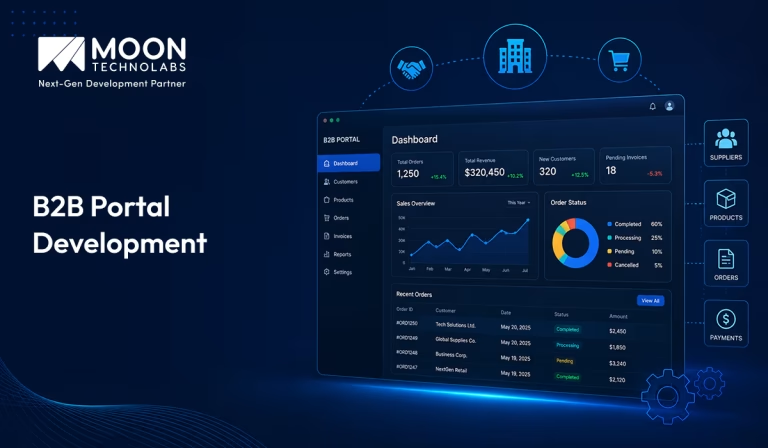
Table of Content


Blog Summary:
B2B portal development helps businesses simplify complex transactions by consolidating purchasing, sales, and account management into a single platform. From custom pricing and bulk ordering to role-based access, order management, and ERP or CRM integrations, these portals improve efficiency and reduce manual work. This blog explores essential B2B portal features, development considerations, and the benefits for growing businesses.
Table of Content
B2B transactions are rarely as simple as a standard online purchase. Businesses often deal with custom pricing, bulk orders, multiple users, approval workflows, recurring purchases, and complex payment terms. A B2B portal brings these processes together on a single platform, giving buyers and sellers a more organized way to manage day-to-day transactions.
With features such as account-based pricing, product catalogs, order management, role-based access, and integrations with ERP or CRM systems, a B2B portal can reduce manual processes while making business operations easier to manage. In this blog, we’ll explore the key aspects of B2B portal development, from essential features and development considerations to the benefits it can offer growing businesses.
What is B2B Portal Development?
A B2B (Business-to-Business) portal is a digital platform that enables businesses to connect, communicate, and conduct transactions efficiently. It provides a centralized space where manufacturers, suppliers, distributors, and customers can manage their business operations online.
B2B web portal development involves designing and building a secure, scalable platform with features such as product catalogs, order management, customer accounts, payment integration, inventory tracking, and real-time communication. The goal is to simplify business processes and improve collaboration between companies.
A well-developed B2B web portal enhances operational efficiency, reduces manual work, and delivers a seamless user experience. It also helps businesses strengthen customer relationships, increase sales, and support long-term business growth through digital transformation.
B2B Portal Market Trends and Statistics
The B2B portal market is evolving as businesses prioritize digital commerce, automation, and personalized customer experiences. The following market trends and statistics highlight this growing shift:
- The global B2B e-commerce market is projected to grow from USD 21.22 trillion in 2024 to approximately USD 102.01 trillion by 2034, registering a 17% CAGR from 2025 to 2034. The rising adoption of digital procurement and online business transactions drives this growth.
- 73% of B2B buyers are comfortable placing orders worth up to $50,000 online.
- In 2025, 80% of all B2B sales interactions occurred online, and B2B eCommerce in the U.S. is now projected to surpass $3 trillion by 2027.
- As B2B companies increasingly prioritize convenient digital purchasing, buyer preferences are shifting toward self-service. Gartner reports that 61% of B2B buyers favor a rep-free buying experience, highlighting the growing demand for efficient, user-driven B2B web portals.
- According to McKinsey, 71% of B2B companies now offer e-commerce, and among those companies, roughly one-third of revenue comes through digital channels.
- More than half of B2B purchases worth $1 million or more were moved through digital self-service channels in 2025.
Why Do Businesses Need a Custom B2B Portal?
Here are the key reasons businesses need a custom B2B portal to simplify operations, improve customer experiences, accelerate order processing, and strengthen collaboration across their business network:
Simplified Business Operations
A custom B2B portal automates routine tasks such as order management, inventory tracking, invoicing, and document sharing. By centralizing these processes on a single secure platform, businesses can reduce manual work, eliminate errors, and improve overall productivity. Employees spend less time on administrative tasks and more time focusing on strategic growth.
Improved Customer Experience
Business customers expect quick access to products, pricing, order history, invoices, and support. A custom B2B portal provides a personalized self-service experience where customers can place orders, track shipments, download documents, and manage their accounts at any time. This convenience improves customer satisfaction, strengthens relationships, and encourages long-term loyalty.
Faster Order Processing
With automated workflows and real-time inventory visibility, a custom B2B portal speeds up the entire order lifecycle. Customers can place orders instantly, while sales teams receive accurate information without manual intervention. Faster processing reduces delays, improves order accuracy, and ensures timely deliveries, leading to better operational efficiency.
Better Business Collaboration
A custom B2B portal creates a centralized communication hub for businesses, suppliers, distributors, and partners. Teams can securely share documents, track project updates, manage approvals, and communicate in real time. Improved collaboration enhances transparency, accelerates decision-making, and helps build stronger, more productive business partnerships.
Power Your Business With Next-Generation B2B Solutions
Enhance collaboration, automate workflows, and simplify transactions with a feature-rich B2B portal designed for modern business needs.
Must-have Features of a B2B Portal
Here are the essential features a B2B portal should include to simplify purchasing, streamline workflows, improve account management, and create a seamless experience for business customers:
Secure User Authentication
Protect sensitive business data with robust authentication mechanisms, including secure login, multi-factor authentication (MFA), and encrypted user credentials. Ensure only authorized users can access your B2B portal while maintaining compliance with industry security standards.
Role-based Access
Assign customized permissions based on user roles such as administrators, sales representatives, distributors, and buyers. Role-based access ensures that every user can view, edit, or manage only the information relevant to their responsibilities, improving security and operational efficiency.
Product Catalog Management
Manage your entire product inventory from a centralized dashboard. Easily organize categories, upload product information, update specifications, manage stock availability, and showcase high-quality images, ensuring customers always have access to accurate and up-to-date product details.
Dynamic Pricing
Deliver personalized pricing based on customer groups, order volume, contracts, or geographic regions. Dynamic pricing helps businesses offer negotiated rates, promotional discounts, and customer-specific price lists, creating a more flexible and competitive buying experience.
Order Management
Streamline the complete order lifecycle from order placement to fulfillment. Track order status in real time, manage approvals, process invoices, monitor shipments, and handle returns efficiently, enabling faster operations and improved customer satisfaction.
Inventory Tracking
Maintain real-time visibility into inventory levels across warehouses, locations, and distribution centers. Track stock availability, monitor low-stock alerts, manage reserved inventory, and optimize replenishment to prevent stockouts or overstocking. Accurate inventory tracking helps businesses fulfill orders efficiently while improving overall supply chain management.
CRM Integration
Connect your B2B portal with a CRM system to centralize customer information, interactions, sales activities, and account history. CRM integration enables sales teams to access customer data, track leads and opportunities, manage communications, and provide personalized service directly through the portal, creating a more connected and efficient customer experience.
ERP Integration
Integrate the B2B portal with your ERP system to synchronize essential business operations, including products, inventory, pricing, orders, customers, invoicing, and fulfillment. Real-time data synchronization reduces manual data entry, minimizes errors, and ensures that teams across sales, finance, operations, and supply chain always work with accurate information.
Payment Gateway Integration
Enable secure and convenient online payments by integrating trusted payment gateways that support multiple payment methods. Businesses can process credit and debit cards, bank transfers, digital wallets, and other payment options while securely managing transactions, payment confirmations, refunds, and invoices. Flexible payment capabilities make it easier for B2B customers to complete purchases and manage their accounts.
Different Types of B2B Portals
B2B portals are designed to support different business relationships, workflows, and customer requirements across industries. Each type serves a specific purpose and offers tailored functionalities for its users. Here are the different types of B2B portals:
Customer Self-service Portal
This type of portal enables business customers to access products, services, and account information without needing direct assistance from the sales or support team. It improves customer satisfaction by offering 24/7 access to essential business functions.
Key Features:
- Product catalog and online ordering
- Order tracking and purchase history
- Invoice and payment management
- Support ticket submission and tracking
- Account and profile management
Vendor and Supplier Portal
It streamlines communication and collaboration between a business and its suppliers. It helps manage procurement processes, purchase orders, inventory updates, and payments from a centralized platform.
Key Features:
- Purchase order management
- Supplier onboarding and registration
- Inventory and stock updates
- Invoice submission and payment tracking
- Document and contract management
Dealer and Distributor Portal
A dealer and distributor portal helps manufacturers efficiently manage their dealer and distributor network. It provides easy access to product information, pricing, marketing resources, and sales performance reports.
Key Features:
- Dealer-specific pricing and catalogs
- Order placement and shipment tracking
- Sales reports and performance dashboards
- Marketing materials and product documentation
- Warranty and service request management
B2B Marketplace Portal
It is a digital platform where multiple suppliers and business buyers can connect, negotiate, and conduct business transactions. It simplifies procurement by offering a centralized marketplace with multiple vendors and products.
Key Features:
- Multi-vendor product listings
- RFQ (Request for Quotation) management
- Secure payment processing
- Bulk ordering and pricing
- Ratings, reviews, and supplier verification
Partner Collaboration Portal
A partner collaboration portal is designed to strengthen relationships between businesses and their strategic partners. It enables seamless collaboration by providing shared access to projects, resources, communication tools, and business insights.
Key Features:
- Shared document and file management
- Project and task collaboration
- Lead sharing and opportunity management
- Training resources and certifications
- Communication tools and performance analytics
You Might Also Like:
Benefits of B2B Portal Development
B2B portal development helps businesses streamline processes, improve customer interactions, reduce operational complexity, and create more efficient digital workflows. Here are the key benefits of B2B portal development that you need to know:
Increased Operational Efficiency
A B2B portal automates routine business processes such as order management, inventory tracking, invoicing, and customer communication. This reduces manual work, eliminates errors, and enables employees to focus on higher-value tasks, resulting in faster and more efficient operations.
Enhanced Customer Satisfaction
A B2B portal provides customers with 24/7 access to product catalogs, pricing, order tracking, and quick issue resolution, improving the overall customer experience and strengthening business relationships.
Centralized Data Management
All business information, including customer details, product data, transactions, and inventory records, is stored in a single centralized platform. This ensures business data consistency, improves accessibility, and simplifies collaboration across different departments.
Reduced Operational Costs
By automating repetitive tasks and reducing paperwork, a B2B portal lowers administrative and operational expenses. It also decreases the need for manual data entry and minimizes costly errors, helping businesses save both time and money.
Better Decision-making with Data Analytics
B2B portals offer analytics and reporting tools that provide insights into sales performance, customer behavior, inventory levels, and market trends. These insights help businesses make informed decisions, optimize strategies, and identify new growth opportunities.
Easy Business Scalability
As a business grows, a B2B portal can easily accommodate more customers, products, suppliers, and transactions. Its flexible architecture supports expansion without requiring significant changes to existing processes, making it ideal for long-term business growth.
B2B Portal Development Process
Developing a B2B portal involves several strategic steps to ensure the platform aligns with business goals and delivers reliable functionality. Here are the main stages of the B2B portal development process:
Business Requirement Analysis
A detailed analysis is conducted to understand business goals, target business users, operational workflows, and functional requirements. This phase helps define the project scope, identify key features, and establish a clear development roadmap.
UI/UX Design and Prototyping
User-centric interfaces and interactive prototypes are designed to visualize the portal’s structure and functionality. Wireframes and mockups are created to validate the user journey and ensure an intuitive, engaging experience before development begins.
Portal Development
The portal is developed using modern technologies with a focus on security, scalability, and performance. Core features such as user management, product catalogs, order processing, dashboards, reporting, role-based access, and workflow automation are implemented in line with business requirements.
Third-party Integrations
The portal is integrated with essential business systems, including ERP, CRM, payment gateways, accounting software, inventory management platforms, logistics providers, and communication tools. These integrations streamline operations, improve data consistency, and automate business processes.
Testing and Ongoing Support
Comprehensive testing is performed to verify functionality, security, performance, compatibility, and usability before deployment. After launch, ongoing maintenance, performance optimization, security updates, bug fixes, and feature enhancements help ensure the portal remains reliable, secure, and aligned with evolving business needs.
Essential Integrations for a B2B Portal
A well-connected B2B portal brings together the essential systems and tools businesses rely on, enabling smoother data flow, automated processes, and more efficient day-to-day operations. Key integrations include:
CRM Integration
Integrate your B2B portal with a CRM system to centralize customer information, manage leads, track sales activities, and automate follow-ups. This improves customer relationships, enhances sales productivity, and delivers a more personalized buying experience.
ERP Integration
Connect your portal with an ERP system to synchronize orders, inventory, procurement, finance, and customer data. This eliminates manual data entry, improves operational accuracy, and enables seamless business processes across departments.
Payment Gateway Integration
Enable secure and hassle-free online payments by integrating trusted payment gateways. Support multiple payment methods, automate payment confirmations, and provide customers with a fast, reliable, and convenient checkout experience.
Inventory and Warehouse Management
It provides real-time stock visibility, automates inventory updates, and streamlines order fulfillment. This helps reduce stock discrepancies, improve warehouse efficiency, and ensure timely deliveries.
Business Intelligence and Analytics Tools
Connect BI and analytics platforms to gain valuable insights into sales performance, customer behavior, inventory trends, and business operations. Interactive dashboards and real-time reports help businesses make informed, data-driven decisions.
How Much Does B2B Portal Development Cost?
A basic B2B portal can cost around $10,000–$25,000, while a mid-level solution with custom workflows, advanced user roles, integrations, and order management may range from $20,000–$50,000. More complex enterprise B2B portals with extensive customization, ERP/CRM integration, automation, and advanced security can cost $60,000–$100,000+.
The final cost depends on factors such as the number of features, level of customization, UI/UX requirements, third-party integrations, technology stack, and development team location. For example, adding real-time inventory synchronization, customer-specific pricing, multi-level approvals, or automated workflows can significantly increase development effort.
For businesses planning a B2B portal, it’s better to define the required features and integrations before setting a budget. This helps development teams provide a more accurate estimate and prevents unexpected costs as the project progresses.
Take Your B2B Operations to the Next Level
Modernize your business processes with a custom B2B portal that connects teams, customers, systems, and workflows efficiently.
Emerging Trends Shaping the Future of B2B Portal Development
B2B portal development is evolving rapidly as businesses adopt smarter technologies, personalized experiences, and connected digital ecosystems. The following trends are shaping the future of B2B portal development:
AI-powered Personalization
AI is making B2B portals more personalized by analyzing user behavior, purchase history, and preferences to deliver relevant product recommendations, pricing, and content. This improves customer engagement, enhances user experience, and drives higher conversions.
Generative AI for Customer Support
It enables B2B portals to provide instant, 24/7 customer support through intelligent chatbots and virtual assistants. It handles routine queries, offers personalized assistance, and reduces response times, allowing support teams to focus on complex issues.
Predictive Analytics
Predictive analytics helps businesses forecast demand, identify sales opportunities, and optimize inventory by analyzing historical and real-time data. These insights support better decision-making and improve operational efficiency.
IoT-enabled Business Operations
It allows B2B portals to monitor inventory, equipment, and supply chain operations in real time. This improves visibility, reduces downtime, and helps businesses streamline operations and increase productivity.
Low-code and No-code Integrations
These platforms simplify B2B portal development by enabling faster integrations and workflow automation with minimal coding. This helps businesses reduce development time, lower costs, and quickly adapt to changing needs.
Why Choose Moon Technolabs for B2B Portal Development?
We focus on building B2B portals around the way businesses actually operate. Whether you need customer-specific pricing, bulk ordering, multi-level approvals, vendor management, subscription-based purchases, or ERP/CRM integrations, our team can tailor the portal to your existing workflows rather than forcing your business into a standard setup.
This helps build a web portal that is practical for both internal teams and business customers.
Beyond development, we can support the portal through customization, integration, testing, deployment, and ongoing improvements. The focus is on creating a solution that can scale with growing user and transaction volumes and business requirements while keeping everyday operations simple.
This makes it easier for businesses to move away from manual processes and manage B2B transactions through a centralized digital platform.
Conclusion
A well-designed B2B portal can simplify complex business processes, improve customer interactions, and create a more efficient way to manage orders, products, pricing, and accounts. As business requirements grow, choosing the right technology, features, integrations, and scalability strategy becomes equally important.
Working with an experienced web portal development company can help businesses build a secure, flexible, and user-friendly portal that aligns with their specific workflows and long-term goals. The right B2B portal is not just a digital platform; it can become an important part of how a business operates and grows.
FAQs
01
What are some examples of B2B portals?
Popular B2B portals include Alibaba, IndiaMART, Amazon Business, SAP Ariba, and Udaan. These platforms connect manufacturers, wholesalers, distributors, and retailers, enabling bulk purchasing, supplier management, product listings, and streamlined procurement. Industry-specific B2B portals also serve sectors like healthcare, manufacturing, and construction.02
How much does a B2B portal development cost?
The cost of developing a B2B portal depends on its features, design, integrations, and complexity. A basic portal may cost a few thousand dollars, while enterprise-grade solutions with custom workflows, ERP integration, analytics, and advanced security can require significantly higher investments and ongoing maintenance.03
Is Walmart a B2B company?
Walmart primarily operates as a B2C retailer, serving individual consumers through its stores and online platform. However, it also offers B2B services through Walmart Business, providing organizations with bulk purchasing, business supplies, and procurement solutions. Therefore, Walmart serves both B2C and B2B markets.04
How to develop a B2B strategy?
Developing a successful B2B strategy starts with identifying your target audience and understanding their business needs. Create a strong value proposition, build relationships through personalized marketing, optimize digital channels, leverage data analytics, and continuously refine your approach based on customer feedback and market trends.05
Is Amazon a B2C or B2B?
Amazon operates as both a B2C and B2B company. Its primary marketplace serves individual consumers, while Amazon Business caters to organizations with features like bulk ordering, business pricing, tax exemptions, and procurement tools. This dual approach allows Amazon to meet diverse customer and business purchasing needs.



Explore modern web development technologies, frameworks, and methodologies for building secure, scalable, and high-performing websites and web applications. Learn about frontend, backend, APIs, architecture, performance optimization, and emerging web development trends. Stay informed about the tools and practices shaping the future of web development.
Submitting the form below will ensure a prompt response from us.
We refine our expertise to deliver innovative business solutions.





205 N Michigan Avenue, #810, Chicago, 60601, Illinois, United States
13500 Long Is Dr, Pflugerville, TX 78660, USA

C/105 Ganesh Meridian, S.G. Highway, Ahmedabad, GJ 380060




Ayse D.
Co-Founder France
“ I highly recommend Moon Technolabs as the quality of service is wonderful. We have hired this company to develop the product based on some complex & technical issues. We get the best quality services as compared with others in the market. Huge Thanks to Moon Technolabs as the team is always ready to give the solution all time.”

Justin G.
Founder & CEO USA
“ Moon Technolabs is a pioneer in the WebRTC based project as they have fixed complicated segments of the module by fulfilling different product lines by providing 24X7 customer support. We really recommended Moon Technolabs as they are able to develop products as per the module deadline and project timeline.”

Flavio S.
Founder & Managing Director Germany
“I am happy to recommend Moon Technolabs for their app development services. They successfully developed apps for me, and I am highly satisfied with the overall outcomes. The development team has swiftly addressed the issues with responsive and effective communication to understand the requirement quickly and actively resolve the back-and-forth problems that arose...”

Jay M.
Founder & CEOUSA“Moon Technolabs is the best company that provides advanced apps and websites development services in the USA and Europe. I am a newbie to develop my app with an external team. I am really happy to work with them as I am not that much mobile apps user. Here, the team and specially the CEO of Moon Technolabs helps me to let me know about the benefits of my app to generate revenue....”


Our Offices
India
C/105 Ganesh Meridian,S.G. Highway, Ahmedabad, GJ 380060USA
205 N Michigan Avenue, #810, Chicago, 60601, Illinois, United StatesContact Information


