


AR in Banking: Transforming Financial Services with Augmented Reality

Jayanti Katariya
Last Updated: May 22, 2026 Total Views: 85
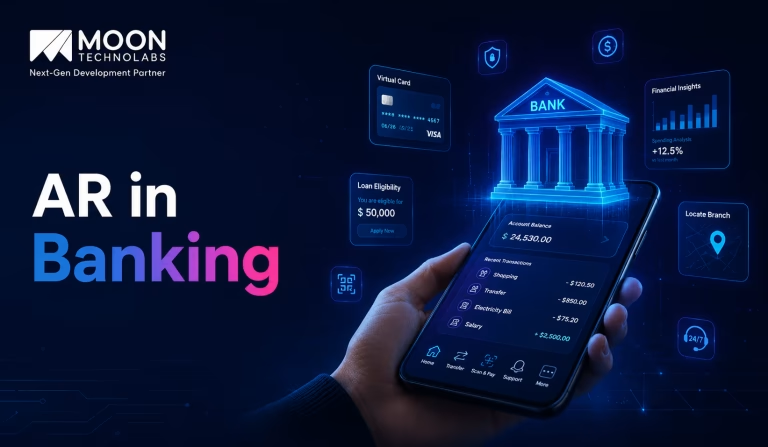
Table of Content


Blog Summary:
AR has redefined banks and financial institutions through interactive financial visualization, immersive customer experiences, AI-based insights, and more. This blog covers the types of AR in banking, considerations for its implementation, trends, applications, and industries benefiting from this technology.
Table of Content
Augmented reality (AR) is nowadays not limited only to gaming and entertainment, transforming many sectors. Banking is one of those. AR in banking is used primarily to make financial services more personalized, interactive, and user-friendly.
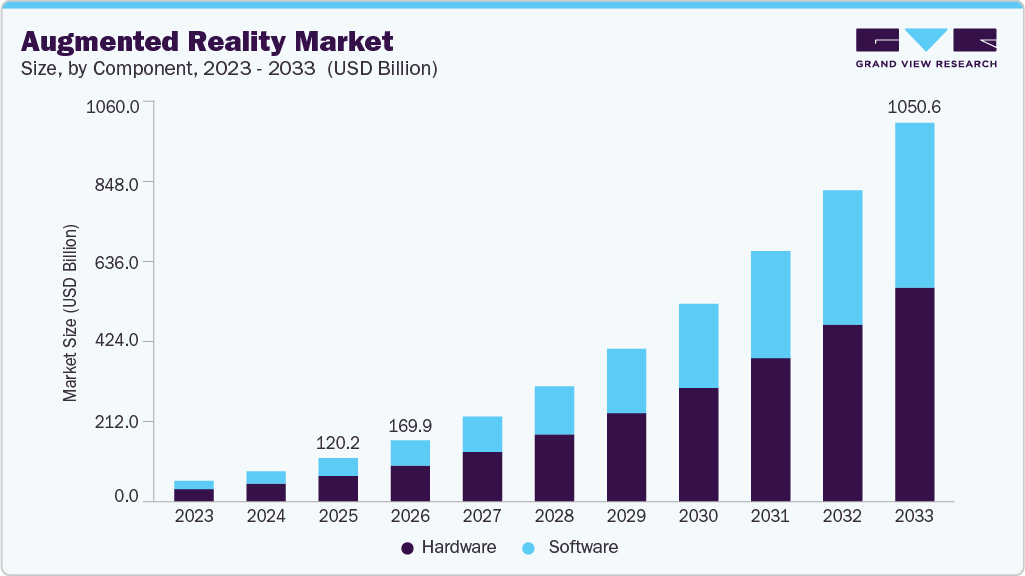
With the growth of digital banking, the adoption rate of AR in banks is increasing rapidly to offer immersive experiences that simplify customer interactions and boost engagement. Grand View Research predicts that the global AR market is likely to reach $1,050.56 billion by 2033, growing at a CAGR of 29.7% from 2026 to 2033.
AR is redefining modern banking experiences in several ways, including smarter customer onboarding and virtual banking assistance. In this blog, we will discuss how banks leverage AR to transform their financial services.
What is Augmented Reality in Banking?
Augmented Reality in banking is all about adding digital elements to the real world to make banking services easier to use and more interactive. The technology connects both digital and physical banking in a way that looks completely simple, easy, and helpful for customers, from analyzing spending patterns to finding nearby ATMs through phone cameras.
The Evolution of AR in Banking
AR in banking didn’t take place instantly – it has evolved steadily from the latest technology to a useful tool. It changes and improves based on the customer’s experience with financial services. Let’s understand the evolution history of AR in banking year by year:
- Early 2010s: Banks began experimenting with AR technology for branch locators and ATMs, using mobile apps.
- Mid-2010s: AR apps offered interactive maps and basic account information overlays.
- Late 2010s: Customer-facing AR features finally expanded into personalized financial dashboards and product visualization.
- Early 2020s: AR experiences became more context-aware and smarter with the integration of AI and machine learning (ML).
- Today: Banks are investing heavily in wearable compatibility, immersive AR interfaces, spatial banking experiences, and more.
Types of Augmented Reality Used in Banking
Banks leverage different types of augmented reality depending on the experience they wish to create and the problems they face. The following are the types of AR used by banks:
Marker-based AR in Banking Apps
Marker-based AR becomes active when a device’s camera detects specific visuals, such as a bank card, QR code, or printed logo. In banking, it’s most commonly used to bring cards and statements to life. Users just need to point their phone at a credit card to quickly check their balance, reward points, transactions, etc.
Markerless AR for Real-time Interaction
Markerless AR doesn’t require any physical trigger. It leverages accelerometers, GPS, computer vision, and other sensors to place digital content in the user’s environment. Banks leverage this for displaying contextual financial tips, spending summaries, or even budgeting insights within the user’s real-world view – it doesn’t require any special marker.
Location-based AR for Banking Services
Location-based AR activates when customers roam a city, providing information about nearby branches, ATMs, partner merchants, and more. These details are visible through their phone camera in real time.
Projection-based AR for Branch Experiences
Projection-based AR can create interactive surfaces. You can picture digital tables where both customers and advisors can explore investment plans, loan options, and more. It makes even complex financial conversations more collaborative, visual, and less intimidating for customers.
Why AR in Banking Is a Game-Changer
Trust and clarity are what matter most in banking. AR brings both by making financial details more interactive and visual. Let’s explore some other reasons:
AR-Powered Customer Engagement
AR has transformed passive banking into an active experience. It lets customers interact with their finances in a way that feels completely engaging and personal, rather than scrolling through numbers on a screen.
Interactive Financial Visualization
Complex data becomes simpler when you can visualize it. AR allows customers to see spending patterns, savings growth, investment performance, and more as dynamic, real-world overlays rather than flat charts.
Enhanced Digital Banking Experiences
AR adds a new layer of interactivity to online and mobile banking that traditional interfaces cannot match. AR ensures digital banking feels more experiential and less transactional, be it its 3D product walkthrough or immersive onboarding experience.
AR Financial Insights: When Visualization Becomes Actionable
The actual power of AR is not only about displaying data but also about offering smart decisions. Insights convert into action naturally when customers visualize a loan repayment schedule overlaid in their environment or the long-term impact of a savings plan.
Key Considerations Before Implementing AR in Banking
Before implementing AR in banking, a bank needs to consider several important things. Some of them are as follows:
Is your Target Audience Ready for AR Adoption?
AR is most useful when your target customers use mobile technology and seek the latest digital experience. Young, tech-savvy customers can adopt it quickly, whereas older demographics may require a simple interface and clear guidance.
Are your Banking Systems Compatible with AR Integration?
AR requires you to connect smoothly with your existing core banking systems, data infrastructure, mobile platforms, and more. Legacy systems pose certain compatibility challenges as well. You should conduct a thorough technical audit to identify gaps and prevent costly rework.
What Level of Data Security is Required?
AR apps that access account details, personal financial data, and transactional history should match strict security and compliance standards. To strengthen security standards, you can implement secure APIs, end-to-end encryption, and ensure regulatory compliance.
How Complex are your Financial Services and Workflows?
A simple ATM locator is completely different from an AR-based investment advisory tool. When you map out workflows in advance, it ensures the AR experience simplifies rather than complicates what customers already find difficult.
What is the Primary Objective of AR Implementation?
If you try to enhance customer engagement, simplify onboarding, minimize brand visits, and differentiate your brand, you should have a clear purpose. You need to understand that AR implementations become expensive experiments with a small measurable return, even without a clear objective.
Is your Infrastructure Scalable for AR Usage?
It’s crucial that your bandwidth capacity, cloud infrastructure, and backend architecture can handle demand spikes without any performance degradation. Scalability should be baked into the planning stage.
How will User Interactions and Outcomes be Measured?
You first determine the key performance indicators – these mainly include feature adoption rates, session duration, conversion metrics, customer satisfaction scores, etc. You need to analyze how users interact with AR features to reveal what works, what should be refined, and also where the next opportunities lie.
We create tailored AR banking apps that improve customer engagement and enhance accessibility. We revolutionize your digital banking experience.
Prerequisite for Success: Effective Change Management
One thing you should know is that technology alone doesn’t foster transformation; it’s actually people behind it. You need to know that even a well-built AR solution can fall without a deliberate change management strategy behind it. Here are the important practices:
Involve Stakeholders Early
It’s crucial to bring stakeholders in before fintech app development begins to prevent misalignment later. When they feel heard during the planning process, they become more satisfied and ensure everything works properly.
Educate Users About AR Benefits
Both employees and customers need to understand what AR actually does for them before adopting it. Whether it’s jargon-free or clear communication, it focuses completely on actual benefits. These are useful for saving time, simplifying complex decisions, and clarifying finances.
Design for Different User Segments
Designing AR experiences that work well for different user groups helps everyone feel included. Besides, its higher adoption rates also reflect the positive impact of that accessibility and inclusiveness.
Train Through Real Use Cases
Guiding employees through real banking situations builds greater confidence and practical skills than learning only through classroom instruction or theory. The situations include fixing an AR onboarding process and assisting a customer in viewing loan details.
Establish Continuous Feedback Loops
Creating a structured channel for ongoing feedback from both internal teams and customers ensures that the AR experience continues to improve. A consistent, small iteration based on real input matters much more than waiting for a complete overhaul.
Trends Shaping AR in Banking
The AR landscape is indeed evolving rapidly, introducing several new and ongoing trends. The following are some of these trends:
AI-powered Financial Insights
Both AI and AR are becoming increasingly interconnected. Driven by intelligent algorithms, AR interfaces not only display data but also interpret it. Customers also gain personalized savings budgets, predictive spending alerts, and real-time financial guidance overlaid in their environment.
Integration With Mobile Banking Apps
Banks nowadays no longer treat AR as a standalone feature. It’s now being added to making adoption frictionless, existing mobile banking apps, and more. Customers access AR capabilities within tools they already use daily, dramatically boosting engagement and minimizing the learning curve.
Personalized AR Financial Experiences
Generic banking experiences are going out of trend nowadays. AR offers the possibility of hyper-personalized interfaces that adapt to individual financial behavior, preferences, goals, etc. It makes every interaction feel tailored rather than templated.
AR-based Customer Support
Virtual AR assistants started reshaping traditional support channels. Customers can obtain step-by-step visual guidance overlaid on their screens, resolving issues quickly and with far less frustration than navigating phone menus.
AR as a Core Banking Experience Tool
AR has now become essential infrastructure rather than an experimental feature. Forward-thinking banks position it as a robust foundational element of their overall customer experience strategy, rather than a differentiator reserved for innovation labs.
Applications of AR in Banking
AR is being used across various real functions in the banking sector today. Let’s have a look at some of the areas where it’s used extensively:
Virtual Branch Experience
Banks leverage AR technology to facilitate customers’ interactions with a fully functional virtual brand. These branches can offer a complete banking experience to customers, whether it’s completing complex transactions or interacting with advisors via an immersive AR interface.
Investment and Portfolio Visualization
AR, of late, transforms investment data into three-dimensional, dynamic visuals that allow customers to explore portfolio performance and compare asset allocations. It also helps customers understand market trends in an intuitive, engaging way.
Loan and Mortgage Simulation
AR allows customers to visually simulate various mortgage terms, loan repayment scenarios, and interest rate impacts in real time. It helps them make a fully informed choice, even without feeling overwhelmed by financial jargon.
Customer Support Assistance
AR-based support offers step-by-step help on the customer’s screen, even during setup or troubleshooting. It can’t be denied that visual guidance reduces overall resolution time, thereby improving the customer experience.
Training and Employee Onboarding
Banks nowadays use AR for modernizing internal training. They train new employees to practice customer interactions, simulate banking scenarios, and learn complex compliance procedures in immersive environments.
We create AR solutions that make banking interactive, smarter, and customer-centered. Let’s transform your digital experiences with immersive financial engagement.
Real-world Examples of AR Adoption in Banking
The shift towards AR in the banking sector is underway. Many fintech companies and banks already put the same in various popular ways:
Virtual Banking Assistants in Mobile Apps
Many popular banks have already begun leveraging AR-driven virtual assistants in their mobile apps. These assistants guide customers in several ways, such as answering queries via interactive overlays, flagging unusual transactions, and managing accounts. These all deliver a conversational banking experience.
AR-based Financial Planning Tools
Fintech companies today have already developed AR tools that enable users to visualize their future financial scenarios. Imagine a situation where customers just point their phone at a property and get every important detail like estimated mortgage costs, long-term financial commitments overlaid, monthly repayments, etc., on the building itself.
Interactive Customer Engagement Platforms
Many banks have already introduced AR-driven engagement platforms that allow customers to explore product offerings, simulate financial decisions through immersive interfaces, and compare account types. These platforms demonstrated measurable improvements in both customer satisfaction and product understanding compared to traditional digital channels.
AR Integration in Fintech Applications
Fintech companies have quickly adopted AR as part of their core product experience. Many fintech platforms have already expanded the possibilities of AR-based financial experiences, from expense-tracking apps that display spending categories with real-world visuals to investment apps that present portfolio data in interactive 3D formats.
Industries Benefiting from AR in Banking
AR is not limited to a single area in the financial world. Its applications indeed create a real value across many sectors, which are as follows:
Retail Banking
Retail banking has gained much more from AR adoption. Every day, customers gain benefits from visual account management, intuitive branch navigation, and personalized financial guidance. All of these minimize friction, making routine banking interactions outstanding.
Investment Banking
In investment banking, AR brings much-needed clarity. It allows both clients and analysts to interact with market data, portfolio projections, and risk assessments through visual interfaces. It converts complex data into actionable and structured intelligence.
Fintech and Digital Wallets
Digital wallet apps use AR to display real-time spending breakdowns, payment confirmations, and merchant offers as seamless visual overlays. It makes everyday transactions smarter and more informed, without adding unnecessary complexity.
Insurance and Wealth Management
AR is revolutionizing how wealth management services and insurance products are understood and presented. It allows advisors to guide clients through risk scenarios, policy comparisons, long-term wealth projections, and more using immersive tools.
Final Thought
AR is redefining the banking sector extensively by making financial services more personalized, interactive, and efficient. It’s driving innovation across the sector, from financial visualization and customer engagement to digital banking experiences and employee training.
As technology evolves, you need a banking software development company like ours to implement scalable AR solutions successfully. We assist you in building AR apps that improve operational efficiency and customer experience.
FAQs
01
How can augmented reality improve customer onboarding in banking apps?
Well, AR can boost customer onboarding in banking apps by providing step-by-step account setup guidance, interactive identity verification, and virtual assistance.02
What are the security challenges of using AR in banking applications?
The major security challenges of using AR in banking apps include unauthorized access, data privacy risks, insecure device connections, and more.03
Can AR be integrated with existing core banking systems?
Yes, AR can be integrated conveniently with existing banking systems through middleware, APIs, and cloud-based architectures.04
What is the cost of implementing AR solutions in the banking sector?
The cost to implement AR solutions in the banking sector ranges from $30,000 to $200,000. It depends on many factors, such as integrations, features, and platform complexity.05
Which banking services benefit the most from augmented reality?
AR enhances banking services, including brand navigation, virtual account assistance, AR-based card management, and interactive financial planning.




Jayanti Katariya is the CEO of Moon Technolabs, a fast-growing IT solutions provider, with 18+ years of experience in the industry. Passionate about developing creative apps from a young age, he pursued an engineering degree to further this interest. Under his leadership, Moon Technolabs has helped numerous brands establish their online presence and he has also launched an invoicing software that assists businesses to streamline their financial operations.
Submitting the form below will ensure a prompt response from us.
We refine our expertise to deliver innovative business solutions.





205 N Michigan Avenue, #810, Chicago, 60601, Illinois, United States
13500 Long Is Dr, Pflugerville, TX 78660, USA

C/105 Ganesh Meridian, S.G. Highway, Ahmedabad, GJ 380060


Ayse D.
Co-Founder France
“ I highly recommend Moon Technolabs as the quality of service is wonderful. We have hired this company to develop the product based on some complex & technical issues. We get the best quality services as compared with others in the market. Huge Thanks to Moon Technolabs as the team is always ready to give the solution all time.”

Justin G.
Founder & CEO USA
USA“ Moon Technolabs is a pioneer in the WebRTC based project as they have fixed complicated segments of the module by fulfilling different product lines by providing 24X7 customer support. We really recommended Moon Technolabs as they are able to develop products as per the module deadline and project timeline.”

Flavio S.
Founder & Managing Director Germany
“I am happy to recommend Moon Technolabs for their app development services. They successfully developed apps for me, and I am highly satisfied with the overall outcomes. The development team has swiftly addressed the issues with responsive and effective communication to understand the requirement quickly and actively resolve the back-and-forth problems that arose...”

Jay M.
Founder & CEOUSA“Moon Technolabs is the best company that provides advanced apps and websites development services in the USA and Europe. I am a newbie to develop my app with an external team. I am really happy to work with them as I am not that much mobile apps user. Here, the team and specially the CEO of Moon Technolabs helps me to let me know about the benefits of my app to generate revenue....”


Our Offices
India
C/105 Ganesh Meridian,S.G. Highway, Ahmedabad, GJ 380060USA
205 N Michigan Avenue, #810, Chicago, 60601, Illinois, United StatesContact Information


