


AIDLC Workflows Guide: Process, Benefits, and Trends

Jayanti Katariya
Last Updated: Jul 02, 2026 Total Views: 157
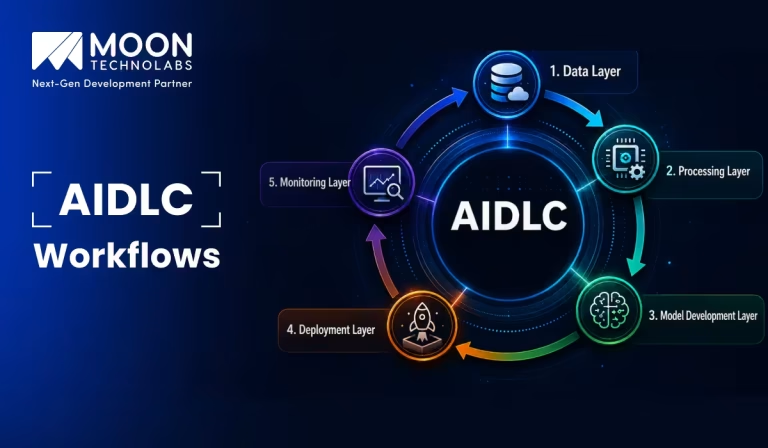
Table of Content


Blog Summary:
AIDLC (AI Development Lifecycle) is a structured framework that transforms chaotic AI development into predictable success. AIDLC eliminates broken pipelines, improves model accuracy, and breaks silo work from data management through continuous monitoring. This guide will walk through the different phases, architecture types, and benefits of implementing AIDLC in your development. It is no longer optional; it is a competitive advantage for businesses.
Table of Content
You confidently deployed your AI model because it was performing flawlessly in testing, but it crashed in production. When you reviewed your AI projects after this crash, you realized your team rebuilds models from scratch every quarter while drowning in data you cannot find when you need it.
If that’s your reality, you’re caught in the unpredictability of ad-hoc AI development. Without structured processes, your projects suffer from inconsistent data quality, broken pipelines, and models that fail in production. Your teams work in isolated silos, governance is a complete mess, and deployments take weeks instead of days.
Your competition isn’t facing these challenges. They’ve adopted AIDLC (Artificial Intelligence Development Life Cycle) workflows, structured processes that guide your entire AI development journey from conception through deployment to continuous improvement. These workflows transform chaos into predictable, repeatable success.
This guide walks you through AIDLC Workflows in detail: the exact process, architecture, and benefits you’ll gain from implementation.
What is an AIDLC Workflow?
An AIDLC workflow is what separates successful AI teams from those that constantly deal with broken pipelines and inaccurate models. This structured process takes your AI project from the idea stage to production, continuous monitoring, and improvement.
Instead of randomly developing the model and hoping it works, your team will follow clear stages to ensure the release of an accurate model. The data is validated across phases, models are tested properly, and deployment is smooth.
Moreover, you are aware when something goes wrong in your model and know where to look while troubleshooting.
Let’s understand why this workflow matters. Imagine you are building a recommendation engine for an application. Without AIDLC, you collect data from disconnected sources, train models across environments, and maybe deploy without thorough testing. Six months later, you observe a drop in accuracy and don’t know the reason.
With AIDLC, you control and document every step and ensure your data passes through standardization checks. Every model is rigorously validated, and when performance degrades, you can identify the source of the problem immediately.
AIDLC eliminates guesswork and delivers models that work reliably in production.
Key Components of an Effective AIDLC System
Six components should work together for your AIDLC workflow actually to operate. They are the foundations of your AI operations.
Data Management
The raw data you get is messy, inconsistent, and unreliable. Robust data management systems clean, organize, and store your data so that your team can access it without hassles. Without data management, you will build models on garbage data, resulting in low-quality output.
Feature Engineering
This component helps transform raw data into meaningful signals. Instead of adding everything to the model, you strategically include features that matter. Consequently, you get a model that performs exceptionally well when deployed.
Model Training Pipelines
Automate data preparation, model training, and results tracking with the model training pipelines component. Instead of handling everything manually, your pipeline handles repetitive tasks consistently and reliably. That saves your team weeks of manual work every quarter.
Model Governance
With model governance, you can establish accountability and control in your AI model. It helps document which models are running in production, who trained them, what data they use, and why they are performing the way they are. It is an audit trail with an insurance policy.
Performance Monitoring
Create an early-warning system using this component. You track data drift, model accuracy, and system health in real-time. You know as soon as the model degrades, and not after the business impact is obvious.
Security and Compliance
Protect your organization with a security and compliance component. Your models handle sensitive data, and deployments must meet regulatory requirements. With strong security practices and compliance frameworks, your data isn’t exposed to breaches, legal issues, or reputation damage.
None of these six components works in isolation. They are interconnected to deliver a flawless model.
Understanding the Core Stages of an AIDLC Workflow
Using the AIDLC workflow, your project follows a predictable journey spanning nine critical stages. Each stage builds on the previous one, creating a structured path from idea to continuous improvement.
Defining Project Goals
This is the first stage where you must ask all the right questions. What problem are we solving? What business outcome do we want? Remember, these aren’t technical questions but strategic ones. Clarity at this stage can help you define your entire workflow neatly. Without these defined goals, you will create models that nobody needs.
Assessing Data Availability and Quality
Next, you must inventory your data sources, identify gaps and inconsistencies, and evaluate data quality. In this stage, you will find whether you can actually build the model you are envisioning or need to adjust the scope. That’s the first checkpoint in your project.
Preparing and Engineering Features
Raw data is useful at this point. Your team will clean datasets, manage missing values, and create new features while maintaining consistency. Eventually, your data will be transformed into something the model can learn from.
Select Model Architecture
Do you need a neural network, gradient boosting, or something simple? The model architecture selection depends on your problem type, performance needs, and data size. Evaluate multiple options before selecting the one that best fits your needs.
Training and Fine-tuning Model
This is where you switch into the experimentation model. You must train multiple models, tweak hyperparameters, and iterate constantly. Document what works and what doesn’t, while building towards the best candidate model through systematic testing.
Validate Model Performance
Test rigorously before you proceed with deploying the models. Check your model against unseen data, evaluate for bias, and measure accuracy while confirming real-world performance. Only models that pass through this quality gate will move forward.
Deploying Models
At this point, your model goes live. You containerize it, set up monitoring, configure APIs, and make sure the systems can handle real traffic. Theory begins to take shape at this stage.
Monitor Model Performance
Continuous monitoring begins at the end of deployment. You must track accuracy metrics, detect data drift, and monitor system health. Watch for real-time anomalies in this stage. You will be alerted as soon as something degrades in this stage.
Retrain and Improve Models
Retraining kicks in when monitoring reveals a performance drop or shifts in data patterns. Your team gathers new data and reengineers features to improve the models. This stage is crucial for maintaining model relevance and accuracy over time.
AIDLC guides your entire AI journey, from problem definition to continuous improvement. Implement clear stages and establish governance to achieve a lasting competitive advantage.
AIDLC Lifecycle Architecture
Understanding the architecture supporting AIDLC helps visualize how these different pieces fit together. Here are the five interconnected layers, each serving a specific purpose.
Data Layer
This is the foundation layer for your AI architecture. In this layer, you store and manage raw data, such as customer transactions, sensor readings, and user and user behavior logs. This layer ensures data is collected consistently, stored securely, and organized properly. Without the data layer, everything will crumble.
Processing Layer
In this layer, your raw data is transformed into something useful. It handles data validation, cleaning, and feature engineering. The layer becomes a bridge between messy real-world data and model-ready datasets. Using automated pipelines, the layer offers consistency across projects.
Model Development Layer
Data scientists and ML engineers mostly work in this layer. It provides the necessary tools for framework training, hyperparameter tuning, and version control. Your team builds, tests, and compares models in a controlled environment on this layer before going live.
Deployment Layer
After validation, the model moves to this layer. The deployment layer manages containerization, orchestration, and serving. Your models are converted to production-grade APIs that any application can call. This layer provides a smooth, reliable, and scalable model.
Monitoring Layer
After deployment, your models don’t stay idle. The monitoring layers continuously track their performance, data drift, and system health. It alerts your team whenever something in the model breaks or degrades. This layer offers continuous insights and feedback to the model development layer. It also triggers retraining whenever needed.
With this architecture, you build an AI operation that is organized, scalable, and maintainable. Each layer has a specific job, but they are designed to work together seamlessly to deliver solid outcomes.
Benefits of Implementing Structured AIDLC Workflows
With AIDLC workflows, you don’t just gain a process; you gain a competitive edge that drives your business forward. Here’s what changes for your business with AIDLC.
Faster Model Development
Stop reinventing the wheel for every project. AIDLC provides standardized processes, proven templates, and reusable components that significantly shorten your development cycles. So, what used to take six months earlier now takes two. Your data scientists also spend less time on infrastructure management and use their hours to innovate.
Improved Model Accuracy
Owing to structured validation, rigorous testing, and continuous monitoring, your models perform better in production. You catch issues before deployment, not after. As you actively monitor and retrain, your model’s accuracy doesn’t degrade mysteriously. Eventually, you get better models resulting in improved business outcomes.
Better Collaboration Across Teams
AIDLC workflows break down silos. As a result, data engineers, ML specialists, and business stakeholders follow the same process and speak the same language. They have clear documentation that mentions what each team is doing and why. Handoffs are smooth, and teams actually work together.
Enhanced Scalability
As AI needs grow, AIDLC processes scale with you. You are not building custom solutions for every project. Instead, you are creating infrastructure, pipelines, and processes that can handle multiple models simultaneously. Adding a new AI project doesn’t mean starting from scratch; you can easily build on your existing framework.
Reduced Operational Risks
The biggest benefit is that you don’t rely on guesswork anymore. AIDLC offers governance, documentation, and audit trails. So, you know which models are running, who trained them, and what data they use. You are also aware of why the models are performing as they are. It also lets you know when something breaks in the model and helps you trace the problems back. With AIDLC, compliance and security are built into your model.
Continuous Model Improvement
Monitoring continuously triggers automatic retraining. Your system continuously learns and adapts to changing data patterns, preventing model degradation over time. Your models stay accurate and relevant without constant manual intervention.
AIDLC transforms your AI operations from the experimental stage to a sustainable competitive advantage.
AIDLC Workflow vs MLOps: Key Differences
You must have heard of MLOps being mentioned alongside AIDLC. While they are related, it is not the same thing. Understanding the difference between these two will help you choose the right approach for your project.
| Factor | AIDLC | MLOps |
|---|---|---|
| Focus | Complete AI development journey | Operational management of deployed models only |
| Lifecycle Coverage | Problem definition to deployment to improvement | Model monitoring and maintenance |
| When to Use | Building new AI capabilities | Managing production models |
| Team Involvement | Data engineers, ML engineers, business analysts | ML engineers, DevOps teams |
| Key Automation | Data processing, training, testing, and deployment | Monitoring, retraining triggers, and performance tracking. |
Purpose and Scope
AIDLC covers your entire AI development journey, from initial ideation and problem definition to deployment and continuous improvement. Conversely, MLOps focuses specifically on operational aspects of deployed models. AIDLC has a broader scope while MLOps includes a narrower one.
Lifecycle Coverage
AIDLC begins before you have built any AI models. The lifecycle covers data collection, feature engineering, model selection, and validation. MLOps assumes you have a trained model and focuses on keeping it healthy throughout the production stage. Once a model reaches production, businesses often rely on MLOps services to enable continuous monitoring, automated retraining, and long-term model governance. AIDLC is a complete journey, and MLOps involves only the final leg of that journey.
Automation Capabilities
AIDLC automates the development pipeline, including data processing, model training, testing, and deployment. MLOps, on the other hand, automates model monitoring, retraining triggers, and performance tracking.
Team Involvement
For AIDLC to work successfully, you need to have data engineers, AI/ML experts, and business analysts throughout the lifecycle on your team. MLOps involves working with ML engineers and DevOps teams after the model has been deployed.
When to Use Each Approach
You can use AIDLC workflows when building new AI capabilities from scratch. At this point, you need a structure that involves defining goals, testing, and then entering the production stage. MLOps is effective when you have a model in production. It helps manage them efficiently. Most organizations use both. AIDLC to guide development and MLOps to keep the models healthy.
You Might Also Like:
Future Trends Shaping AIDLC Development
AIDLC is evolving rapidly, and the trends emerging today will define how your organization builds AI tomorrow. Here’s a look at all the trends shaping AIDLC development.
Generative AI Integration
This will redefine how you develop AI. AIDLC workflows are gradually adapting to handle large language models, image generation, and other generative systems. Your validation and monitoring processes must account for different failure modes and biases unique to these models.
Automated Machine Learning (AutoML)
AutoML is reducing the need for manual model selection and hyperparameter tuning. In the future, AIDLC workflows will increasingly automate these decisions, allowing your team to focus on defining problems and validating results.
AI Governance Frameworks
Organizations need stronger governance with explainability and accountability. AIDLC workflows embed governance requirements from the start, not bolt them on afterward. Your models will need documentation about training data, decision logic, and bias assessments built into the development process.
Edge AI Deployment
Your models won’t live in cloud data centers. AI deployment for devices, phones, and IoT hardware is accelerating. That will also change your AIDLC workflow. You will need to optimize for model size, latency, and offline functionality. Even your validation processes must account for edge-specific constraints.
Continuous Learning Systems
Static models are becoming obsolete, and future systems will continuously learn from data without human intervention. Your AIDLC workflows will include an automated retraining trigger for data drifts. There will be safeguards to ensure your models don’t learn bad patterns or drift into problematic behavior.
These trends are not distant futures. If anything, they are happening now. Organizations that invest in AIDLC frameworks are positioning themselves to adopt these advances smoothly.
At Moon Technolabs, we design AIDLC workflows customized to your organization’s needs. We guide architecture design, tool selection, and team training for sustainable AI success.
How Moon Technolabs Can Help Implement Efficient AIDLC Workflows?
Building an AIDLC framework from scratch is pretty complex. You need expertise across engineering, data, ML operations, and even governance. Moon Technolabs specializes in helping organizations like yours implement structured AIDLC workflows that actually work.
We don’t just hand you a template and leave. We work with your team to assess your current AI maturity, identify bottlenecks, and design a custom AIDLC framework that fits your actual needs. Whether you are starting from chaos or optimizing existing processes, we guide you through architectural design, tool selection, and implementation.
Our approach covers everything, from setting up data pipelines to establishing governance frameworks and building monitoring systems. We have helped several organizations reduce model development cycles and cut their deployment time from weeks to days.
Our team understands the real challenges that come with deploying AI at scale. Your models need to perform reliably in production, your teams should collaborate seamlessly, and your organization requires sustainable practices to scale AI efficiently.
That’s why we implement AIDLC so your operations go from chaos to predictable, repeatable success.
Conclusion
When you started this guide, you were dealing with broken pipelines, crashed models, and even siloed teams. AIDLC workflows can fix all this by transforming AI development into a predictable success rather than the chaotic experience you have seen across multiple projects.
With this workflow, your models work reliably in production, teams collaborate effectively, and systems improve without constant manual intervention.
AIDLC isn’t a one-time implementation; it is a mindset shift toward systematic processes rather than ad hoc decisions. Your competition is already moving faster with structured AIDLC frameworks. The right question at this moment isn’t whether you should implement them; it is whether you can afford to avoid them.
If you are ready to get started with AIDLC, Moon Technolabs can help design and implement efficient workflows. Connect with our team, and we will assess your current process, identify bottlenecks, and guide you through structured implementation.
FAQs
01
How is AIDLC different from traditional SDLC?
The traditional software development lifecycle follows linear stages, such as design, development, testing, and deployment. AIDLC is cyclical because AI is iterative. In this, you train models, monitor performance, and retrain continuously. AIDLC prioritizes data quality and model governance, which your traditional software development lifecycle doesn’t consider. That’s why you build static software with SDLC and living learning systems with AIDLC.02
What AI tools work with AIDLC?
AIDLC is a framework-agnostic workflow. You can use TensorFlor, PyTorch, and other ML frameworks to get started. To define pipelines, you can use tools like Apache Airflow and Kubeflow. Prometheus is great for monitoring. Having a structured process matters more than the specific tools you must use.03
How does AIDLC improve AI project success rates?
AIDLC offers checkpoints and validation at each stage to catch problems early, before they become expensive. The clear processes reduce miscommunication between teams. Proper governance in the early stages prevents the model from degrading silently during the production stage. Organizations using AIDLC workflows report 3x higher model deployment rates and improved accuracy.04
Can AIDLC be used for generative AI applications?
Yes. You need AIDLC for generative AI applications, as these apps require data preparation, model validation, and monitoring. The validation processes may differ, as you are testing for biases, hallucinations, and output quality rather than accuracy metrics.




Jayanti Katariya is the CEO of Moon Technolabs, a fast-growing IT solutions provider, with 18+ years of experience in the industry. Passionate about developing creative apps from a young age, he pursued an engineering degree to further this interest. Under his leadership, Moon Technolabs has helped numerous brands establish their online presence and he has also launched an invoicing software that assists businesses to streamline their financial operations.
Submitting the form below will ensure a prompt response from us.
We refine our expertise to deliver innovative business solutions.





205 N Michigan Avenue, #810, Chicago, 60601, Illinois, United States
13500 Long Is Dr, Pflugerville, TX 78660, USA

C/105 Ganesh Meridian, S.G. Highway, Ahmedabad, GJ 380060


Ayse D.
Co-Founder France
“ I highly recommend Moon Technolabs as the quality of service is wonderful. We have hired this company to develop the product based on some complex & technical issues. We get the best quality services as compared with others in the market. Huge Thanks to Moon Technolabs as the team is always ready to give the solution all time.”

Justin G.
Founder & CEO USA
USA“ Moon Technolabs is a pioneer in the WebRTC based project as they have fixed complicated segments of the module by fulfilling different product lines by providing 24X7 customer support. We really recommended Moon Technolabs as they are able to develop products as per the module deadline and project timeline.”

Flavio S.
Founder & Managing Director Germany
“I am happy to recommend Moon Technolabs for their app development services. They successfully developed apps for me, and I am highly satisfied with the overall outcomes. The development team has swiftly addressed the issues with responsive and effective communication to understand the requirement quickly and actively resolve the back-and-forth problems that arose...”

Jay M.
Founder & CEOUSA“Moon Technolabs is the best company that provides advanced apps and websites development services in the USA and Europe. I am a newbie to develop my app with an external team. I am really happy to work with them as I am not that much mobile apps user. Here, the team and specially the CEO of Moon Technolabs helps me to let me know about the benefits of my app to generate revenue....”


Our Offices
India
C/105 Ganesh Meridian,S.G. Highway, Ahmedabad, GJ 380060USA
205 N Michigan Avenue, #810, Chicago, 60601, Illinois, United StatesContact Information


