


AI in Clinical Data Management: Use Cases, Benefits, Challenges, and Future Trends

Artificial Intelligence Team
Last Updated: Nov 19, 2026 Total Views: 81
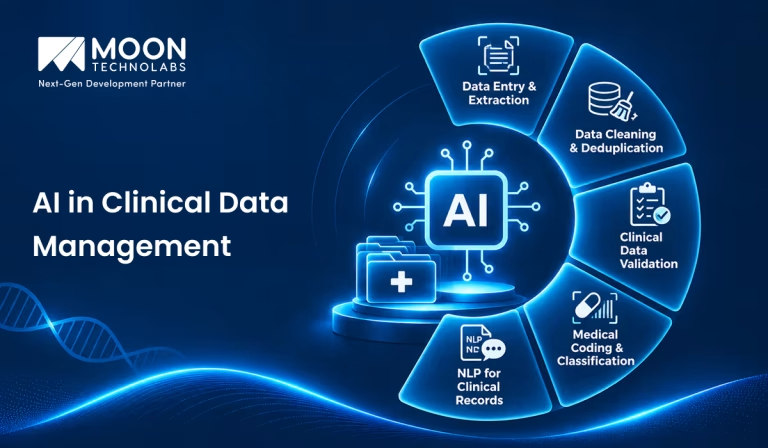
Table of Content


Blog Summary:
AI in clinical data management is transforming how research teams validate data, monitor quality, and analyze results. This blog explores practical applications, key benefits, implementation challenges, and emerging trends, including generative AI, predictive analytics, and FHIR integration, shaping more efficient, accurate, and scalable clinical research workflows.
Table of Content
Clinical data management involves much more than collecting patient information. Research teams must handle data from multiple trial sites, reconcile records, identify inconsistencies, resolve queries, and ensure every dataset meets quality and regulatory requirements.
As these responsibilities become more demanding, AI in clinical data management is opening new ways to simplify clinical data workflows, automate repetitive tasks, and reduce manual intervention.
According to Medidata’s State of AI in Clinical Trials survey, 92% of organizations plan to increase AI spending over the next one to two years (2027–2028), highlighting AI’s growing importance in clinical research. But where does AI fit into clinical data management, and what challenges come with its adoption? Let’s explore its key use cases, benefits, implementation challenges, and future trends.
Why is AI Needed in Clinical Data Management?
Clinical trials now generate vast amounts of complex data from electronic health records, EDC systems, laboratories, wearable devices, and patient-reported outcomes. Handling information from these diverse sources requires efficient data processing, accurate validation, and seamless integration.
As discussed in our guide to machine learning in healthcare, intelligent technologies can help healthcare organizations extract meaningful insights from increasingly complex datasets.
Traditional clinical data management relies heavily on manual activities such as data entry, validation, reconciliation, and query resolution. These processes can be time-consuming, resource-intensive, and prone to human errors, creating bottlenecks that affect data quality and clinical trial timelines.
AI helps overcome these challenges by automating repetitive tasks, identifying missing or inconsistent information, and enabling faster data processing. Intelligent validation and predictive monitoring also allow clinical data teams to detect potential issues earlier, improve data accuracy, reduce operational effort, and maintain regulatory compliance throughout the clinical trial lifecycle.
Key Use Cases of AI in Clinical Data Management
AI supports various clinical data management activities, from automated data entry to intelligent monitoring. Here are the key use cases to explore:
Automated Data Entry and Data Extraction
AI-powered tools extract relevant information from electronic health records, laboratory reports, and case report forms, reducing manual data entry, minimizing transcription errors, and speeding up clinical data collection.
AI-powered Data Cleaning and Deduplication
Machine learning algorithms identify duplicate records, missing values, and inconsistent entries across clinical datasets. This helps data management teams resolve discrepancies early and maintain accurate, reliable clinical databases.
Natural Language Processing (NLP) for Clinical Records
NLP converts unstructured clinical information, such as physician notes and discharge summaries, into structured data by identifying medical terms, diagnoses, medications, and relevant clinical observations.
Automated Clinical Data Validation
Automated validation tools check clinical datasets against predefined rules, study protocols, and data standards. They identify missing fields, unusual values, and inconsistencies, supporting faster query resolution and clinical data review.
Intelligent Medical Coding and Data Classification
AI-assisted coding tools identify medical terminology, suggest standardized codes, and classify adverse events, medications, and medical history, improving coding consistency and reducing repetitive manual effort.
Real-time Clinical Data Monitoring
AI-powered monitoring systems continuously analyze incoming trial data to identify unusual patterns, missing information, and potential safety signals, allowing research teams to investigate issues and respond promptly.
AI-powered Clinical Trial Data Management
AI streamlines clinical trial data management through automated query prioritization, data trend identification, and risk-based monitoring, helping research teams maintain data quality and improve trial oversight.
Automated Data Integration Across Healthcare Systems
AI-assisted integration connects information from EDC platforms, EHR systems, and laboratory databases. It maps, extracts, and reconciles clinical information, reducing data silos and improving consistency across datasets.
Modernize clinical data operations with AI-powered automation, predictive analytics, and intelligent data processing tailored to your business needs.
Predictive Analytics for Clinical Data Quality and Compliance
Predictive analytics helps identify potential data quality issues and compliance risks early. Here are its key applications in clinical data management:
AI-based Anomaly Detection
Machine learning algorithms analyze clinical datasets to identify unusual values, unexpected patterns, and deviations from established data trends. Early detection helps data managers investigate potential errors, inconsistencies, and quality concerns before database lock.
Predictive Data Quality Monitoring
Predictive models assess historical and incoming clinical data to identify areas where quality issues are likely to occur. This allows teams to prioritize data reviews, address recurring errors, and maintain consistent data quality throughout clinical trials.
Risk-based Clinical Trial Monitoring
AI analyzes clinical trial data to identify high-risk sites, recurring discrepancies, and unusual data patterns. These insights help research teams prioritize monitoring, allocate resources effectively, and focus on areas needing closer oversight.
Regulatory Compliance and Audit Readiness
AI-powered compliance tools support audit readiness by monitoring data inconsistencies, maintaining documentation, and identifying potential compliance gaps. Automated checks and traceable records help organizations maintain data integrity and align processes with applicable regulatory requirements.
Automated Detection of Missing and Inconsistent Data
Automated detection systems identify incomplete fields, conflicting patient information, and inconsistencies across clinical records. By flagging these issues early, data management teams can initiate corrective actions, reduce manual review, and improve overall dataset completeness.
Benefits of AI Across the Clinical Data Lifecycle
From collecting patient information to validating records and analyzing trial datasets, AI improves several clinical data management activities. Here are the key benefits research teams can achieve across the clinical data lifecycle:
Improved Clinical Data Accuracy
Errors such as incorrect patient entries, inconsistent values, and missing information can affect clinical trial outcomes. Intelligent data validation helps identify these issues as data enters the system, allowing teams to investigate discrepancies early and maintain accurate, reliable clinical records.
Faster Data Collection and Processing
Clinical trials generate data from EDC platforms, EHRs, laboratories, and wearable devices. Our healthcare integration solution leverages AI, OCR, NLP, and HL7 FHIR to streamline clinical data extraction, validation, consolidation, and exchange. It reduces manual effort, minimizes processing delays, improves data accuracy, and enables research teams to access timely, reliable clinical information for faster decision-making.
Reduced Manual Workload
Data entry, medical coding, query generation, and record reconciliation often consume significant time during clinical trials. Automating these repetitive activities allows clinical data managers to spend less time on administrative tasks and more time reviewing complex discrepancies, overseeing data quality, and resolving critical issues.
Enhanced Data Quality and Consistency
Maintaining consistent data across multiple trial sites can be challenging, particularly in large, multinational studies. Automated quality checks help identify deviations from predefined data standards, inconsistent entries, and incomplete records, enabling teams to address data quality issues throughout the study.
Faster Clinical Trial Data Analysis
Manually reviewing large clinical datasets can slow the process of identifying trends and meaningful patterns. Machine learning and advanced analytics help process complex datasets more efficiently, support faster data review, and provide researchers with insights for informed clinical trial decisions.
Improved Regulatory Compliance
Clinical data must meet strict requirements for accuracy, traceability, security, and integrity. Automated audit trails, validation checks, and standardized documentation help maintain consistent records and support compliance with applicable regulatory frameworks, including FDA 21 CFR Part 11 and relevant GCP guidelines.
Cost Optimization and Operational Efficiency
Repeated data corrections, manual reviews, and delayed query resolution can increase clinical trial operating costs. Streamlined workflows help reduce unnecessary effort, improve resource allocation, and minimize rework, allowing clinical research organizations to manage growing data volumes without proportionately increasing operational resources.
FHIR and AI Integration in Clinical Data Management
Clinical data is often scattered across EHRs, EDC platforms, and laboratory systems. Integrating AI with Fast Healthcare Interoperability Resources (FHIR) enables standardized data exchange, intelligent processing, and seamless clinical data integration across healthcare systems.
What Is FHIR in Healthcare?
Fast Healthcare Interoperability Resources (FHIR) is a healthcare data exchange standard developed by HL7. It uses standardized data components called resources to represent information such as patient details, medications, observations, and diagnostic reports.
Through APIs and common data formats, FHIR allows different healthcare applications to exchange clinical information more consistently, improving interoperability across healthcare systems.
How AI and FHIR Work Together
FHIR provides a standardized structure for exchanging clinical information, while AI helps process and interpret that information. Combining these technologies allows clinical data management teams to automate several activities, including:
- Clinical Data Analysis: AI models analyze FHIR-based resources to identify patterns and extract meaningful clinical insights.
- Automated Data Validation: Machine learning algorithms identify missing fields, inconsistent values, and potential data errors.
- Intelligent Data Classification: AI helps categorize clinical information, including diagnoses, medications, and laboratory observations.
- Anomaly Detection: AI identifies unusual data patterns that may require further investigation.
- Predictive Insights: Historical and incoming clinical data can be analyzed to identify potential quality issues and emerging trends.
FHIR-based Clinical Data Interoperability
Clinical research organizations often collect information from multiple systems that use different data structures and formats. FHIR standardizes how clinical information is represented and exchanged through resources such as patient, observation, medication, and diagnosticReport.
Incorporating these standards into medical software development improves interoperability, connects diverse clinical data sources, reduces information silos, and maintains consistent records across research environments.
AI-powered Data Exchange Across Healthcare Systems
AI can make FHIR-based data exchange more efficient by helping healthcare applications extract, classify, validate, and reconcile information received from connected systems.
For example, an AI-powered solution can review laboratory observations, identify missing clinical details, and flag inconsistent patient records as information moves between EHR, EDC, and laboratory platforms. This supports smoother data exchange and reduces repetitive manual review.
Challenges of Implementing AI in Clinical Data Management
Despite its potential to improve clinical data workflows, AI implementation comes with practical challenges involving sensitive patient information, regulatory requirements, data consistency, and system integration. Here are the key challenges organizations need to address:
Patient Data Privacy and Security
Clinical datasets contain sensitive patient information that requires strong protection. Implementing AI involves managing risks of unauthorized access, data breaches, and improper data use while maintaining appropriate security controls and patient confidentiality.
Regulatory Compliance Requirements
AI-powered clinical data management solutions must align with applicable regulatory requirements, including FDA 21 CFR Part 11, GDPR, and GCP guidelines. Ensuring system validation, data traceability, documentation, and audit readiness can complicate implementation.
Data Quality and Standardization
AI models depend on accurate, consistent, and well-structured data. Incomplete records, inconsistent formats, and differences in data collection practices across trial sites can affect model performance and produce unreliable results.
AI Model Bias and Explainability
AI models may produce biased or inconsistent results when trained on unrepresentative clinical datasets. Limited explainability also makes it difficult for researchers to understand automated decisions, highlighting the need for transparent models and human oversight.
Integration With Legacy Healthcare Systems
Many clinical research organizations rely on legacy EDC platforms, EHR systems, and laboratory databases. Integrating AI solutions with these outdated systems often requires significant technical effort, customization, and investment, making healthcare software modernization essential to improve compatibility, enable seamless data exchange, and support efficient clinical data management.
Future of AI in Clinical Data Management
Emerging AI technologies are set to change how clinical research teams process, monitor, and manage trial data. Here are the key trends expected to shape the future of clinical data management:
Generative AI for Clinical Data Processing
Generative AI is expected to simplify clinical data processing through automated documentation, clinical text summarization, query drafting, and data classification. With appropriate human review, these capabilities can reduce administrative effort and accelerate routine data management activities.
Predictive Analytics in Clinical Research
Predictive analytics will help researchers identify potential data quality issues, trial delays, and emerging risks before they become significant problems. By analyzing historical and real-time datasets, predictive models can support proactive monitoring and better research decisions.
AI-driven Clinical Trial Automation
Future clinical trial workflows will increasingly incorporate intelligent automation for data entry, validation, query management, and reconciliation. This will reduce repetitive manual activities, improve workflow coordination, and help research teams manage increasingly complex clinical studies.
Real-time Healthcare Data Intelligence
AI advancements will enable faster analysis of clinical information collected from EHRs, wearable devices, laboratories, and connected healthcare systems. Real-time actionable insights can help research teams monitor data trends, identify potential issues, and make timely decisions.
Intelligent and Interoperable Clinical Data Platforms
Next-generation clinical data platforms will increasingly combine AI capabilities with interoperable healthcare systems. Seamless data exchange, standardized formats, and intelligent data processing will help organizations reduce data silos and maintain consistent information across clinical research environments.
Simplify data integration, automate validation, and reduce manual workload with AI solutions designed around your operational needs.
How Moon Technolabs Helps Implement AI in Clinical Data Management
Moon Technolabs helps clinical research organizations address practical data management challenges, such as fragmented clinical records, manual data validation, duplicate entries, and delayed query resolution. Our team can develop AI-powered solutions for data extraction, anomaly detection, automated classification, and predictive data quality monitoring to make clinical data workflows more efficient.
With our AI consulting services, we work with businesses to identify automation opportunities, evaluate suitable AI technologies, and plan implementation around existing clinical data systems. We build solutions that meet operational requirements, integrate with existing workflows, and support accurate, consistent, and accessible clinical data.
Conclusion
AI is changing how clinical data is collected, processed, validated, and analyzed. From automated data entry and anomaly detection to predictive analytics and regulatory compliance, its applications help clinical research organizations address data complexity, reduce manual effort, and improve the reliability of clinical trial datasets.
However, successful implementation depends on data security, model transparency, regulatory alignment, and seamless integration with existing systems. As clinical research evolves, investing in the right AI capabilities can help organizations build more efficient, scalable data management processes.
Businesses exploring AI in healthcare can partner with experienced technology teams to identify practical opportunities and develop solutions aligned with their requirements. Moon Technolabs helps businesses turn these opportunities into actionable solutions. If you plan to adopt AI in your clinical workflows, hire AI developers to build, integrate, and scale intelligent solutions that support your long-term goals.
FAQs
01
What is AI in clinical data management?
AI in clinical data management refers to using artificial intelligence technologies to collect, process, validate, and analyze clinical trial data. It automates repetitive tasks, improves data quality, reduces manual errors, and supports faster decision-making.02
How is AI used in clinical trials and clinical data management?
AI automates data entry, identifies inconsistencies, monitors patient safety, detects anomalies, and streamlines data analysis. It also supports patient recruitment, risk-based monitoring, and real-time clinical data management.03
What are the benefits of AI in clinical data management?
AI improves operational efficiency by automating repetitive processes, reducing human errors, and accelerating data processing. It enhances data quality, supports faster decision-making, lowers administrative costs, and helps clinical research teams manage complex trial datasets.04
How does AI improve clinical data accuracy and regulatory compliance?
AI improves clinical data accuracy by identifying missing values, inconsistencies, duplicate records, and unusual patterns. Automated validation checks, audit trails, and standardized workflows also support regulatory compliance and help maintain data integrity throughout clinical trials.05
How much does it cost to implement AI in clinical data management?
The cost of implementing AI in clinical data management varies depending on software, integration requirements, trial complexity, and infrastructure. Costs may include licensing, customization, training, validation, and ongoing maintenance, so vendor-specific assessments are essential.



Explore the latest insights on Artificial Intelligence, including Generative AI, Agentic AI, natural language processing, computer vision, automation, and enterprise AI solutions. This category covers industry trends, practical applications, implementation strategies, and innovations that help businesses leverage AI for smarter decision-making and digital transformation. Stay updated with evolving AI technologies that are reshaping industries worldwide.
Submitting the form below will ensure a prompt response from us.
We refine our expertise to deliver innovative business solutions.





205 N Michigan Avenue, #810, Chicago, 60601, Illinois, United States
13500 Long Is Dr, Pflugerville, TX 78660, USA

C/105 Ganesh Meridian, S.G. Highway, Ahmedabad, GJ 380060




Ayse D.
Co-Founder France
“ I highly recommend Moon Technolabs as the quality of service is wonderful. We have hired this company to develop the product based on some complex & technical issues. We get the best quality services as compared with others in the market. Huge Thanks to Moon Technolabs as the team is always ready to give the solution all time.”

Justin G.
Founder & CEO USA
“ Moon Technolabs is a pioneer in the WebRTC based project as they have fixed complicated segments of the module by fulfilling different product lines by providing 24X7 customer support. We really recommended Moon Technolabs as they are able to develop products as per the module deadline and project timeline.”

Flavio S.
Founder & Managing Director Germany
“I am happy to recommend Moon Technolabs for their app development services. They successfully developed apps for me, and I am highly satisfied with the overall outcomes. The development team has swiftly addressed the issues with responsive and effective communication to understand the requirement quickly and actively resolve the back-and-forth problems that arose...”

Jay M.
Founder & CEOUSA“Moon Technolabs is the best company that provides advanced apps and websites development services in the USA and Europe. I am a newbie to develop my app with an external team. I am really happy to work with them as I am not that much mobile apps user. Here, the team and specially the CEO of Moon Technolabs helps me to let me know about the benefits of my app to generate revenue....”


Our Offices
India
C/105 Ganesh Meridian,S.G. Highway, Ahmedabad, GJ 380060USA
205 N Michigan Avenue, #810, Chicago, 60601, Illinois, United StatesContact Information


