


AI Agent vs Chatbot: How They Differ and Which Is Right for Your Business

Artificial Intelligence Team
Last Updated: Sep 29, 2026 Total Views: 86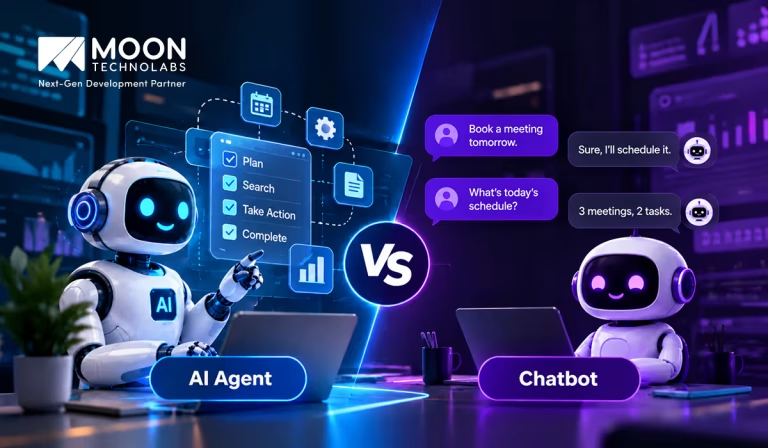
Table of Content


Blog Summary:
The AI agent vs chatbot comparison is becoming increasingly important as businesses adopt AI to improve customer interactions and automate everyday tasks. While both support AI-powered communication, they differ in capabilities, functionality, and applications. This blog explores their key differences, use cases, benefits, and limitations to help businesses choose the solution that best aligns with their goals and operational needs.
Table of Content
Artificial intelligence is rapidly changing how businesses communicate with customers and automate operations. As AI evolves, businesses are exploring smarter solutions to improve efficiency, deliver better experiences, and streamline everyday tasks.
Among the technologies gaining attention, AI agents and chatbots are becoming key parts of modern business strategies. But with so many AI solutions available, it can be challenging to know which approach fits a specific need.
In this blog, we’ll explore AI Agent vs Chatbot, their key differences, and how businesses can choose the right solution.
What is a Chatbot?
A chatbot is a software application that simulates human conversation, typically through text or voice interfaces. Traditional versions rely heavily on pre-written scripts, decision trees, or basic keyword matching to answer predictable questions like business hours or shipping updates.
Modern chatbots often incorporate basic natural language processing to understand user intent more flexibly, though they remain bound to conversational interfaces. They are primarily used for front-line customer support and handling high-volume, repetitive inquiries without human intervention.
What is an AI Agent?
An AI agent is an autonomous software entity driven by advanced machine learning models that can reason, plan, and execute complex multi-step workflows. Unlike traditional chat interfaces, AI agents are designed to achieve specific high-level goals by independently interacting with various backend tools, APIs, and databases.
These systems maintain long-term memory, evaluate dynamic conditions, and solve problems proactively without needing constant human guidance. They support sophisticated automation, such as cross-system data integration, comprehensive research, and end-to-end task execution.
AI Agent vs Chatbot: Key Differences
Here are the key differences between chatbot and AI agent. Take a closer look to understand how they differ in capabilities, functionality, and applications.
| Aspect | Traditional Chatbot | AI Agent |
|---|---|---|
| Core Intelligence | Rule-based (if/else trees) or basic pattern matching | LLM/VLM-driven reasoning, planning, and contextual memory |
| Primary Scope | Scripted Q&A, FAQ deflection, specific single-turn tasks | Multi-step workflow execution, problem-solving, and tool use |
| Agency & Autonomy | Reactive; waits for explicit prompts within rigid paths | Proactive/semi-autonomous; can break down goals and execute steps |
| Tool/API Integration | Limited, tightly hardcoded integrations (e.g., Zendesk ticket lookup) | Dynamic tool/function calling (browsing, writing code, calling APIs) |
| Handling Ambiguity | Fails or falls back to “I don’t understand” / human handoff | Clarifies intent, adapts plan, or retries upon encountering errors |
| Example Use Case | Password reset bot on a bank website that runs a decision tree | AI researcher that reads docs, writes code, tests it, and opens a PR |
How AI Agents and Chatbots Work?
Understanding their workflows can help you see how each technology approaches tasks and interactions differently. Here’s a closer look at how AI agents and chatbots work, and how they handle interactions, tasks, and user requests:
Chatbot Workflow
Traditional chatbots rely on deterministic logic and linear routing. When a user sends a message, the system evaluates it against predefined patterns or decision trees.
Workflow:
- User Input: User types a message (e.g., “Where is my order?”).
- NLU / Keyword Match: Regex, intent classifier, or keyword matching extracts intent (order_status).
- State Management: Session state tracks where the user is in a rigid flow (e.g., Waiting for Order ID).
- Backend Lookup: Queries a specific database table via a hardcoded API endpoint using the collected Order ID.
- Response Generation: Populates a static template string (e.g., “Your order #123 is shipped.”) and renders it.
AI Agent Workflow
AI agents use a cognitive loop powered by an LLM or Multimodal model. Instead of following a rigid flowchart, the model dynamically determines the next step based on the evolving context.
Workflow (ReAct / Plan-and-Solve Pattern):
- User Goal/Input: User gives an open-ended objective (e.g., “Find why Q3 revenue dropped and email a summary to finance.”).
- Perception & Context Load: Injects system prompt, history, tool definitions, and memory into the LLM context window.
- Reasoning / Planning: LLM analyzes the goal and generates a structured thought/plan (e.g., Step 1: query database for Q3 regional breakdown).
- Action / Tool Execution: Model outputs a tool-call request (e.g., sql_query(q3_data)). Environment executes the tool and returns raw output.
- Observation & Reflection: The model evaluates the tool output. Did it fail? Do I need another tool? (e.g., Sales are fine; check marketing spend next via fetch_api(marketing)).
- Loop or Finalize: Repeats steps 3–5 until the objective is met, then outputs the final synthesis/action.
Take Your Business Automation to the Next Level
See how AI-powered solutions can simplify workflows, enhance customer experiences, and help your business run more efficiently.
Chatbot vs AI Agent: Benefits and Limitations
When choosing between an AI agent and a chatbot, the key difference lies in the level of automation, flexibility, and task execution required. While both can improve customer interactions and business efficiency, they offer different capabilities. Here are the benefits and limitations of AI agents and chatbots.
Benefits of AI Agents
AI agents are particularly valuable for businesses looking to automate complex, multi-step processes. They can work across connected tools and systems, make decisions based on available information, and take action toward a specific goal.
- Greater automation: AI agents can handle tasks end-to-end with less human intervention.
- Multi-step task execution: They can break down complex requests into multiple actions and complete them sequentially.
- Tool and system integration: Agents can interact with APIs, databases, CRM platforms, business applications, and other tools.
- Context-aware interactions: They can use information from previous steps to decide what to do next.
- Improved operational efficiency: By automating repetitive and time-consuming workflows, AI agents can reduce manual effort.
- Scalable task management: Agents can handle multiple processes simultaneously, making them useful for growing businesses.
Limitations of AI Agents
Despite their broader capabilities, AI agents can introduce additional complexity and risk.
- Higher implementation complexity: Building reliable agents often requires integrations, workflow design, testing, and ongoing monitoring.
- Greater costs: Development, infrastructure, integrations, and maintenance can make AI agents more expensive than basic chatbot solutions.
- Potential for incorrect actions: If an agent misunderstands a request or works with inaccurate information, it may take an inappropriate action.
- Security and access concerns: Agents connected to business systems require strong permissions, authentication, and safeguards.
- Need for monitoring: Autonomous workflows may require human oversight, particularly when handling sensitive or business-critical operations.
Benefits of Chatbots
Chatbots remain useful for businesses that primarily need fast, consistent, and scalable communication.
- Quick customer responses: Chatbots can instantly handle common questions and requests.
- 24/7 availability: Customers can receive assistance outside normal business hours.
- Lower implementation complexity: Basic chatbot solutions are generally easier to deploy and manage.
- Consistent responses: They can provide standardized information across customer interactions.
- High-volume support: Chatbots can manage numerous conversations at the same time.
- Reduced support workload: Routine questions can be handled automatically, allowing human teams to focus on more complex issues.
Limitations of Chatbots
Chatbots may become less effective when users need more than straightforward information or predefined assistance.
- Limited task automation: Many chatbots are better suited to answering questions than completing complex workflows.
- Difficulty handling unusual requests: Unexpected questions or conversations can lead to inaccurate or irrelevant responses.
- Limited system interaction: Some chatbot implementations have little or no ability to perform actions in external business systems.
- Dependence on predefined workflows: Highly structured chatbots may struggle when conversations move outside expected scenarios.
- Human escalation: Complex customer issues may still require intervention from a support representative.
When Should You Use a Chatbot?
Implementing conversational AI can completely transform how your business operates, but knowing where and when to deploy it is key to maximizing its value. Not every customer interaction requires a bot, and not every complex issue should be handled by a human.
Here is a breakdown of the scenarios where using a chatbot delivers the highest return on investment:
Simple, Repetitive Inquiries
If your support team spends hours every day answering the same questions—such as shipping policies, store hours, or password resets—a chatbot is your best solution. Bots provide instant availability by offering immediate answers 24 hours a day, preventing off-hours frustration.
Automating repetitive tier-one support tasks also significantly reduces operational overhead while ensuring customers receive accurate, consistent policy information.
Guided Conversations
Online shoppers often experience decision fatigue, and a well-placed chatbot can act as a virtual sales assistant to boost conversions. These digital assistants can ask targeted questions to recommend items tailored to a customer’s specific needs or budget.
Automated prompts can also offer quick help or gentle reminders when a user lingers on the checkout page, while suggesting relevant add-ons or complementary products based on previous selections.
For Streamlining Lead Generation and Qualification
Capturing prospective client data shouldn’t wait for a sales representative to review a contact form manually. Chatbots can engage visitors the moment they land on your site, asking qualifying questions to gauge their intent and budget.
Once a lead is qualified, the bot can integrate directly with your calendar tool to book a meeting instantly, organize the collected details, and push them straight to your CRM without manual data entry.
When Onboarding Users and Delivering Interactive Training
Complex software products and digital services often have a steep learning curve, making chatbots ideal interactive guides during the critical first few days of adoption. Instead of forcing users to read a lengthy knowledge base, bots can prompt them through their first setup actions. Providing contextual help and interactive assistance when a user seems stuck helps reduce early churn rates.
When Should You Use an AI Agent?
While a traditional chatbot responds to basic prompts and follows fixed scripts, an AI agent is an autonomous system built to reason through complex goals, execute multi-step workflows, and take actions across multiple backend software platforms.
Deploy an AI agent when your operational challenges require deep logic, independent problem-solving, and cross-system integration rather than simple conversational replies.
Here are the primary scenarios where utilizing an AI agent is the right choice:
Complex Workflows
If a task requires jumping across different applications, checking databases, evaluating policies, and executing operations without human hand-holding, an AI agent is necessary.
For instance, handling a customer return request often requires a chatbot to provide policy text, whereas an AI agent can independently verify purchase history in a CRM, check warehouse inventory, process the refund through payment systems, update order records, and email the customer confirmation.
When Proactive Problem-Solving and Long-Term Memory Are Needed
Chatbots are strictly reactive and reset after every single session, meaning they forget context once a window closes. Sophisticated AI agents are stateful, meaning they maintain memory, track progress over extended periods, and act proactively.
Use them when you need a system to monitor conditions over time—such as tracking a client’s account health, predicting churn risk, and initiating retention campaigns autonomously before a human even notices an issue.
When Handling Unpredictable Edge Cases
Traditional automation and rigid chatbots frequently crash or loop into error messages the moment a user steps off the expected script. AI agents have more advanced reasoning capabilities that let them adapt to unexpected inputs, evaluate alternative paths, and navigate unfamiliar edge cases without crashing.
Research and Analysis
When an assignment demands synthesizing information from unstructured sources and feeding it into external enterprise AI tools, standard automation falls short. AI agents excel at utilizing external APIs, querying complex databases, and making real-time decisions based on dynamic data.
This makes them ideal for tasks like automated financial underwriting, continuous compliance monitoring, or compiling deep competitive research across disparate web systems.
Can a Chatbot and AI Agent Work Together?
Yes, a chatbot and an AI agent can, and often do, work together to create a powerful, multi-layered support and automation system. While they serve different primary functions, combining them allows organizations to bridge the gap between friendly user communication and heavy back-end execution.
This synergy keeps routine interactions fast and conversational while giving complex tasks the deep reasoning and technical muscle they need. In this collaborative setup, the chatbot acts as the friendly front-end interface that greets users, handles simple inquiries, and answers routine questions.
When a user requests something complex that requires deep reasoning, database lookups, or executing multi-step actions across different software tools, the chatbot seamlessly hands the task off to the AI agent behind the scenes. An AI chatbot maintains a continuous, human-like dialogue, ensuring the user always feels supported without needing to understand the intricate technical machinery running in the background.
Once the AI agent finishes its work, it simply hands the final output back to the chatbot to display to the user.
Accelerate Business Growth With Intelligent AI Solutions
Work with our experts to identify practical AI opportunities and turn promising ideas into solutions that deliver value.
Why Choose Moon Technolabs for AI Agent and Chatbot Development?
Choosing the right technology partner is critical when scaling intelligent operations, and Moon Technolabs brings unmatched technical expertise to every custom project. As a trusted AI agent development company, our engineering teams specialize in designing secure, scalable architectures that bridge user-facing conversations and deep back-end automation.
Whether you need an autonomous problem-solver for multi-step workflows or custom logic engines, we deliver tailored solutions that integrate seamlessly with your existing enterprise ecosystem.
Beyond core agentic architectures, we excel as a premier AI chatbot development company, ensuring your front-line user engagement remains smooth and context-aware. Moon Technolabs acts as a strategic partner focused on long-term performance optimization, rigorous data security, and continuous model fine-tuning.
By leveraging advanced frameworks and machine learning libraries, we keep your systems responsive and adaptable, turning rigid digital touchpoints into smart, cohesive experiences that drive efficiency and cut operational costs.
Conclusion
Both AI agents and AI chatbots offer valuable benefits, but the right choice depends on your business needs and required level of automation. Chatbots are ideal for handling routine queries and providing quick customer support.
AI agents, meanwhile, suit complex, multi-step tasks that require decision-making, tool integration, and greater autonomy. By understanding the differences between AI agents and chatbots, businesses can choose the right solution, or combine both to improve efficiency, streamline operations, and deliver better customer experiences.
FAQs
01
Can AI agents and chatbots work together?
Yes. Businesses can use chatbots for initial conversations and FAQs while AI agents handle more complex requests, actions, or workflows.02
Are AI agents more expensive than chatbots?
The cost depends on factors such as features, integrations, complexity, and development requirements. AI agents may require a larger investment when they involve advanced automation and integrations.03
Can an AI agent integrate with existing business tools?
Yes. AI agents can be integrated with CRM platforms, databases, communication tools, APIs, and other business software to perform specific tasks and access relevant information.04
Can a chatbot be upgraded to an AI agent?
In many cases, yes. An existing chatbot can be enhanced with capabilities such as tool integration, task execution, decision-making, and workflow automation to function more like an AI agent.05
Do AI agents require human supervision?
Depending on the task and level of autonomy, human oversight may still be useful. Businesses can define approval steps, access limits, and escalation processes for sensitive or complex tasks.



Explore the latest insights on Artificial Intelligence, including Generative AI, Agentic AI, natural language processing, computer vision, automation, and enterprise AI solutions. This category covers industry trends, practical applications, implementation strategies, and innovations that help businesses leverage AI for smarter decision-making and digital transformation. Stay updated with evolving AI technologies that are reshaping industries worldwide.
Submitting the form below will ensure a prompt response from us.
We refine our expertise to deliver innovative business solutions.





205 N Michigan Avenue, #810, Chicago, 60601, Illinois, United States
13500 Long Is Dr, Pflugerville, TX 78660, USA

C/105 Ganesh Meridian, S.G. Highway, Ahmedabad, GJ 380060


Ayse D.
Co-Founder France
“ I highly recommend Moon Technolabs as the quality of service is wonderful. We have hired this company to develop the product based on some complex & technical issues. We get the best quality services as compared with others in the market. Huge Thanks to Moon Technolabs as the team is always ready to give the solution all time.”

Justin G.
Founder & CEO USA
USA“ Moon Technolabs is a pioneer in the WebRTC based project as they have fixed complicated segments of the module by fulfilling different product lines by providing 24X7 customer support. We really recommended Moon Technolabs as they are able to develop products as per the module deadline and project timeline.”

Flavio S.
Founder & Managing Director Germany
“I am happy to recommend Moon Technolabs for their app development services. They successfully developed apps for me, and I am highly satisfied with the overall outcomes. The development team has swiftly addressed the issues with responsive and effective communication to understand the requirement quickly and actively resolve the back-and-forth problems that arose...”

Jay M.
Founder & CEOUSA“Moon Technolabs is the best company that provides advanced apps and websites development services in the USA and Europe. I am a newbie to develop my app with an external team. I am really happy to work with them as I am not that much mobile apps user. Here, the team and specially the CEO of Moon Technolabs helps me to let me know about the benefits of my app to generate revenue....”


Our Offices
India
C/105 Ganesh Meridian,S.G. Highway, Ahmedabad, GJ 380060USA
205 N Michigan Avenue, #810, Chicago, 60601, Illinois, United StatesContact Information


