


AI Integration Examples: Top Business Use Cases

Jayanti Katariya
Last Updated: May 29, 2026 Total Views: 248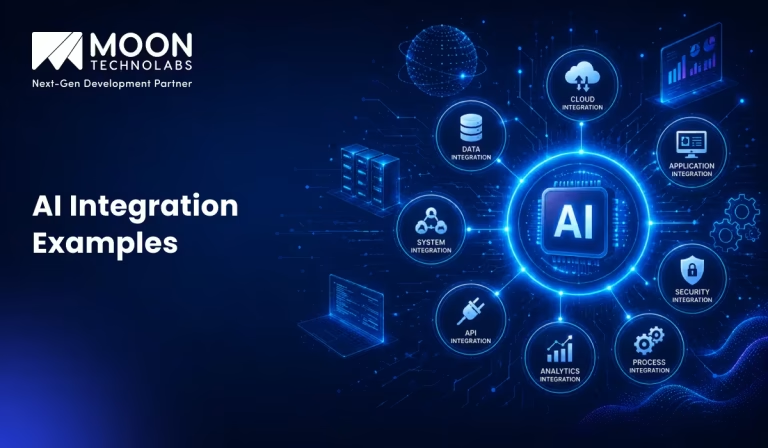
Table of Content


Blog Summary:
AI integration is no longer just a technology upgrade; it has become a key driver of business growth, efficiency, and customer experience. In this article, we will explore what AI integration really means, the different ways businesses can apply it, and practical AI Integration Examples from leading companies like Amazon, Tesla, and Netflix. You will also get a clear, step-by-step roadmap to help you integrate AI into your business effectively.
Table of Content
Everyone is talking about AI as if it were a magic solution. Buy a tool, turn it on, and results will start coming automatically. But in reality, AI does not work that way.
AI alone cannot transform a business. If an AI model operates separately from your existing systems, business data, workflows, and decision-making processes, it becomes just another costly tool with limited impact. True value comes when AI is deeply integrated into your operations, helping teams automate tasks, improve decisions, personalize experiences, and solve real business challenges.
So, what actually changes things and separates the businesses seeing real ROI from the ones waiting for their AI moment? It’s integration!
It was never about which AI tool you pick. It’s always about how deeply it connects to the way your business already runs.
This article will show you what meaningful AI Integration Examples look like across industries, the different forms it takes, and a step-by-step approach to doing it right, without the guesswork.
What is AI Integration in Business?
AI integration in business refers to embedding AI capabilities into existing systems, applications, workflows, and decision-making processes. Instead of using AI as a separate tool, businesses integrate it into their core operations to automate tasks, analyze data, improve accuracy, and enable faster decision-making.
For example, an AI-integrated CRM can help identify high-potential leads, predict customer behavior, and recommend the next best action for sales teams. Similarly, AI in supply chain management can detect demand fluctuations, forecast disruptions, and optimize inventory planning before issues affect operations.
AI integration can also improve customer support by enabling chatbots, virtual assistants, and automated ticket-routing systems to handle routine queries, prioritize urgent requests, and provide agents with real-time insights.
The goal of AI integration is not to replace existing business systems but to make them more intelligent, efficient, and responsive. From automating repetitive tasks to enabling predictive analytics and real-time decision-making, AI integration helps businesses improve performance across departments.
It is also no longer limited to large enterprises. Startups, SMEs, and growing businesses can integrate AI into their existing infrastructure in practical ways, depending on their goals, data maturity, and operational needs. In simple terms, AI integration helps businesses use their existing systems more effectively by adding intelligence, automation, and data-driven decision-making.
What Are the Types of AI Integration
One thing you need to know about AI integration is that it isn’t a one-size-fits-all approach. It can take several different forms depending on your business needs, infrastructure, and goals. Here are the five most impactful ones you must know.
AI-native Integration
In this integration type, AI is built into the core of the system or product from day one, not bolted on later. Examples include tools like GitHub Copilot and Salesforce Einstein. AI isn’t a feature in this case; it becomes the foundation of the application. Businesses going AI-native from the ground up move faster and scale smarter than those retrofitting intelligence into legacy systems.
Conversational AI
Chatbots, virtual assistants, and voice interfaces that understand and respond to human language naturally are the best examples of conversational AI. Modern conversational AI handles complex queries, personalizes responses, and closes sales, in addition to answering FAQs. It is the AI layer that most customers interact with. When done right, you will realize that customers rarely notice it isn’t a human on the other side.
Computer Vision
Using this AI type, machines can see and interpret visual data. Retailers use it to manage cashierless checkout. Manufacturers use it to identify defects on their production lines. Healthcare providers include this to analyze medical imaging. Computer vision is quietly replacing manual effort with speed and accuracy wherever visual inspection is important.
Data Integration Layer
Most businesses are drowning in data that’s spread across disconnected systems. A data integration layer uses AI to unify, clean, and make sense of data in real time. That results in decisions based on a single source of truth rather than educated guesses using siloed spreadsheets.
Hybrid Integration
This combines AI with existing cloud platforms, automations, and human workflows. It is the most practical approach for businesses in the middle of transformation, helping them keep what works while layering intelligence on top.
Real-world AI Integration Examples Across Industries
Talking about AI integrations is one thing. Seeing how the world’s largest businesses are actually implementing it is an altogether different matter. Here are the top 7 real-world examples across industries that show what meaningful AI integration looks like in practice.
Amazon
Amazon is considered the gold standard for AI integration. Its recommendation engine alone drives 35% of its total revenue by predicting what customers want before they even search for it. Behind the scenes, AI is powering their inventory forecasting, dynamic pricing, and warehouse robotics. Even the Alexa ecosystem is a masterclass in conversational AI at scale. Amazon is a business that doesn’t use AI in one corner of its operations; it runs the technology throughout virtually every layer of its operations.
BMW
BMW uses AI integration in both manufacturing and customer experience. Computer vision systems are used to inspect thousands of vehicle components for defects with precision no human team can match. BMW has an intelligent personal assistant that responds to voice commands, learns the driver’s preferences, and delivers an in-car experience accordingly. AI isn’t just a future investment for this company. It is already on their factory floor and driver’s seat.
JPMorgan Chase
Speed and accuracy are everything in the financial services sector. JPMorgan Chase uses an AI program called COiN (Contract Intelligence) to review commercial loan agreements in seconds. This same task used to take lawyers 360,000 hours annually. Beyond that, their AI offers fraud detection, risk assessment, and personalized financial advice across retail banking platforms. This business is a prime example of how AI integration translates into cost savings and greater confidence in compliance.
Johnson & Johnson
Johnson & Johnson integrates AI across surgical robotics, supply chain operations, and pharmaceutical research. In drug discovery, AI models analyze massive datasets to determine viable compounds significantly faster than traditional methods. The Ottava robotic surgical system uses AI to assist surgeons with great precision during procedures. On the supply chain end, AI ensures critical medical products reach the right place at the right time. This business is the perfect example of how AI integration in healthcare isn’t just about efficiency; it impacts outcomes.
Meta Platforms
Meta’s entire business model runs on AI integration. The content recommendation algorithm determines what users see across all platforms, Facebook, Instagram, and Threads, every single day. AI powers ad targeting,g helping businesses on Meta reach the right audience with great precision. Meta has also used AI to detect and remove harmful content at a scale no moderation team can handle alone. This is the most sophisticated example of AI integration running at a global scale.
Netflix
The platform’s recommendation engine is one of the most well-known examples of AI integration in consumer products. It analyzes viewing history, search patterns, and even how long a person hovers over a thumbnail. Netflix also uses AI to inform content production decisions, using audience data to determine which shows to greenlight. This has resulted in lower churn, higher engagement, and a platform that feels personal.
Tesla
Tesla has built its product on continuous AI integration. The Autopilot and full self-driving systems learn from billions of real-world miles driven by Tesla vehicles globally. Each car on the road feeds data back, making the entire system smarter. AI also manages the car’s battery performance, predictive maintenance alerts, and over-the-air software updates. It isn’t just another car company using AI; it is essentially a data company making cars.
Key Benefits of AI Integration for Enterprises
AI integration is quickly becoming the baseline expectation for businesses that want to grow, scale, and stay relevant. Here’s what you gain when AI is woven into how your business operates.
Improved Operational Efficiency
With AI handling repetitive, time-consuming tasks that slow down your teams, everything moves faster. Data entry, report generation, invoice processing, and even quality checks are tasks that take hours every week. AI doesn’t get tired or make copy-paste errors. You get leaner operations, faster turnaround time, and teams free to focus on work that requires thinking and creativity.
Enhanced Customer Experience
Customers today expect fast, consistent, and personalized experiences. That’s regardless of the time of day or the channel they are on. AI integration makes it possible at scale. From intelligent chatbots resolving issues instantly to recommendation engines delivering personalized suggestions. AI helps businesses deliver experiences that build loyalty. Consequently, it improves the retention rate, which every business understands is cheaper to maintain than acquiring new customers.
Faster Data-driven Decision-making
Most businesses have more data than they realize. AI changes that. Instead of waiting for your weekly reports or manually crunching numbers across disconnected systems, AI offers real-time insights. This gives leaders the information they need to make confident decisions faster. In markets that move quickly, this ability to act on fresh data rather than yesterday’s numbers offers a significant edge.
Reduced Operational Costs
AI integration helps businesses reduce operational costs by automating repetitive tasks, improving resource utilization, and minimizing process inefficiencies. By reducing dependence on manual workflows, companies can save time, reduce labor-intensive tasks, and improve overall productivity.
Predictive maintenance can help prevent costly equipment failures and unplanned downtime, while AI-powered inventory management can reduce waste, overstocking, and unnecessary storage costs. These savings are not just minor improvements. Businesses that integrate AI strategically can achieve significant reductions in operational costs within the first year of implementation.
Better Risk Management & Security
AI is great at spotting what a human eye might miss. In financial services, it can flag fraudulent transactions in milliseconds. In cybersecurity, it detects unusual network behavior before it becomes a breach. In case of operations, it identifies supply chain vulnerabilities before they escalate. By continuously monitoring patterns and anomalies across systems, AI provides businesses with complete visibility into risks that manual oversight overlooks.
Increased Business Scalability
Growth usually means hiring more people, adding complexity, and increasing the number of tools your business uses. AI integration can significantly change that equation. When your systems become more intelligent, scaling does not always require a proportional increase in headcount. Instead, AI-enabled systems can help businesses handle more customers, operational complexity, and transaction volume without adding unnecessary overhead.
5 Steps to Successful AI Integration & Adoption
Knowing the benefits of AI integration is one thing. Actually, pulling it off in a real business with real constraints is another matter. The good news is that it doesn’t have to be overwhelming. Here’s a clear and practical roadmap that works regardless of your industry or company size.
Identify High-impact Use Cases
A more effective way to begin an AI journey is to focus on one clear business priority rather than launching too many initiatives at once. When companies invest in multiple tools or pilots without a focused strategy, it can become difficult to measure impact, manage adoption, and achieve meaningful results.
A smarter approach is to start with a specific use case, validate its value, and then expand AI integration gradually across other areas of the business. This helps organizations build confidence, reduce complexity, and create a stronger foundation for long-term AI success.
First, look at your operations and identify the biggest bottlenecks. Where is the manual effort eating the most time? Where is all decision-making slow due to the lack of the right data in real time? All of them are your highest-impact use cases, the places where AI integration will deliver visible and measurable results quickly.
Start with one or two well-chosen use cases to build internal confidence, generate early wins, and give you proof points to scale further. Think of it as planting a flag instead of drawing a map of the entire territory all at once.
Build a Unified Data Foundation
AI is only as good as the data it learns from. This is the step most businesses underestimate. It is also the one that causes major integration failures down the line. If your data is scattered across multiple systems, riddled with duplicates, or simply incomplete, no AI can save you.
Before layering AI into your operations, invest time in getting your data house in order. That includes consolidating data sources, establishing data formats, and ensuring quality control. A unified data foundation doesn’t just make AI work better. It makes your entire business operate with better clarity and confidence.
Establish Governance & Ethics
AI, with its guardrails, becomes a liability very soon. When you integrate AI into your business, you need clear policies around how it makes decisions, what data it uses, and who is accountable when something goes wrong. That is no longer about being overly cautious. It is about building AI that your customers, employees, and even regulators can trust.
Define who owns AI decisions within the organization. Establish guidelines around data privacy, bias detection, and model transparency. Make sure there is a human accountability layer for high-stakes decisions.
If you get governance right from the start, you avoid messy and expensive corrective actions that arise from ignoring it until problems surface.
Upskill Your Workforce & Embed AI
AI integration doesn’t just change your systems; it changes how your people work. Employees who understand how to work with AI, interpret its outputs, and flag when something doesn’t look right are far more valuable than those who simply hand tasks to automation before walking away.
You must invest in training programs that build AI literacy across your teams, not just the technical people. The goal isn’t to turn everyone into a data scientist. It is to create a workforce that is comfortable working with AI tools, confident in acting on AI-generated insights, and capable of identifying where technology falls short. Embedding AI into your daily workflows gradually, rather than all at once, makes adoption smoother and resistance lower.
Measure, Learn, and Evolve
AI integration isn’t a one-time project with a finish line. It is an ongoing process of refinement. Once your AI systems go live, the real work, like tracking performance, identifying gaps, and continuously improving how technology works, begins.
Set clear KPIs for every AI initiative from day one. Is the chatbot reducing customer support ticket volume? Has the demand forecasting model improved inventory accuracy? Is the fraud detection system catching more anomalies with fewer false positives?
These numbers will tell what’s working and where you must double down. Businesses treating AI integration as a living, evolving capability are the ones that can compound advantage with time.
We help businesses integrate AI into their existing systems the right way, delivering results without the overwhelm or guesswork.
How Moon Technolabs Helps Businesses with AI Integration?
Understanding AI integration is important. But even more crucial is having the right partner to execute your integration needs.
As a top-notch AI development company, we don’t believe in dropping a generic AI tool into your business and calling it a day. We take time to understand how your business operates. We get to know everything, from your systems and workflows to your goals and data, before recommending a solution.
We use a practical and outcome-driven approach. Whether you are looking to automate repetitive back-office processes, build a conversational AI layer for customer experience, or create a unified data foundation to enable smarter decisions, we build solutions that fit around the way you work, not the other way around.
We have helped several businesses across industries, ranging from healthcare and finance to retail and logistics, integrate AI in ways that deliver measurable results without disrupting what’s already working. Every engagement starts with identifying use cases that move the needle the fastest. Every solution is built with scalability in mind from day one.
If you are ready to move past the hype and build AI integration that actually works for your business, Moon Technolabs is ready to help you get there.
A Final Word
AI integration isn’t another trend you must chase or a buzzword to throw into your next strategy presentation. It is a fundamental shift in how businesses operate, compete, and grow. It is happening now, across every industry.
Businesses winning with AI aren’t necessarily the ones with the biggest budgets or most advanced tech stacks. They are the ones that integrated thoughtfully, started with the right use cases, and built on a foundation designed to scale.
You don’t have to figure it all out at once; you just have to start smart. And now that you know what meaningful AI integration looks like, the next step is putting it into action. Whether you are just exploring your options or ready to build, Moon Technolabs has helped businesses across industries turn AI integration from concept into a competitive advantage.
Get in touch with our team and take your first step towards AI integration that actually delivers.
FAQs
01
What are examples of AI integration?
Amazon’s recommendation engine, Netflix’s personalization, JPMorgan’s contract review tool, and Tesla’s self-driving system are strong examples of AI integration. On a smaller scale, the examples include automated invoicing and chatbots.02
What are the 4 AI platforms?
The four widely used AI platforms include Google Cloud AI, Microsoft Azure AI, Amazon Web Services (AWS) AI, and IBM Watson. Each platform offers AI tools and services tailored to various business needs, including machine learning, natural language processing, automation, predictive analytics, and enterprise AI integration.03
Is ChatGPT AI or generative AI?
ChatGPT is both. It is an AI system in the generative AI category. That means it creates new content, such as text and code, based on patterns learned from large datasets.04
What does it mean to integrate AI into existing systems?
It means connecting AI capabilities to tools and workflows your business already uses. This makes them smarter without you having to rebuild from scratch.05
What are the different types of AI integration?
The five main types of AI integration include AI-native integration, conversational AI, data integration, computer vision, and hybrid integration. Most businesses use a combination based on their goals.




Jayanti Katariya is the CEO of Moon Technolabs, a fast-growing IT solutions provider, with 18+ years of experience in the industry. Passionate about developing creative apps from a young age, he pursued an engineering degree to further this interest. Under his leadership, Moon Technolabs has helped numerous brands establish their online presence and he has also launched an invoicing software that assists businesses to streamline their financial operations.
Submitting the form below will ensure a prompt response from us.
We refine our expertise to deliver innovative business solutions.





205 N Michigan Avenue, #810, Chicago, 60601, Illinois, United States
13500 Long Is Dr, Pflugerville, TX 78660, USA

C/105 Ganesh Meridian, S.G. Highway, Ahmedabad, GJ 380060


Ayse D.
Co-Founder France
“ I highly recommend Moon Technolabs as the quality of service is wonderful. We have hired this company to develop the product based on some complex & technical issues. We get the best quality services as compared with others in the market. Huge Thanks to Moon Technolabs as the team is always ready to give the solution all time.”

Justin G.
Founder & CEO USA
USA“ Moon Technolabs is a pioneer in the WebRTC based project as they have fixed complicated segments of the module by fulfilling different product lines by providing 24X7 customer support. We really recommended Moon Technolabs as they are able to develop products as per the module deadline and project timeline.”

Flavio S.
Founder & Managing Director Germany
“I am happy to recommend Moon Technolabs for their app development services. They successfully developed apps for me, and I am highly satisfied with the overall outcomes. The development team has swiftly addressed the issues with responsive and effective communication to understand the requirement quickly and actively resolve the back-and-forth problems that arose...”

Jay M.
Founder & CEOUSA“Moon Technolabs is the best company that provides advanced apps and websites development services in the USA and Europe. I am a newbie to develop my app with an external team. I am really happy to work with them as I am not that much mobile apps user. Here, the team and specially the CEO of Moon Technolabs helps me to let me know about the benefits of my app to generate revenue....”


Our Offices
India
C/105 Ganesh Meridian,S.G. Highway, Ahmedabad, GJ 380060USA
205 N Michigan Avenue, #810, Chicago, 60601, Illinois, United StatesContact Information


