


RAG vs MCP: Key Differences, Features, Benefits, and Use Cases

Artificial Intelligence Team
Last Updated: Nov 26, 2026 Total Views: 86
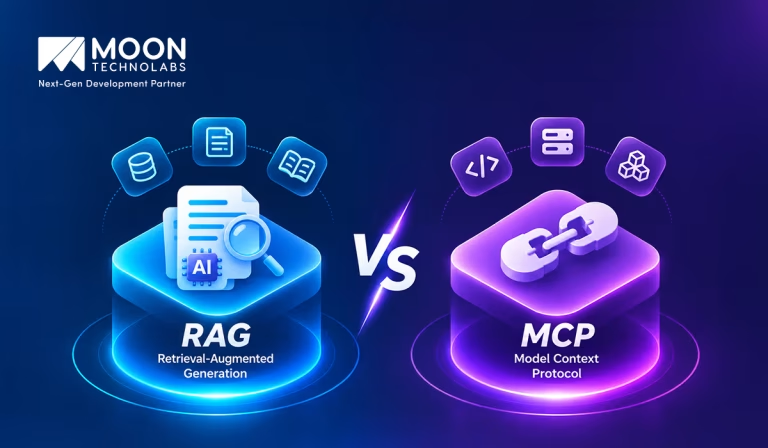
Table of Content


Blog Summary:
Understanding RAG vs MCP helps businesses choose the right technology for their AI applications. RAG improves knowledge retrieval and response accuracy, while MCP enables standardized tool integration and task execution. Together, they can build intelligent AI agents that access relevant information, interact with external systems, and automate business workflows.
Table of Content
As AI applications advance, technologies like Retrieval-Augmented Generation (RAG) and Model Context Protocol (MCP) are expanding the capabilities of Large Language Models (LLMs), and understanding RAG vs MCP matters because each addresses different challenges in AI development. RAG helps AI systems retrieve relevant information from external knowledge sources, while MCP lets them connect with tools, applications, and services to perform tasks.
In this blog, we’ll explore the key differences between RAG and MCP, their core features, benefits, practical use cases, and how businesses can choose the right approach for their AI solutions.
What is RAG (Retrieval-augmented Generation)?
RAG lets LLMs access and use information beyond their training data. When a user submits a query, the system searches connected knowledge sources, retrieves relevant documents or data passages, and provides that information to the model as context for generating an answer.
Businesses can use RAG to develop AI applications that work with their proprietary data, including internal documentation, product manuals, customer records, company policies, and technical resources. Instead of manually searching multiple repositories or relying on generic AI-generated responses, employees can ask questions in natural language and get contextually relevant answers.
Choosing reliable RAG development services helps organizations create customized solutions that connect language models with existing business knowledge sources.
Core Features of RAG
RAG combines several capabilities to improve information retrieval and response generation. Here are its core features and how they support more accurate, context-aware AI applications:
Retrieval of External Knowledge
AI applications can access information from external sources such as PDFs, websites, internal documents, databases, and company knowledge repositories. This lets language models retrieve relevant information at query time instead of relying entirely on their pre-trained knowledge.
Vector Databases and Semantic Search
Information is converted into numerical representations called vector embeddings and stored in vector databases. Semantic search then identifies relevant content based on meaning, intent, and context, allowing AI systems to find useful information even when exact keywords do not match.
Context-aware Response Generation
The system supplies retrieved information to the language model as additional context before generating a response. This helps the model understand specific queries, incorporate relevant facts, and produce answers grounded in the information provided rather than relying solely on its training data.
Integration With Enterprise Knowledge Bases
Business data stored across platforms such as SharePoint, Google Drive, Confluence, internal databases, and document management systems can be connected to AI applications. Employees can access company-specific information through a unified interface without searching multiple platforms individually.
Source Attribution and Traceability
Generated answers can include references to the original documents, records, or passages used during retrieval. This makes it easier for users to verify information, review supporting evidence, and maintain transparency when using AI for business-critical decisions.
Real-time Knowledge Retrieval
Connected data sources can be queried to retrieve recently updated information whenever a user submits a request. With proper indexing and synchronization, new documents and business records become searchable without retraining the underlying language model.
Discuss your requirements with our team and explore practical RAG and MCP solutions to make your AI initiatives more effective.
Advantages of RAG
RAG offers several benefits that make AI applications more reliable, informative, and efficient. Let’s explore its key advantages and how they add value to business operations:
Improved Response Accuracy
By providing relevant information from trusted external sources, RAG helps language models generate more precise and contextually relevant answers. This reduces dependency on general training knowledge and lets AI applications respond with information specific to the user’s query.
Reduced LLM Hallucinations
Grounding responses in retrieved documents and verified data helps minimize incorrect or fabricated information. When relevant context is available, the model has a stronger factual foundation for generating answers, although RAG does not eliminate hallucinations.
Access to Updated Information
Organizations can connect AI applications to regularly updated databases, documents, and knowledge repositories. This enables users to retrieve current business information, policies, product details, and operational data without waiting for the language model to be retrained.
Reduced Need for Model Fine-tuning
New information can be added to connected knowledge sources without modifying the underlying language model. This reduces the need for repeated fine-tuning when business data changes, making knowledge updates easier and often more cost-effective.
Better Domain-specific Responses
By retrieving industry-specific documents, technical resources, and internal business information, RAG helps general-purpose language models address specialized queries. This makes AI applications more useful in areas such as healthcare, finance, legal services, customer support, and enterprise operations.
RAG Use Cases
RAG supports a wide range of practical applications across industries. Here are some common use cases that show how businesses use it to improve information access and automate everyday tasks:
Enterprise Knowledge Assistants
Organizations use RAG-powered knowledge assistants to help employees find information across internal documents, company policies, project files, and operational databases. Employees can ask questions in natural language and receive relevant answers based on the organization’s existing knowledge repositories.
Document Search and Question Answering
RAG enables users to search large collections of documents and extract answers without manually reviewing individual files. It retrieves relevant sections from reports, manuals, contracts, and technical documentation, helping users locate specific information and understand complex content faster.
AI-powered Customer Support
Customer support platforms use RAG to retrieve accurate information from product documentation, FAQs, troubleshooting guides, and knowledge bases. This helps AI assistants answer customer queries, provide relevant solutions, explain product features, and maintain consistency across support interactions.
Healthcare Information Retrieval
Healthcare organizations can use RAG to retrieve relevant information from medical guidelines, clinical research papers, hospital documentation, and healthcare knowledge repositories. It helps medical professionals access supporting information more efficiently while keeping responses grounded in available reference materials.
Legal and Financial Document Analysis
Legal and financial professionals can use RAG to search contracts, regulatory documents, compliance guidelines, financial reports, and case records. By retrieving relevant clauses and supporting information, these systems help streamline document reviews, research, and information analysis.
Want to explore more applications? Check out these real-world RAG use cases to see how businesses across industries use retrieval augmented generation to improve operations, automate information retrieval, and build smarter AI-powered solutions.
What is MCP (Model Context Protocol)?
MCP is an open standard that defines how AI applications connect with external tools, data sources, and services. It provides a common communication framework that lets AI assistants discover capabilities, access resources, and interact with connected systems without needing a separate integration method for every tool.
For businesses planning to build AI agents that interact with multiple applications, the right integration approach is essential. Custom MCP server development enables AI systems to communicate with external tools, access business data, and perform application-specific operations through a standardized interface. This makes it easier to extend AI capabilities while keeping integrations aligned with existing business workflows.
Core Features of MCP
MCP offers several capabilities that simplify how AI applications connect with external tools and data sources. Here are its core features and how they support seamless AI system integration:
Standardized AI Tool Integration
MCP provides a standardized way for AI applications to connect with external tools, services, and data sources. Developers can integrate different systems through a common protocol instead of building separate, custom integrations for every AI model or application.
Client-Server Architecture
The protocol follows a client-server architecture where an MCP client communicates with MCP servers to access external capabilities. The client manages communication, while servers expose tools, resources, and prompts that AI applications can use when needed.
Tool Discovery and Execution
MCP servers can expose available tools along with their descriptions, input parameters, and expected functionality. AI applications can discover these tools and invoke appropriate operations, enabling agents to perform tasks such as retrieving data, running queries, or interacting with external services.
Access to External Resources
Through MCP, AI applications can access external resources such as files, databases, documents, and other structured information. This lets models retrieve relevant context from connected systems without requiring direct, custom-built access to every data source.
Support for Prompts and Context Sharing
MCP supports reusable prompts and structured resources that provide AI applications with additional context for specific tasks. These capabilities help developers standardize common workflows, supply relevant information, and maintain consistency across interactions with connected systems.
Extensible Integration Architecture
MCP supports an extensible architecture that allows developers to build custom servers and connect additional tools, resources, and services. As application requirements evolve, organizations can introduce new integrations without redesigning their entire AI application or communication framework.
Advantages of MCP
MCP brings several advantages to AI development by simplifying integrations and expanding agent capabilities. Let’s explore its key benefits and how they help businesses build more connected and scalable AI applications:
Simplified AI System Integration
MCP simplifies connecting AI applications with external tools, databases, APIs, and business systems. Its standardized communication approach reduces integration complexity, letting developers connect different services without building a separate communication mechanism for each application.
Reusable Tool and Data Connections
Once an MCP server is developed for a particular tool or data source, multiple compatible AI applications can reuse that integration. This eliminates repetitive development work and makes it easier to maintain consistent access to shared resources across different projects.
Improved AI Agent Capabilities
By connecting language models with external tools and services, MCP lets AI agents take action beyond generating text. Agents can retrieve information, interact with business applications, execute supported operations, and complete multi-step workflows based on user instructions.
Reduced Custom Integration Efforts
MCP reduces the need to build and maintain individual integrations for every AI application and external service. Developers can follow a common communication protocol, making integration workflows more consistent and reducing ongoing development and maintenance effort.
Flexible and Scalable AI Architecture
Organizations can expand their AI infrastructure by adding new MCP servers, tools, and data sources as requirements change. This modular approach supports evolving business needs without requiring major changes to the existing AI application architecture.
You May Also Like:
AI in Software Development: Transforming Processes & Innovation
MCP Use Cases
MCP enables AI applications to interact with external systems and handle practical business tasks. Here are some common use cases that demonstrate how organizations apply MCP across different workflows and applications:
AI Agents With External Tool Access
AI agents use MCP to connect with external tools, APIs, and services to perform tasks beyond text generation. For example, an agent can access calendars, retrieve information, send emails, or interact with business applications through supported tool integrations.
Enterprise Application Integration
Organizations can use MCP to connect AI assistants with enterprise applications such as CRM platforms, project management tools, communication systems, and cloud services. This allows employees to interact with multiple business applications through a single AI-powered interface.
Database Querying and Data Access
MCP enables AI applications to interact with connected databases through tools exposed by MCP servers. Users can request specific information in natural language, while the AI application can invoke supported database operations to retrieve records and access relevant business data.
Developer Assistants and Coding Tools
Development teams can use MCP to connect AI coding assistants with code repositories, development environments, documentation, and testing tools. These integrations help developers retrieve technical information, inspect project files, execute supported operations, and streamline everyday development activities.
Workflow Automation and Task Execution
MCP allows AI agents to interact with multiple external services to coordinate business tasks and automate workflows. For example, an agent can retrieve customer information, update CRM records, create project tasks, and trigger supported actions across connected applications.
RAG vs MCP: Key Differences
Understanding MCP vs RAG clarifies how these technologies differ in purpose, architecture, and capabilities, even though both enhance AI applications. Here’s a side-by-side comparison of their key differences across important technical and business aspects:
| Comparison Factor | RAG | MCP |
|---|---|---|
| Primary Purpose | Retrieves external information to generate accurate, context-aware responses. | Connects AI applications with external tools, services, and data sources. |
| Architecture and Core Components | Uses embedding models, vector databases, retrievers, and language models. | Uses MCP clients, MCP servers, tools, resources, and prompts. |
| Data Retrieval vs Tool Integration | Focuses on searching and retrieving relevant information from knowledge sources. | Focuses on connecting AI models with tools and enabling external operations. |
| Context Management | Supplies retrieved documents and relevant data as context for response generation. | Provides access to resources and prompts through a standardized communication protocol. |
| External System Connectivity | Connects primarily to document repositories, databases, and knowledge bases. | Connects to APIs, databases, applications, development tools, and external services. |
| Implementation Complexity | Requires document processing, chunking, embeddings, indexing, and retrieval configuration. | Requires MCP client and server setup, tool definitions, and integration configuration. |
| Security and Access Control | Requires secure data retrieval, document-level permissions, and access controls. | Requires authentication, authorization, permission management, and secure tool execution. |
| Scalability and Performance | Depends on indexing strategies, vector database performance, retrieval quality, and model latency. | Depends on server performance, tool execution, connection management, and external service availability. |
| Development and Maintenance Costs | Costs include embedding generation, vector storage, infrastructure, data processing, and maintenance. | Costs include server development, tool integrations, infrastructure, security, and ongoing maintenance. |
| Best Use Cases | Enterprise knowledge assistants, document search, customer support, and domain-specific question answering. | AI agents, workflow automation, enterprise integrations, database access, and developer assistants. |
MCP vs RAG: Which One Should You Choose?
Choosing between MCP and RAG depends on what you want your AI application to achieve. Understanding RAG vs MCP helps identify when to use each technology and how combining both can support more capable, connected, and efficient AI solutions:
When to Choose MCP
Choose MCP when your AI application needs to:
- Connect with external tools, APIs, and business applications.
- Let AI agents take action beyond text generation.
- Automate workflows across multiple enterprise systems.
- Retrieve information from connected databases and services.
- Integrate different tools through a standardized communication protocol.
- Build AI agents that can interact with external environments.
When to Choose RAG
Choose RAG when your AI application needs to:
- Retrieve information from large document collections and knowledge bases.
- Generate context-aware responses using external data.
- Build enterprise knowledge assistants and AI chatbots.
- Enable semantic search across unstructured business documents.
- Reduce hallucinations by grounding responses in retrieved information.
- Provide accurate answers using domain-specific or frequently updated data.
Can RAG and MCP Work Together?
Yes, RAG and MCP can complement each other within the same AI application.
- Knowledge Retrieval: RAG retrieves relevant information from documents, databases, and enterprise knowledge bases.
- Tool Integration: MCP connects AI applications with external tools, APIs, and business services.
- Contextual Responses: Retrieved information helps AI models generate more relevant and informed responses.
- Task Execution: MCP enables AI agents to perform actions using connected tools and applications.
- Combined Capabilities: Together, they enable AI agents to retrieve information, understand context, interact with external systems, and execute multi-step workflows.
See how RAG and MCP can enhance your AI capabilities with our tailored solutions designed around your business goals and workflows.
How Moon Technolabs Helps Businesses Implement RAG and MCP Solutions
Moon Technolabs works with businesses to identify where RAG and MCP can add value to their existing operations. Whether the goal is to build an internal knowledge assistant, improve document search, or enable AI agents to interact with enterprise software, we focus on selecting the right architecture and implementing it effectively.
For organizations planning to move beyond basic AI chatbots, Moon Technolabs offers AI development services to build intelligent applications with capabilities such as knowledge retrieval, tool integration, workflow automation, and enterprise system connectivity.
Conclusion
RAG and MCP serve different but complementary purposes in modern AI applications. When comparing RAG and MCP, it’s important to understand that RAG helps language models retrieve relevant information and generate context-aware responses.
At the same time, MCP connects AI systems to external tools, services, and business applications so they can perform tasks. The right choice depends on your project requirements, data accessibility, and desired functionality.
Businesses can also combine both technologies to build AI agents that retrieve information and execute actions within connected systems. Working with an experienced AI agent development company helps organizations turn these capabilities into practical AI solutions that support business operations, improve productivity, and automate complex workflows.
FAQs
01
What is the main difference between RAG and MCP?
The RAG system helps AI models retrieve relevant information from external knowledge sources. MCP connects AI models with external tools, systems, and data sources through a standardized communication protocol.02
Can RAG and MCP be used together in AI applications?
Yes, RAG and MCP can work together effectively. RAG provides relevant context, while MCP lets AI applications access external tools, databases, and services for more intelligent, dynamic responses.03
Is MCP an alternative to RAG?
No, MCP is not a direct alternative to RAG. They serve different purposes: RAG enhances knowledge retrieval, while MCP standardizes connections between AI models and external tools, resources, and services.04
Which is better for building AI agents: RAG or MCP?
Neither is universally better. RAG is ideal for knowledge-intensive agents, while MCP enables tool integration and external interactions. Combining both creates more capable AI agents with contextual knowledge and operational flexibility.05
How much does it cost to implement RAG and MCP solutions?
Implementation costs depend on project complexity, infrastructure, data volume, integrations, and development requirements. Basic solutions may cost a few thousand dollars, while enterprise implementations require significantly larger investments.



Explore the latest insights on Artificial Intelligence, including Generative AI, Agentic AI, natural language processing, computer vision, automation, and enterprise AI solutions. This category covers industry trends, practical applications, implementation strategies, and innovations that help businesses leverage AI for smarter decision-making and digital transformation. Stay updated with evolving AI technologies that are reshaping industries worldwide.
Submitting the form below will ensure a prompt response from us.
We refine our expertise to deliver innovative business solutions.




205 N Michigan Avenue, #810, Chicago, 60601, Illinois, United States
13500 Long Is Dr, Pflugerville, TX 78660, USA

C/105 Ganesh Meridian, S.G. Highway, Ahmedabad, GJ 380060




Ayse D.
Co-Founder France
“ I highly recommend Moon Technolabs as the quality of service is wonderful. We have hired this company to develop the product based on some complex & technical issues. We get the best quality services as compared with others in the market. Huge Thanks to Moon Technolabs as the team is always ready to give the solution all time.”

Justin G.
Founder & CEO USA
“ Moon Technolabs is a pioneer in the WebRTC based project as they have fixed complicated segments of the module by fulfilling different product lines by providing 24X7 customer support. We really recommended Moon Technolabs as they are able to develop products as per the module deadline and project timeline.”

Flavio S.
Founder & Managing Director Germany
“I am happy to recommend Moon Technolabs for their app development services. They successfully developed apps for me, and I am highly satisfied with the overall outcomes. The development team has swiftly addressed the issues with responsive and effective communication to understand the requirement quickly and actively resolve the back-and-forth problems that arose...”

Jay M.
Founder & CEOUSA“Moon Technolabs is the best company that provides advanced apps and websites development services in the USA and Europe. I am a newbie to develop my app with an external team. I am really happy to work with them as I am not that much mobile apps user. Here, the team and specially the CEO of Moon Technolabs helps me to let me know about the benefits of my app to generate revenue....”


Our Offices
India
C/105 Ganesh Meridian,S.G. Highway, Ahmedabad, GJ 380060USA
205 N Michigan Avenue, #810, Chicago, 60601, Illinois, United StatesContact Information


