


Top 10 Product Development Software to Streamline Your Product Lifecycle

Jayanti Katariya
Last Updated: May 19, 2026 Total Views: 500
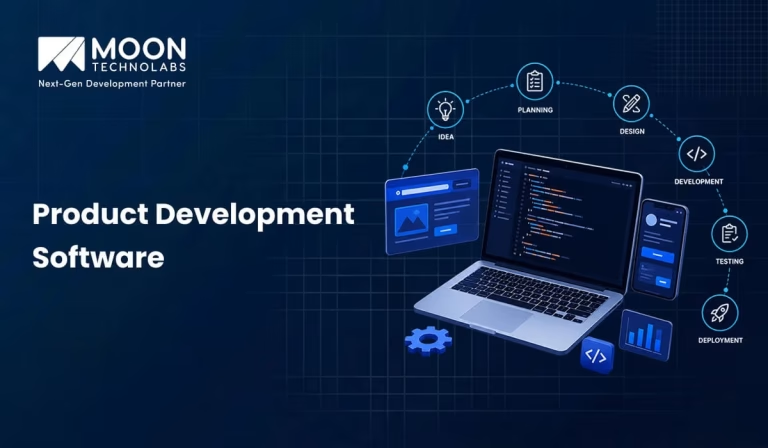
Table of Content


Blog Summary:
Productivity development software lets businesses build top-rated products efficiently while staying competitive – but choosing the right one from plenty of available options is clumsy. This blog lets you explore the best product development solutions, along with key details such as features, pricing, use cases, and more. Based on these details, you can dive into an effective comparison and select the right tool for your organization.
Table of Content
Most businesses, especially those that rely on manual workflows, face many difficulties with product planning, development, collaboration, testing, and delivery. With the increasing complexity of product development cycles, organizations need smart methods to transform operations, enhance team coordination, and launch products rapidly.
By using the relevant product development software, they can avail themselves of these benefits easily. It helps businesses simplify their entire product lifecycle while minimizing errors and enhancing visibility across teams. These tools also increase their productivity and thus time-to-market.
Meanwhile, selecting a perfect product development software is certainly not an easy task – it requires a lot of research work to gather various details. In this post, we will provide a list of some popular software that helps selecting the right one.
How We Selected the Best Product Development Software?
Well, we understand that selecting the best product development software is something that varies based on several factors, including the needs, size, etc., of an organization. We have compiled the entire selection process through a criteria-driven and structured methodology to ensure every important tool on this list earns its place genuinely.
Below are some important pillars that our selection is focused on completely:
Ease of Use
We have reviewed every platform to understand its intuitive interface, steep learning curve, and its teams (whether they are technical or non-technical). Those tools come with drag-and-drop functionality, clean dashboards, responsive customer support, etc., and have gained a huge appreciation from their users.
Collaboration Features
Modern product development requires a vast collaboration across different team members. They can be either designers, developers, stakeholders, product managers, or even end users. We have thoroughly analyzed how each tool offers real-time collaboration, commenting, feedback sharing, cross-functional visibility, and task assignment.
Integration Capabilities
It’s crucial for your product development tool to work well with the vast ecosystem that your team relies heavily on, be it Slack, Jira, Figma, GitHub, or Salesforce. We have carefully evaluated every platform’s native integration, compatibility, and API access with many third-party tools.
Scalability
A tool that works for a team of 5 people startups can be a big problem for an organization with 200 people. We have analyzed how perfectly each platform scales, not only in terms of user seats but also in handling complex workflows, increasing data volumes, expanded team structures, and various product lines.
Pricing Flexibility
When it comes to budget consideration, it’s a great reality for every organization, from early-stage startups to established enterprises. Our team has gone through the pricing structure of each tool to check whether it offers pay-as-you-go plans, free tiers, customizable enterprise packages, or modular pricing.
Industry Suitability
It’s true that not every product development software is designed with the same industries in mind. A platform that is meant for SaaS development may not be able to cater to hardware manufacturers or even any healthcare product teams with the same efficiency. We have also considered how perfectly each tool adapts to multiple industry contexts, workflow complexities, regulatory requirements, and more.
Top 10 Product Development Software
Your selection of the software can make or even break your entire workflow, whether you are a startup mapping out your first MVP or an enterprise that manages complex and multi-sprint releases. We have listed below some of the most popular product development software:
Jira Software
Best for: Agile and development teams
As one of the most widely used software, Jira is apt for product development. It’s highly popular among software teams as a project management tool. It’s best for agile development and facilitates teams to plan sprints, manage backlogs, track issues, and analyze project progress in real time. Jira emerged as the right option for SaaS companies, startups, enterprises, and many others.
Key Features:
- Scrum and Kanban boards
- Sprint planning and backlog management
- Advanced bug and issue tracking
- Custom workflows and automation
Ideal Use Case:
Jira is the best option for agile software teams that require strong sprint management, engineering collaboration capabilities, and bug tracking.
Asana

Best for: Task and workflow management
As an intuitive product management platform, Asana allows teams to organize multiple tasks, workflows, and projects with higher efficiency. It comes with collaborative features and a clean interface that make it quite popular among different teams, whether it’s technical or non–technical teams. The tools let businesses manage product launches, analyze deadlines, assign responsibilities, and maintain visibility across teams.
Features:
- Timeline and calendar views
- Workflow automation
- Task dependencies and milestones
- Team collaboration tools
Ideal Use Cases:
Asana works perfectly for organizations seeking a simple yet robust workflow management solution that supports cross-functional collaboration.
Monday.com
Best for: Customizable workflows
Monday.com provides a customizable and visual platform when it comes to managing product development workflows. Teams can craft automated repetitive tasks, craft tailored dashboards, and track project performance from a centralized workspace. It comes with a flexibility that makes it a perfect choice for businesses across multiple industries, such as manufacturing, marketing, software, etc.
Key Features:
- Custom dashboards and workflow templates
- Automation for repetitive processes
- Project timeline management
- Multiple project visualization options
Idea Use Cases:
Asana works outstandingly for cross-functional product teams that manage a variety of projects simultaneously. It’s useful specifically when non-technical stakeholders need to stay looped in without navigating a developer-centered interface.
ClickUp

Best for: All-in-one product development management
ClickUp strongly positions itself as the one application for replacing them all, and it mainly delivers on that promise. It includes a range of features packed into an individual platform, which is developed mainly for those teams that wish for comprehensive functionality even without juggling various subscriptions.
Key Features:
- Docs and knowledge management
- Goal and milestone tracking
- Sprint planning tools
- Time tracking and reporting
Ideal Use Cases:
ClickUp is the right choice for teams looking for a one-stop product development platform that blends collaboration, productivity, and project management.
Productboard
Best for: Product roadmap and prioritization
Designed specifically for product managers, Productboard is a good choice for managers who need to prioritize features, align product strategies, and manage customer feedback with business objectives. The platform allows organizations to make data-based product decisions through the consolidation of development priorities and customer insights in one place.
Key Features:
- Customer feedback management
- Feature prioritization frameworks
- Product roadmap creation
- Stakeholder collaboration
Ideal Use Case:
Productboard is the right option for product teams emphasized on customer-based product planning and strategic roadmap management.
Aha!

Best for: Strategic product planning
Being a comprehensive product management software, Aha allows businesses to define product strategies, create detailed roadmaps, and manage ideas. It’s mainly used through organizations that need long-term product planning and advanced reporting capabilities. The platform allows leadership teams to align product initiatives with company goals while maintaining complete visibility into implementation.
Key Features:
- Strategic product roadmaps
- Idea and feedback management
- Product analytics and reporting
- Goal alignment tools
Ideal Use Case:
Aha is a perfect match for enterprises and product leaders to manage strategic planning across different teams and products.
Trello
Best for: Simple visual workflows
As a user-friendly project management tool, Trello is based on Kanban methodology. It boasts a card-based interface that makes it convenient for teams to organize tasks, collaborate visually, and track progress. Though it’s simpler than enterprise-grade platforms, Trello is highly effective for small businesses, startups, and teams to manage lightweight product workflows.
Key Features:
- Visual Kanban boards
- Drag-and-drop task cards
- Checklists and due dates
- Collaboration and commenting tools
Ideal Use Case:
Trello is the best option for startups and small teams seeking a smooth product workflow management solution.
Wrike
Best for: Enterprise teams
As an advanced work management platform, Wrike is designed mainly for large organizations that handle even complex product development processes. It includes workload management, extensive reporting, collaborative features, etc., for enterprise-scale operations. The tool supports cross-functional teams while letting businesses boost productivity and resource utilization.
Key Features:
- Advanced reporting and analytics
- Resource and workload management
- Custom workflows
- Team collaboration tools
Ideal Use Case:
Wrike is the apt choice for enterprise businesses that require resource allocation, advanced reporting, large-scale project management capabilities, etc.
Notion
Best for: Documentation and collaboration
Notion is another top-rated productivity platform for product teams, mainly due to its flexibility to manage knowledge bases, documentation, collaboration, and task tracking. It facilitates teams to centralize product requirements, roadmaps, meeting notes, project updates, etc., within a single workspace.
Key Features:
- Collaborative wiki and documentation
- Custom databases
- Task and project tracking
- Templates for workflows and planning
Ideal Use Case:
Notion is perfect for teams desiring to combine collaboration, documentation, lightweight project management, etc., in a single platform.
Zoho Projects
Best for: Budget-friendly product development
Zoho Projects includes the capability of feature-rich project management solutions, though it’s affordable. It’s good for businesses that manage product development workflows on a budget. Even though it has lower pricing, the platform mainly includes automation, collaboration, and reporting capabilities.
Key Features:
- Task automation and workflow rules
- Milestone tracking
- Time tracking and reporting
- Team collaboration tools
Ideal Use Case:
Zoho Projects is the right option for businesses that are growing rapidly and seeking reliable product development management software, even without investing in expensive enterprise platforms.
Comparison of Top Product Development Software
If you are still confused about selecting the right product development tool for your organization, you can go through the following table to get a detailed comparison of these tools. We have provided a detailed comparison of these tools based on factors like pricing, features, team size, and best use.
| Software | Pricing | Best For | Key Features | Team Size Suitability |
|---|---|---|---|---|
| Jira Software | Free: Up to 10 users Standard: $8.15/user/month. |
Agile software development teams | Sprint planning, scrum boards, bug tracking, CI/CD integrations, etc. | Small to large size team. |
| Asana | Free: Up to 15 users Starter: $13.49/user/month. Advanced: $30.49/user/month. |
Tasks and workflow management | Automation, Timeline view, Team collaboration, workload management, etc. | Small to large (10 to 1000+ users) |
| Monday.com | Free: Up to 2 users Basic:$12/user/mo Standard: $14/user/mo; Pro: $24/user/mo; Enterprise – Custom |
Customizable workflows | Dashboards, no-code automation, 200+ integrations, workload tracking | Small to large (2–1,000+ users) |
| ClickUp | Free Forever; Unlimited $7/user/mo; Business $12/user/mo; Enterprise – Custom | All-in-one product development | Docs, goals, sprints, time tracking, mind maps, whiteboards | Freelancers to enterprise |
| Productboard | Starter $19/maker/mo; Pro $59/maker/mo; Scale – Custom; Enterprise – Custom | Product roadmap and prioritization | Customer feedback hub, prioritization scoring, roadmaps, integration with dev tools | Mid to large (10–500+ users) |
| Aha | Roadmaps $59/user/mo; Ideas $39/user/mo; Whiteboards $9/user/mo; Develop $9/user/mo | Strategic product planning | Roadmaps, idea management, analytics, goal tracking, reporting | Mid to large (10–1,000+ users) |
| Trello | Free; Standard $5/user/mo; Premium $10/user/mo; Enterprise $17.50/user/mo | Simple visual workflows | Kanban boards, cards, checklists, Power-Ups, calendar view | Freelancers to mid-size (1–500 users) |
| Wrike | Free; Team $9.80/user/mo; Business $24.80/user/mo; Enterprise and Pinnacle – Custom | Enterprise-grade project management | Advanced reporting, resource management, time tracking, approval workflows | Mid to enterprise (20–1,000+ users) |
| Notion | Free; Plus $10/user/mo; Business $15/user/mo; Enterprise – Custom | Documentation and collaboration | Wikis, databases, task tracking, templates, AI-assisted writing | Freelancers to large (1–1,000+ users) |
| Zoho Projects | Free (up to 3 users); Premium $4/user/mo; Enterprise $9/user/mo | Budget-friendly product development | Task automation, Gantt charts, time tracking, integrations, issue tracking | Small to mid-size (3–500 users) |
How to Choose the Right Product Development Software?
Choosing the top product development software is all about finding the platform that matches smoothly into the workflow at different stages of the product lifecycle. Here are some important factors you need to consider to make the right selection:
Generate and Validate Product Ideas
When it comes to generating and validating product ideas, you need a tool that supports idea capturing, supports brainstorming, and validation through customer feedback. You need to look for those tools with voting mechanisms, idea portals, feedback aggregation capabilities, etc.
Plan Product Requirements and Strategy
Once validating the idea completely, you need to focus your efforts completely to define your actual requirements and thus align the team across a clear strategy. Your selected software should support prioritization, roadmapping, stakeholder communication, etc.
Design User Experience and Prototypes
During designing product software, collaboration is something that is pivotal between designers, product managers, and developers. You should look for those platforms that integrate smoothly with many design tools, such as Figma, prototyping support, etc. For this purpose, you can leverage tools such as Notion, ClickUp, etc.
Develop and Build the Product
At this stage, you can use mainly developer-centric tools that cater to different purposes. For this purpose, you can use Jira Software for various purposes such as bug tracking, sprint planning, CI/CD integrations, etc. These make it the most preferred environment for engineering teams implementing builds.
Test Performance and Quality Assurance
QA requires a complete tracking of bug reports, test cases, resolution cycles, etc. For this purpose, you can use tools like Wrike and Jira. They provide powerful issue-tracking and reporting capabilities that ensure quality assurance structured with transparency.
Deploy, Monitor, and Optimize the Product
Once you launch your product successfully, you need to ensure it supports user feedback collection, performance monitoring, iterative optimization, and more. Besides, you can also use tools, including Productboard, that let you close the loop by feeding real-world usage insights back into the roadmap completely.
Benefits of Using Product Development Software
Using the appropriate product development software ensures your team’s day-to-day work is manageable. Besides, it also creates a huge impact on speed, quality, and consistency. The following are some other benefits:
Faster Time-to-Market
For product development software, speed is something that keeps a great advantage. You need to take into account that such software removes any friction caused by scattered spreadsheets, disconnected workflows, endless email chains, and more. Whether it’s automated task management, centralized planning, or real-time progress tracking, it lets teams move from ideation to launch fast.
Better Team Collaboration
Product development platforms create a shared workspace where team members such as designers, developers, product managers, and others communicate smoothly. They also share feedback and track decisions in one place.
Whether your team is distributed across time zones or co-located, collaboration features, including task assignments, real-time commenting, and a shared dashboard, while ensuring everyone stays engaged and also works towards the same objective.
Improved Visibility and Tracking
Another advantage of using product development software is that it brings clarity even to many complex projects as well. Be it team members or leaders, they gain fast visibility into individual workloads, project status, potential risks, and milestone progress. Automated reporting and a customizable dashboard replace guesswork with data, which allows more confident and fast decision making.
Reduced Development Errors
Any unclear requirements and miscommunication are repercussions of expensive development errors. Many factors, such as detailed documentation, structured workflows, integrated bug-tracking features, etc., remove ambiguity and ensure every team member works from the updated source.
How Moon Technolabs Helps Build Product Development Solutions?
As a custom software development company, we work as your technology partner to develop, customize, and scale to match your unique business requirements. Our team has the potential to engineer product development platforms that are purpose-driven for the way your team works.
Custom Product Development Platforms
You need to take into account that not two businesses have the same workflows, and also, generic software emphasizes that teams need to compromise. We craft and build custom product development platforms tailored to match your industry requirements, processes, and long-term growth objectives.
Integration with Existing Tools
We have an enormous understanding of how your team relies mainly on a carefully assembled ecosystem of tools. Our team includes engineers who perform a smooth integration between your existing stack and new platform, be it Slack, Jira, Salesforce, or GitHub.
Scalable Architecture
We specialize in developing cloud-ready and scalable architecture that expands effortlessly along with your user base, team, and product complexity. Whether you wish to launch across new markets or on-board new team members, your platform scales even without compromise.
AI-powered Automation Capabilities
As a leading software product development company, we perform integration of intelligent automation into the core of your product workflow, right from predictive bottleneck detection and smart task prioritization to automated reporting. The result is a platform that not only supports your team but also allows them to work smart.
Conclusion
Selecting the top product development software improves the overall process of how businesses manage planning, development, testing, collaboration, and product delivery. By using the best platform, teams work fast while maintaining higher efficiency.
You can select the best software that improves your entire product lifecycle by determining your workflow complexity, business objectives, and scalability requirements. Partnering with a product development company like us helps you develop customized and future-ready solutions tailored to match your exact business requirements.
FAQs
01
What is product development software, and how does it help teams manage the product lifecycle?
Well, product development software is basically a digital solution. It allows teams to plan, develop, analyze, and manage products throughout their lifecycle. It streamlines workflows, fosters collaboration, minimizes errors, and improves product delivery.02
How do you choose the best product development software based on features, scalability, and pricing?
You can select product development software by determining necessary features, integration capabilities, scalability for future growth, customer support, user experience, pricing models, etc.03
What are the key benefits of using product development software like Jira, Asana, and ClickUp for agile teams?
The major benefits of product development software like Asana, Jira, and ClickUp include improved collaboration, streamlined task management, automating workflows, tracking sprint progress, improving visibility, and more.04
Which is the best product development software for startups, enterprises, and agile development teams?
The top product development software depends on actual business requirements. Startups prefer mainly lightweight tools such as Jira, whereas enterprises select SAP Product Lifecycle Management. On the other hand, agile teams use ClickUp for tracking, collaboration, and fast releases.05
How does product development software improve collaboration, workflow automation, and time-to-market?
Product development software fosters collaboration with the help of centralized communication, improves decision-making, and automates repetitive workflows. All these are possible with real-time tracking that allows teams to minimize delay, boost productivity, and launch products fast.




Jayanti Katariya is the CEO of Moon Technolabs, a fast-growing IT solutions provider, with 18+ years of experience in the industry. Passionate about developing creative apps from a young age, he pursued an engineering degree to further this interest. Under his leadership, Moon Technolabs has helped numerous brands establish their online presence and he has also launched an invoicing software that assists businesses to streamline their financial operations.
Submitting the form below will ensure a prompt response from us.
We refine our expertise to deliver innovative business solutions.




205 N Michigan Avenue, #810, Chicago, 60601, Illinois, United States
13500 Long Is Dr, Pflugerville, TX 78660, USA

C/105 Ganesh Meridian, S.G. Highway, Ahmedabad, GJ 380060


Ayse D.
Co-Founder France
“ I highly recommend Moon Technolabs as the quality of service is wonderful. We have hired this company to develop the product based on some complex & technical issues. We get the best quality services as compared with others in the market. Huge Thanks to Moon Technolabs as the team is always ready to give the solution all time.”

Justin G.
Founder & CEO USA
USA“ Moon Technolabs is a pioneer in the WebRTC based project as they have fixed complicated segments of the module by fulfilling different product lines by providing 24X7 customer support. We really recommended Moon Technolabs as they are able to develop products as per the module deadline and project timeline.”

Flavio S.
Founder & Managing Director Germany
“I am happy to recommend Moon Technolabs for their app development services. They successfully developed apps for me, and I am highly satisfied with the overall outcomes. The development team has swiftly addressed the issues with responsive and effective communication to understand the requirement quickly and actively resolve the back-and-forth problems that arose...”

Jay M.
Founder & CEOUSA“Moon Technolabs is the best company that provides advanced apps and websites development services in the USA and Europe. I am a newbie to develop my app with an external team. I am really happy to work with them as I am not that much mobile apps user. Here, the team and specially the CEO of Moon Technolabs helps me to let me know about the benefits of my app to generate revenue....”


Our Offices
India
C/105 Ganesh Meridian,S.G. Highway, Ahmedabad, GJ 380060USA
205 N Michigan Avenue, #810, Chicago, 60601, Illinois, United StatesContact Information


