


A Complete Guide on mCommerce App Development For Your Business

Jayanti Katariya
Last Updated: February 19, 2026 Total Views: 242
Table of Content


Blog Summary:
mCommerce apps have transformed the way consumers shop by enabling seamless purchasing experiences directly through mobile devices. This in-depth guide acts as a roadmap for startups, retailers, and enterprises planning to invest in mCommerce App Development to strengthen digital sales channels.
Table of Content
From browsing products and comparing prices to completing secure mobile payments and tracking deliveries, modern consumers expect speed, convenience, and personalization — all within a few taps.
However, managing mobile traffic, real-time inventory, payment security, and user experience across devices is not simple. Many businesses struggle with fragmented systems, cart abandonment, and inconsistent customer journeys.
This is where mCommerce App Development plays a crucial role.
By building a powerful mobile commerce ecosystem, businesses can connect products, customers, payments, and logistics on one unified platform. The result is higher conversions, better customer engagement, improved retention, and scalable growth.
In this blog, we’ll explore how building an mCommerce app is not just about selling online — it’s about creating a mobile-first digital commerce experience.
What are mCommerce Apps?
mCommerce (mobile commerce) apps enable users to buy products and services directly using smartphones and tablets. These apps allow businesses to offer fast, personalized, and location-aware shopping experiences.
mCommerce apps connect:
- Customers browsing on mobile
- Sellers managing products
- Payment gateways processing transactions
- Logistics partners handling deliveries
Unlike traditional eCommerce websites, mCommerce apps are designed specifically for mobile behavior — swipe-based navigation, push notifications, biometric authentication, and one-tap checkout.
To manage mobile sales efficiently, mCommerce app development benefits multiple stakeholders:
- Retail brands and online stores
- Marketplace owners
- Payment providers
- Logistics partners
- Marketing and analytics teams
Whether you’re a D2C brand, marketplace startup, or enterprise retailer, investing in mCommerce app development enables direct customer engagement and higher mobile conversions.
Business Model of mCommerce Apps
Before launching an mCommerce app, defining a revenue model is essential. Without a clear business model, scaling and profitability become difficult. Common mCommerce business models include subscriptions, commissions, advertising, and hybrid approaches.
Let’s understand them with examples:
Subscription-based Business Model
This model ensures predictable recurring revenue while improving customer retention. Users are more likely to stay loyal when they receive exclusive benefits and priority services. It works best for brands focusing on long-term customer relationships.
- Scenario:
A premium fashion brand wants to offer early access, exclusive deals, and express delivery. - Best Model:
Monthly or annual subscription plans for premium shoppers.
Commission-based Business Model
The platform earns a fixed percentage from each successful order. This model scales easily as revenue grows with increasing sellers and transactions. It is widely used by marketplaces across fashion, electronics, and grocery.
- Scenario:
A multi-vendor marketplace connects sellers and buyers. - Best Model:
Commission on every transaction processed through the app.
On-demand or Pay-per-Order Model
Revenue is generated per completed order, making it ideal for quick commerce and local delivery services. It allows businesses to start with minimal risk and grow based on demand volume and service efficiency.
- Scenario:
A local retail chain offers same-day delivery via mobile app. - Best Model:
Customers pay per order, plus delivery fees.
Hybrid Business Model
This model maximizes revenue streams by combining multiple monetization methods. It offers flexibility, higher profit potential, and better scalability. Most large mCommerce platforms adopt hybrid models as they grow.
- Scenario:
An omnichannel retailer combines direct sales, vendor listings, ads, and loyalty programs. - Best Model:
Hybrid monetization using commissions, subscriptions, promotions, and featured listings.
Want to Launch a Revenue-driven mCommerce App?
Moon Technolabs helps you build fast, secure, and scalable mCommerce apps that deliver seamless mobile shopping experiences.
How do mCommerce Apps Work?
mCommerce ecosystems typically rely on multiple interconnected applications to manage operations smoothly.
These include:
Seller/Vendor App
| Role and Workflow | Benefits |
|---|---|
| Register and manage store profiles | Centralized inventory management |
| Add product listings | Real-time order updates |
| Update prices and stock | Increased sales visibility |
| Process incoming orders |
Delivery Agent App
| Role and Workflow | Benefits |
|---|---|
| Receive delivery assignments | Faster deliveries |
| Optimize routes | Reduced logistics cost |
| Update delivery status | Improved customer satisfaction |
| Verify order completion |
Admin Panel
| Role and Workflow | Benefits |
|---|---|
| Monitor all app activity | Data-driven decisions |
| Track orders, revenue, and users | Operational transparency |
| Manage disputes and refunds | Performance optimization |
| Analyze business performance |
Customer App
| Role and Workflow | Benefits |
|---|---|
| Browse products | Seamless mobile shopping |
| Add to cart and checkout | Flexible payment options |
| Track orders | Personalized experiences |
| Receive offers and notifications |
Why Invest in mCommerce App Development?
Mobile commerce has become the dominant digital sales channel globally. With smartphones driving most online purchases, mCommerce continues to grow rapidly. The global mobile commerce market was valued at over USD 4.2 trillion in 2024 and is expected to grow at a CAGR of over 7% through 2029.
Let’s see how different businesses benefit:
| Business Type | Industry Challenge | mCommerce Solution |
|---|---|---|
| Retail brands | Low repeat purchases | Mobile loyalty programs |
| D2C startups | High cart abandonment | One-tap checkout |
| Marketplaces | Vendor management | Multi-vendor dashboards |
| Grocery apps | Time-sensitive orders | Real-time tracking |
| Fashion brands | Customer retention | Personalized recommendations |
An mCommerce app allows businesses to stay connected with users at all times — right in their pockets.
Benefits of mCommerce App Development
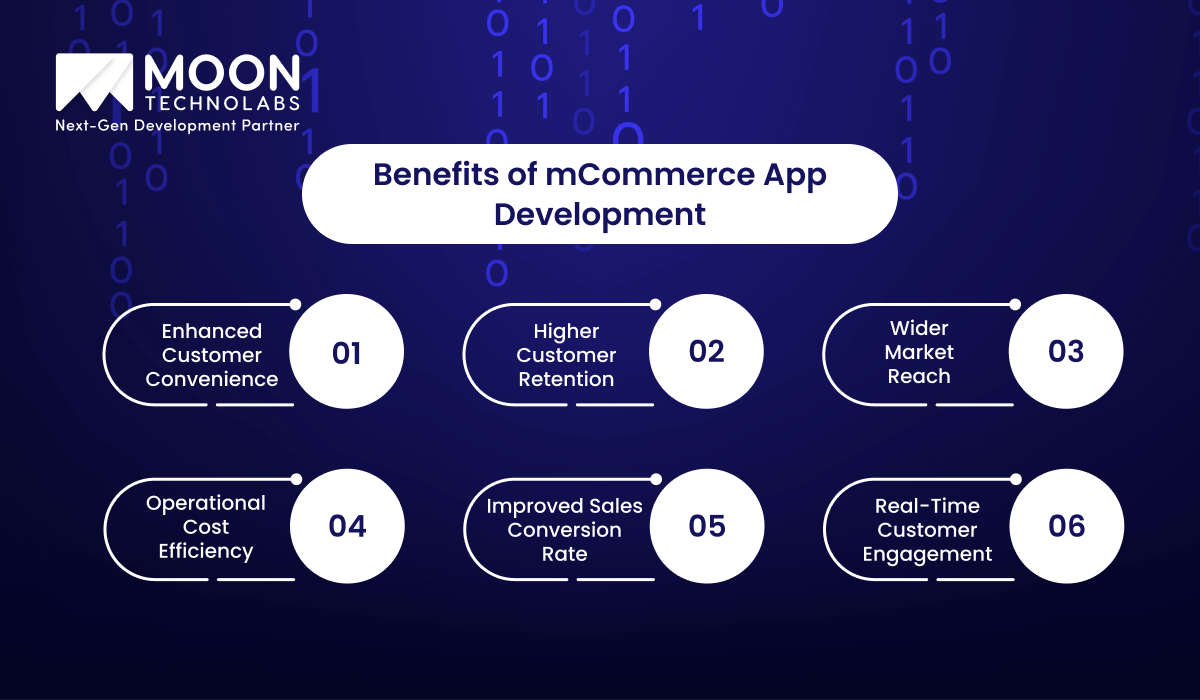
It helps businesses adapt to the growing mobile-first buying behavior of modern consumers. By offering faster transactions, personalized experiences, and real-time engagement, mobile commerce apps enable brands to improve customer satisfaction while optimizing business operations.
Enhanced Customer Convenience
mCommerce apps allow users to shop effortlessly from their smartphones at any time of the day. From browsing products to placing orders and tracking deliveries, everything happens within a few taps. Features like saved preferences, quick checkout, and real-time updates significantly improve the overall shopping experience. This convenience directly increases user satisfaction and engagement.
Higher Customer Retention
mCommerce apps help businesses stay connected with users through push notifications, personalized deals, and loyalty rewards. By analyzing customer behavior, apps can deliver relevant product recommendations and timely offers. This personalization builds trust and encourages repeat purchases. Over time, it strengthens long-term customer relationships.
Wider Market Reach
With an mCommerce app, businesses are no longer limited by physical location or store hours. Mobile apps enable brands to reach customers across cities, regions, and even countries. Multiple touchpoints, such as notifications, in-app offers, and promotions, improve visibility. This expanded reach helps businesses scale faster in competitive markets.
Operational Cost Efficiency
mCommerce apps automate key business operations, including order processing, inventory updates, billing, and reporting. This reduces manual effort and minimizes operational errors. Centralized data access helps businesses make faster, data-driven decisions. As a result, companies achieve better efficiency while lowering long-term operational costs.
Improved Sales Conversion Rate
mCommerce apps are designed for quick decision-making, with features such as one-tap checkout, saved payment details, and personalized product suggestions. These mobile-optimized experiences reduce cart abandonment and encourage faster purchases. As a result, businesses achieve higher conversion rates than on traditional web platforms.
Real-time Customer Engagement
With mobile apps, businesses can interact with customers instantly through push notifications, flash deals, and order updates. Real-time communication keeps users informed and engaged throughout their buying journey. This continuous interaction helps brands stay top of mind and increases purchase frequency.
Key Features of a Successful mCommerce App
A successful mCommerce app relies on powerful features that ensure a smooth shopping experience, secure transactions, and efficient order management. These features work together to enhance user experience, streamline operations, and support business scalability.
The table below highlights the essential features required across different app modules:
| App | Customer App | Vendor App | Delivery App | Admin Panel |
| Key Features | User registration and profiles Product search and filters Wishlist and cart Secure mobile payments |
Product management Pricing and stock control Order processing Payment tracking |
GPS tracking Route optimization Delivery verification Real-time updates |
Dashboard analytics User and vendor management Promotions and discounts Revenue reports |
The Process of Developing an mCommerce App
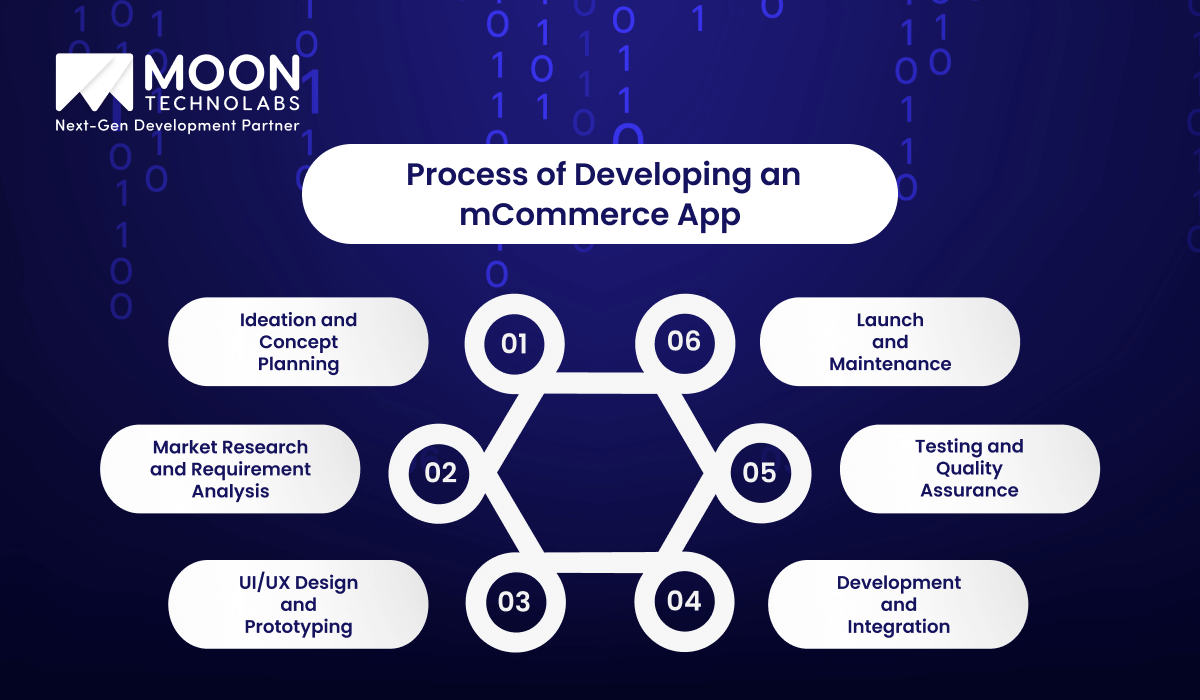
Developing an mCommerce app requires a structured approach to ensure performance, scalability, and a seamless user experience. From idea validation to post-launch optimization, each stage plays a critical role in building a reliable mobile commerce platform. A well-defined development process helps businesses reduce risks and achieve faster time-to-market:
Ideation and Concept Planning
This stage focuses on defining the core idea of the mCommerce app, including business goals, target users, and the problem it aims to solve. A clear value proposition helps shape the app’s functionality and long-term vision. Proper planning at this stage reduces risks during development.
Market Research and Requirement Analysis
Thorough market research helps identify competitors, customer behavior, and industry trends. Based on these insights, functional and technical requirements are finalized. This ensures the app is built around real user needs and business objectives.
UI/UX Design and Prototyping
Design and prototyping help visualize the app’s layout, navigation flow, and user interactions. A mobile-first approach ensures faster loading, intuitive journeys, and better engagement. Wireframes also help validate ideas before development begins.
Development and Integration
During this phase, developers build the core features such as product catalog, cart, payments, and user management. Agile development allows continuous improvements through iterative releases. Third-party services and APIs are integrated for smooth functionality.
Testing and Quality Assurance
In this phase, the app undergoes rigorous testing to ensure functionality, performance, and data security. This includes usability testing, load testing, and device and platform compatibility. Quality assurance ensures a stable and reliable user experience.
Launch and Maintenance
After successful testing, the app is deployed on app stores with proper configurations. Post-launch maintenance includes performance monitoring, bug fixes, and feature enhancements. Continuous updates help the app stay competitive and scalable.
Cost of Developing an mCommerce App
The cost of mCommerce app development ranges between USD 15,000 to USD 120,000, depending on complexity.
Approximate Breakdown:
- Customer App: USD 15,000 – 25,000
- Vendor App: USD 18,000 – 30,000
- Delivery App: USD 12,000 – 20,000
- Admin Panel: USD 30,000 – 45,000
Cost by App Type:
- Basic app: USD 15,000 – 30,000
- Medium complexity: USD 30,000 – 60,000
- Advanced AI-powered app: USD 65,000 – 100,000+
Development location, platforms, integrations, and post-launch support significantly impact the final budget.
The Challenges of Building an mCommerce App
High Competition
With thousands of shopping apps available on app stores, gaining user attention has become increasingly difficult. Businesses must differentiate their app through intuitive design, smooth navigation, and personalized experiences. A strong UX helps improve visibility, engagement, and long-term usage.
Payment Security
mCommerce apps handle sensitive customer information, including card details and transaction data. Any security gap can damage trust and brand reputation. Implementing PCI-DSS compliance, secure payment gateways, and end-to-end encryption ensures safe and reliable transactions.
Scalability Issues
During festive sales or promotional campaigns, sudden traffic spikes can overload systems and affect performance. Without proper scalability, these apps may crash or slow down. Cloud-based infrastructure enables seamless scaling to efficiently handle high user volumes.
Customer Retention
Mobile users uninstall apps quickly when performance is slow or the flow is complex. Retaining users requires consistent engagement and a smooth shopping experience. Features such as push notifications, loyalty programs, and personalized offers help sustain long-term user engagement.
How Moon Technolabs Can Help?
Imagine launching an mCommerce app that attracts users but struggles with performance, payments, and scalability. Moon Technolabs helps businesses build secure, scalable, and conversion-focused mCommerce applications tailored to modern consumer behavior.
From UI/UX design and multi-vendor systems to payment gateways integration and analytics dashboards, we deliver end-to-end mCommerce app development solutions. If you’re planning to build a custom mCommerce app, our team ensures performance, security, and long-term growth.
Ready to Build a Powerful mCommerce App?
Moon Technolabs helps businesses design and develop secure, feature-rich mCommerce apps that drive conversions and mobile sales growth.
Conclusion
Mobile commerce is no longer optional — it is the future of digital retail.
As consumer behavior continues shifting toward mobile-first shopping, businesses must adapt by investing in robust mCommerce app development.
A well-designed mCommerce app enhances engagement, boosts conversions, and builds long-term customer relationships.
For brands ready to scale digitally, an intelligent mCommerce platform serves as the foundation for sustainable online growth.
FAQs
01
What is the difference between e-commerce and mCommerce apps?
eCommerce refers to online buying and selling through websites, while mCommerce focuses specifically on transactions made through mobile apps. mCommerce apps are designed for mobile-first behavior, offering features such as push notifications, biometric login, and faster checkout that significantly improve user engagement and conversions.02
How long does it take to develop an mCommerce app?
The development timeline depends on app complexity and features. A basic mCommerce app may take 3–4 months, while a medium-to-advanced app with multi-vendor support, payment integrations, and analytics can take 6–9 months or longer. Custom features and third-party integrations may further extend the timeline.03
Can an mCommerce app support multiple payment methods?
Yes, modern mCommerce apps can integrate multiple payment options, including credit/debit cards, digital wallets, UPI, net banking, and buy now, pay later services. Secure payment gateway integration ensures smooth transactions while maintaining data privacy and compliance standards.04
Is mCommerce app development suitable for small businesses and startups?
Absolutely. mCommerce apps help small businesses reach mobile users directly, reduce dependency on third-party marketplaces, and build brand loyalty. With scalable architecture and MVP-based development, startups can launch cost-effectively and expand features as their business grows.




Jayanti Katariya is the CEO of Moon Technolabs, a fast-growing IT solutions provider, with 18+ years of experience in the industry. Passionate about developing creative apps from a young age, he pursued an engineering degree to further this interest. Under his leadership, Moon Technolabs has helped numerous brands establish their online presence and he has also launched an invoicing software that assists businesses to streamline their financial operations.
Submitting the form below will ensure a prompt response from us.
We refine our expertise to deliver innovative business solutions.





205 N Michigan Avenue, #810, Chicago, 60601, Illinois, United States
13500 Long Is Dr, Pflugerville, TX 78660, USA

C/105 Ganesh Meridian, S.G. Highway, Ahmedabad, GJ 380060


Ayse D.
Co-Founder France
“ I highly recommend Moon Technolabs as the quality of service is wonderful. We have hired this company to develop the product based on some complex & technical issues. We get the best quality services as compared with others in the market. Huge Thanks to Moon Technolabs as the team is always ready to give the solution all time.”

Justin G.
Founder & CEO USA
USA“ Moon Technolabs is a pioneer in the WebRTC based project as they have fixed complicated segments of the module by fulfilling different product lines by providing 24X7 customer support. We really recommended Moon Technolabs as they are able to develop products as per the module deadline and project timeline.”

Flavio S.
Founder & Managing Director Germany
“I am happy to recommend Moon Technolabs for their app development services. They successfully developed apps for me, and I am highly satisfied with the overall outcomes. The development team has swiftly addressed the issues with responsive and effective communication to understand the requirement quickly and actively resolve the back-and-forth problems that arose...”

Jay M.
Founder & CEOUSA“Moon Technolabs is the best company that provides advanced apps and websites development services in the USA and Europe. I am a newbie to develop my app with an external team. I am really happy to work with them as I am not that much mobile apps user. Here, the team and specially the CEO of Moon Technolabs helps me to let me know about the benefits of my app to generate revenue....”


Our Offices
India
C/105 Ganesh Meridian,S.G. Highway, Ahmedabad, GJ 380060USA
205 N Michigan Avenue, #810, Chicago, 60601, Illinois, United StatesContact Information


