


Machine Learning in Marketing: Benefits and Real-World Use Cases

Jayanti Katariya
Last Updated: Aug 17, 2026 Total Views: 177
Table of Content


Blog Summary:
Machine learning in marketing is transforming how businesses understand customers, optimize campaigns, and deliver personalized experiences. This blog explores the key benefits and real-world applications of ML, including predictive analytics, customer segmentation, automation, and personalization. Discover how brands are using data-driven strategies to improve engagement, enhance efficiency, and achieve better marketing results.
Table of Content
Marketing is no longer driven by guesswork; data powers it. Machine learning helps businesses analyze customer behavior, identify patterns, and make smarter decisions at every stage of the marketing journey. By identifying customer preferences, improving targeting, and streamlining marketing processes, ML helps brands create more meaningful connections with their audiences.
In this blog, we’ll explore the key benefits of Machine Learning in Marketing and real-world use cases that show how businesses are using it to create more targeted, efficient, and impactful strategies.
Why Does Machine Learning Matter for Marketing?
Machine learning in marketing matters because it helps businesses understand customer behavior, preferences, and buying patterns by analyzing large amounts of data quickly and accurately. Instead of relying on assumptions, marketers can use machine learning to identify trends, segment audiences, and deliver personalized experiences.
This enables companies to recommend relevant products, optimize email campaigns, predict customer needs, and improve engagement, resulting in stronger customer relationships and higher conversion rates.
Machine learning also enhances marketing efficiency by automating repetitive tasks and providing real-time insights for better decision-making. It can predict campaign performance, optimize advertising budgets, detect customer churn, and improve targeting across multiple channels.
By leveraging machine learning in marketing, marketers can create more effective strategies, reduce costs, and maximize ROI, making it an essential tool for achieving sustainable business growth.
Benefits of Machine Learning in Marketing
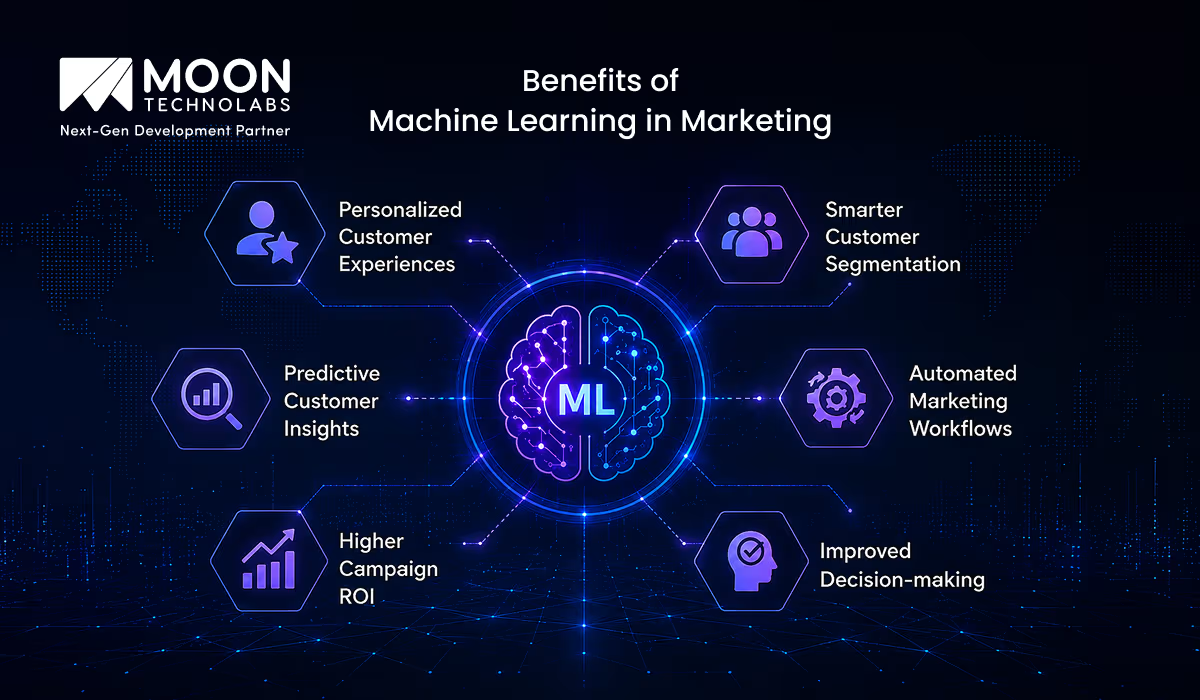
Below are the key benefits of machine learning in marketing. Have a look at how ML helps businesses improve personalization, automate processes, make smarter decisions, enhance targeting, and optimize campaigns:
Personalized Customer Experiences
Machine learning helps businesses deliver highly personalized experiences by analyzing customer behavior, preferences, and purchase history. It enables marketers to recommend relevant products, create customized content, and send targeted messages, leading to increased customer satisfaction and stronger brand loyalty.
Smarter Customer Segmentation
Instead of relying on basic demographic data, machine learning groups customers based on their behaviors, interests, and buying patterns. This allows marketers to create more precise audience segments and deliver campaigns that resonate with each group, improving engagement and conversion rates.
Predictive Customer Insights
Machine learning uses historical and real-time data to predict future customer behavior, such as purchase intent, churn risk, or product preferences. These insights help businesses take proactive actions, optimize marketing strategies, and build long-term customer relationships.
Automated Marketing Workflows
Machine learning in marketing automates repetitive marketing tasks such as email personalization, audience targeting, lead scoring, content recommendations, and campaign optimization. Automation saves time, reduces manual effort, and allows marketing teams to focus on strategy and creativity.
Higher Campaign ROI
By identifying the most effective channels, audience segments, and marketing messages, machine learning helps businesses allocate budgets more efficiently. Real-time campaign optimization improves conversion rates while reducing wasted advertising spend, resulting in a higher return on investment.
Improved Decision-making
Machine learning transforms large volumes of marketing data into actionable insights. It identifies trends, measures campaign performance, and uncovers hidden opportunities, enabling marketers to make faster, data-driven decisions that improve overall business performance.
Connect with our specialists to explore machine learning solutions that improve targeting, customer engagement, and campaign outcomes.
Top 15 Use Cases of Machine Learning in Marketing
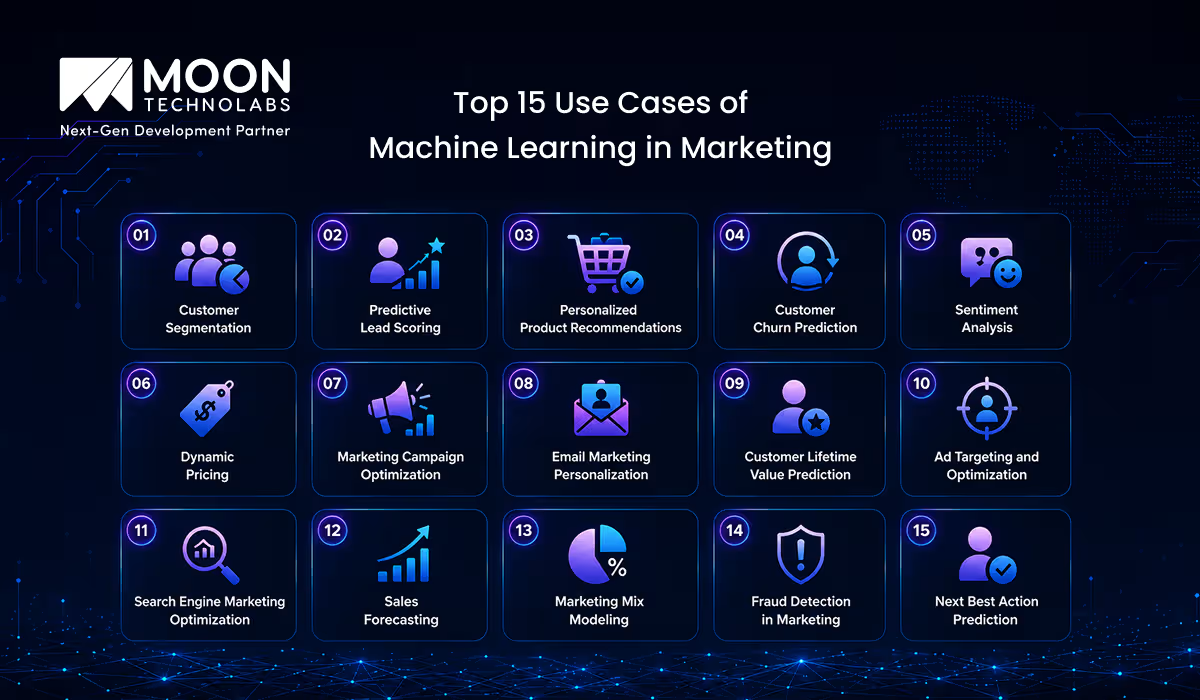
Machine learning in marketing is transforming modern marketing by enabling businesses to analyze massive amounts of customer data, automate decision-making, and deliver highly personalized experiences. Below are the top 15 machine learning marketing use cases you need to know:
Customer Segmentation
ML helps marketers divide customers into meaningful groups based on demographics, purchase history, browsing behavior, interests, and engagement patterns. Unlike traditional segmentation, ML continuously updates customer segments as new data becomes available.
Benefits:
- Better audience targeting
- Personalized marketing campaigns
- Higher engagement rates
- Improved customer experience
Example: An online fashion retailer groups customers into categories such as luxury buyers, discount shoppers, and frequent buyers to send personalized offers. They can also personalize virtual try-on recommendations for different customer segments based on browsing behavior and purchase preferences.
Predictive Lead Scoring
By analyzing historical customer data, interactions, and behavioral patterns, machine learning models can identify which leads are most likely to convert into paying customers. This helps sales teams prioritize high-quality prospects, improve targeting, and focus efforts on opportunities with greater conversion potential.
Benefits:
- Increased sales productivity
- Higher conversion rates
- Reduced time spent on unqualified leads
- Better alignment between marketing and sales
Example: A SaaS company automatically assigns lead scores based on website visits, email engagement, company size, and previous interactions.
Personalized Product Recommendations
Recommendation engines use machine learning algorithms to analyze customer preferences, browsing behavior, and previous purchases to suggest relevant products and services. These personalized recommendations help businesses improve customer experiences, increase engagement, and encourage higher conversions by delivering content that matches individual interests.
Benefits:
- Increased average order value
- Higher customer satisfaction
- Better cross-selling and upselling
- Improved customer retention
Example: E-commerce platforms recommend products similar to items customers have viewed or purchased.
Customer Churn Prediction
Machine learning in marketing helps identify customers likely to stop using a product or service by analyzing purchase patterns, engagement levels, feedback, and customer interactions. By predicting potential churn risks, businesses can take proactive actions, such as offering personalized incentives or targeted support, to retain customers and strengthen long-term relationships.
Benefits:
- Reduced customer attrition
- Improved retention campaigns
- Increased customer loyalty
- Lower acquisition costs
Example: Subscription-based businesses send personalized offers to customers predicted to cancel their memberships.
Sentiment Analysis
ML-powered Natural Language Processing (NLP) analyzes customer reviews, social media posts, emails, and survey responses to determine customer sentiment and understand customer opinions. This helps businesses identify trends, measure satisfaction levels, address concerns quickly, and improve their marketing strategies based on real-time customer feedback.
Benefits:
- Understand customer opinions
- Improve brand reputation
- Detect emerging issues quickly
- Measure campaign effectiveness
Example: Brands monitor social media conversations to identify positive and negative customer feedback in real time.
Dynamic Pricing
By analyzing demand patterns, competitor pricing, inventory levels, customer behavior, and market conditions, machine learning enables businesses to adjust product prices dynamically. These data-driven pricing strategies help companies maximize revenue, stay competitive, respond to market changes, and deliver more relevant offers to customers.
Benefits:
- Increased revenue
- Better competitiveness
- Improved inventory management
- Optimized profit margins
Example: Travel and hotel booking platforms change prices based on demand, seasonality, and booking trends.
Marketing Campaign Optimization
By analyzing campaign performance across multiple channels, machine learning identifies patterns and recommends improvements for audience targeting, budget allocation, and messaging. These insights help marketers optimize campaigns in real time, improve customer engagement, reduce wasted ad spend, and achieve better overall marketing performance.
Benefits:
- Higher ROI
- Better budget utilization
- Improved campaign performance
- Faster optimization
Example: Digital advertising platforms automatically optimize bids and audience targeting during active campaigns.
Email Marketing Personalization
Using customer data and behavioral insights, machine learning in marketing enables the personalization of email subject lines, content, send times, and product recommendations. This allows businesses to create more relevant email campaigns, enhance customer engagement, improve open and click-through rates, and increase conversion opportunities.
Benefits:
- Higher open rates
- Increased click-through rates
- Better customer engagement
- Improved conversions
Example: An online retailer sends personalized product suggestions based on each customer’s browsing history.
Customer Lifetime Value Prediction
Predictive lead scoring uses historical customer interactions, engagement patterns, and behavioral data to identify prospects with the highest likelihood of conversion. By analyzing these insights, businesses can prioritize valuable leads, improve sales and marketing alignment, focus resources on high-potential opportunities, and increase overall conversion rates.
Benefits:
- Smarter customer acquisition
- Better retention strategies
- Optimized marketing investments
- Improved profitability
Example: Companies invest more marketing resources in customers with higher predicted lifetime value.
Ad Targeting and Optimization
ML identifies the most relevant audiences for advertisements by analyzing user behavior, interests, demographics, online activities, and purchase intent. By understanding audience preferences and predicting customer needs, machine learning helps businesses create more targeted ad campaigns, improve ad performance, reduce wasted spending, and reach potential customers more effectively.
Benefits:
- Higher ad relevance
- Increased conversion rates
- Lower advertising costs
- Better audience reach
Example: Advertising platforms automatically deliver ads to users most likely to make a purchase.
Search Engine Marketing Optimization
Through advanced data analysis and automation, ML enhances paid search campaigns by optimizing keyword selection, bidding strategies, audience targeting, and ad performance. It helps marketers understand search patterns, identify valuable opportunities, allocate budgets effectively, and improve campaign results by delivering more relevant ads to potential customers.
Benefits:
- Better ad rankings
- Reduced cost per click (CPC)
- Higher click-through rates
- Increased return on ad spend (ROAS)
Example: ML algorithms automatically adjust keyword bids based on predicted conversion probability.
Sales Forecasting
Using historical sales data, customer insights, and market trends, machine learning in marketing helps businesses predict future sales outcomes with greater accuracy. This allows marketers and decision-makers to identify upcoming opportunities, prepare for changes in demand, optimize campaigns, and develop strategies that drive better business results.
Benefits:
- Accurate demand planning
- Better inventory management
- Improved budgeting
- Strategic business planning
Example: Retailers forecast holiday sales to optimize inventory and staffing levels.
Marketing Mix Modeling
Machine learning evaluates the effectiveness of different marketing channels, including television, digital advertising, email, social media, and offline campaigns, by analyzing customer interactions and campaign performance data. These insights help businesses understand which channels deliver the best results, optimize budget allocation, improve marketing strategies, and maximize overall campaign impact.
Benefits:
- Optimized marketing budgets
- Better channel performance
- Improved ROI measurement
- Data-driven decision-making
Example: A company determines whether investing more in social media advertising yields higher returns than investing in television advertising.
Fraud Detection in Marketing
With the ability to analyze large volumes of data in real time, machine learning identifies suspicious patterns linked to click fraud, fake leads, bot traffic, coupon abuse, and advertising fraud. This enables businesses to safeguard marketing investments, improve campaign accuracy, and ensure resources are directed toward genuine customer interactions.
Benefits:
- Reduced financial losses
- Improved campaign accuracy
- Better data quality
- Enhanced security
Example: Digital advertising platforms identify fraudulent clicks generated by automated bots.
Next Best Action Prediction
By analyzing customer data, preferences, and past interactions, machine learning identifies the next best action to engage each customer. This helps businesses create personalized campaigns, provide relevant recommendations, improve customer experiences, and increase the effectiveness of their marketing efforts.
Benefits:
- Personalized customer journeys
- Increased customer engagement
- Higher conversion rates
- Improved customer satisfaction
Example: A telecom software development company recommends the ideal upgrade plan, promotional offer, or support interaction for each customer based on machine learning marketing analytics.
You Might Want to Read:
Revolutionizing Retail: Machine Learning in Retail Demand Forecasting
Real-world Machine Learning Marketing Examples
Here are the real-world use cases of machine learning in marketing, showcasing how businesses leverage ML for personalization, automation, customer analysis, and smarter campaign strategies:
Netflix’s Personalized Content Recommendations
Netflix uses machine learning to recommend movies and TV shows based on users’ viewing history, search activity, and preferences. By providing personalized suggestions, Netflix increases user engagement, watch time, and customer retention.
Amazon’s Product Recommendation Engine
Amazon analyzes customers’ browsing history, purchase records, and shopping behavior to recommend relevant products. These personalized recommendations improve the shopping experience, increase sales, and encourage cross-selling and repeat purchases.
Spotify’s Personalized Music Recommendations
Spotify uses machine learning to study users’ listening habits and recommend songs, artists, and playlists that match their interests. Features like Discover Weekly help users find new music, increasing engagement and customer loyalty.
Starbucks’ AI-driven Customer Personalization
Starbucks uses AI to deliver personalized offers and product recommendations through its mobile app and loyalty program. By analyzing purchase history, location, and customer preferences, Starbucks enhances customer experience, encourages repeat visits, and strengthens brand loyalty.
What is the Future of Machine Learning for Marketing?
Machine learning is changing how businesses connect with customers by making marketing more personalized, data-driven, and efficient. Three major trends, which will shape the future of marketing, are:
Hyper-personalized Customer Experiences
Machine learning analyzes customer data such as browsing history, purchases, and preferences to deliver personalized recommendations, targeted emails, and customized advertisements. This helps businesses improve customer satisfaction, increase engagement, and build stronger brand loyalty.
AI-powered Omnichannel Marketing
Customers interact with brands through websites, social media, email, mobile apps, and physical stores. Machine learning connects data from these channels to provide a consistent customer experience. It also helps marketers choose the best channel, message, and timing for each customer, improving campaign performance.
Predictive and Autonomous Marketing
Machine learning can predict customer behavior, identify potential leads, and detect customers at risk of leaving. With advances in AI development, intelligent systems can automate tasks such as campaign optimization, budget allocation, and content recommendations, allowing marketers to focus on strategy and creativity.
Why Trust Moon Technolabs for Machine Learning Marketing Solutions?
ML is transforming modern marketing by enabling businesses to analyze customer behavior, predict trends, personalize campaigns, and automate decision-making. As a trusted ML development company, we combine advanced machine learning expertise with data-driven marketing strategies to help businesses achieve measurable growth.
By leveraging intelligent algorithms, predictive analytics, and automation, we deliver customized solutions that improve campaign performance, enhance customer engagement, and maximize return on investment. With a strong focus on innovation, scalability, and business objectives, we empower organizations to stay ahead in today’s digital landscape.
Benefits of choosing us for cutting-edge ML development services:
- Backed by a team of skilled machine learning engineers and AI specialists with extensive industry expertise.
- Forecast customer behavior, market trends, and campaign performance with greater accuracy.
- Deliver intelligent recommendations and personalized campaigns to boost engagement and conversions.
- Streamline repetitive marketing processes with AI-powered automation to improve efficiency.
- Turn complex datasets into actionable insights that support smarter marketing strategies.
- Tailored machine learning solutions aligned with your unique business goals and marketing objectives.
Connect with our specialists to implement machine learning strategies that deliver actionable insights and improved campaign performance.
A Final Word
Machine learning is no longer just an emerging technology. It is becoming a key driver of successful marketing strategies. By leveraging data intelligently, businesses can deliver personalized experiences, improve campaign performance, and make faster, more informed decisions.
Partnering with the right machine learning development company ensures you can turn these capabilities into measurable business outcomes and stay ahead in a competitive market.
FAQs
01
How does machine learning personalize customer experiences?
Machine learning personalizes customer experiences by analyzing customer data such as browsing behavior, purchase history, preferences, and engagement patterns. It identifies trends and predicts what each customer is most likely to want, enabling businesses to deliver personalized product recommendations, targeted content, customized emails, and relevant offers.02
What are the 4 basics of machine learning?
The four basic types of machine learning are supervised learning, unsupervised learning, semi-supervised learning, and reinforcement learning.03
What tools support machine learning in marketing?
Many marketing platforms include machine learning capabilities to automate and improve campaigns. Popular tools include Google Analytics 4, HubSpot, Salesforce Marketing Cloud, Adobe Experience Cloud, Mailchimp, Amazon Personalize, and Google Vertex AI. These tools help with customer segmentation, predictive analytics, recommendation engines, lead scoring, content optimization, and machine learning marketing automation.04
Can machine learning improve email marketing results?
Yes. Machine learning enhances email marketing by predicting optimal email send times, personalizing subject lines and content, segmenting audiences by behavior, recommending relevant products, and identifying subscribers most likely to engage. These capabilities can increase open rates, click-through rates, conversions, and overall campaign performance while reducing unsubscribe rates.05
How does machine learning reduce marketing costs?
Machine learning reduces marketing costs by automating repetitive tasks, improving audience targeting, and optimizing advertising spend. It helps businesses identify high-value customers, predict campaign performance, reduce wasted ad impressions, and allocate budgets more efficiently. By improving marketing accuracy and reducing manual effort, companies can achieve better results while lowering overall customer acquisition and operational costs.




Jayanti Katariya is the CEO of Moon Technolabs, a fast-growing IT solutions provider, with 18+ years of experience in the industry. Passionate about developing creative apps from a young age, he pursued an engineering degree to further this interest. Under his leadership, Moon Technolabs has helped numerous brands establish their online presence and he has also launched an invoicing software that assists businesses to streamline their financial operations.
Submitting the form below will ensure a prompt response from us.
We refine our expertise to deliver innovative business solutions.





205 N Michigan Avenue, #810, Chicago, 60601, Illinois, United States
13500 Long Is Dr, Pflugerville, TX 78660, USA

C/105 Ganesh Meridian, S.G. Highway, Ahmedabad, GJ 380060


Ayse D.
Co-Founder France
“ I highly recommend Moon Technolabs as the quality of service is wonderful. We have hired this company to develop the product based on some complex & technical issues. We get the best quality services as compared with others in the market. Huge Thanks to Moon Technolabs as the team is always ready to give the solution all time.”

Justin G.
Founder & CEO USA
USA“ Moon Technolabs is a pioneer in the WebRTC based project as they have fixed complicated segments of the module by fulfilling different product lines by providing 24X7 customer support. We really recommended Moon Technolabs as they are able to develop products as per the module deadline and project timeline.”

Flavio S.
Founder & Managing Director Germany
“I am happy to recommend Moon Technolabs for their app development services. They successfully developed apps for me, and I am highly satisfied with the overall outcomes. The development team has swiftly addressed the issues with responsive and effective communication to understand the requirement quickly and actively resolve the back-and-forth problems that arose...”

Jay M.
Founder & CEOUSA“Moon Technolabs is the best company that provides advanced apps and websites development services in the USA and Europe. I am a newbie to develop my app with an external team. I am really happy to work with them as I am not that much mobile apps user. Here, the team and specially the CEO of Moon Technolabs helps me to let me know about the benefits of my app to generate revenue....”


Our Offices
India
C/105 Ganesh Meridian,S.G. Highway, Ahmedabad, GJ 380060USA
205 N Michigan Avenue, #810, Chicago, 60601, Illinois, United StatesContact Information


