


E commerce Payment System: Types, How It Works & Benefits

Web Development Team
Last Updated: Nov 18, 2026 Total Views: 81
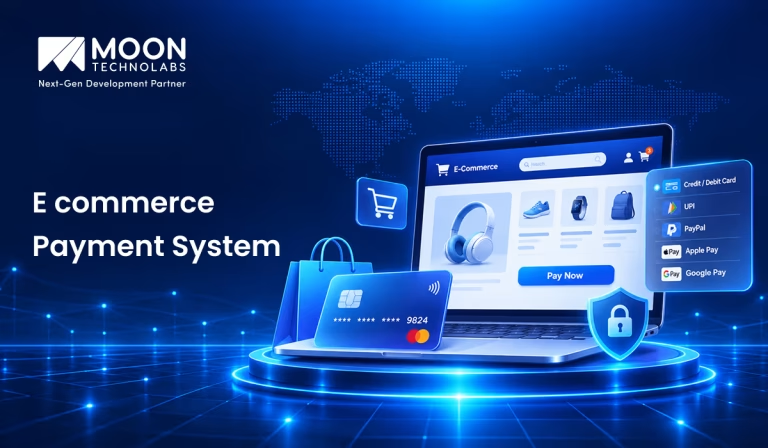
Table of Content


Blog Summary:
As online transactions grow, e-commerce businesses need a secure e-commerce payment system to protect sensitive customer information, prevent payment fraud, and avoid revenue losses from failed transactions. This blog explores payment methods, essential features, business benefits, security measures, and future trends to help businesses build reliable online payment experiences and protect customer trust.
Table of Content
Every successful eCommerce transaction depends on a payment process that works smoothly behind the scenes. An eCommerce payment system handles everything involved in completing an online purchase, including payment authorization, transaction verification, fund transfers, and refunds, while helping businesses manage payments efficiently and deliver a hassle-free checkout experience.
The right setup can reduce checkout friction, prevent payment-related issues, and make online shopping more convenient.
According to Statista, the global eCommerce market is expected to generate US$3.89 trillion in revenue in 2026, with a projected CAGR of 5.83% through 2031, reaching US$5.17 trillion. This growth makes reliable payment infrastructure increasingly important for businesses competing in the online marketplace.
But what makes an e-commerce payment system effective? Let’s explore how these systems work, the different online payment methods available, their benefits, and the key factors to consider when choosing one for your business.
What is an E-commerce Payment System?
An e-commerce payment system is the technology that handles the money side of an online purchase. When a customer clicks the Pay Now button, it manages the payment request, verifies the available payment method, and helps complete the transaction between the customer and the online store.
Behind every successful online payment, several components work together, including the payment gateway, payment processor, the customer’s bank, and the merchant’s bank. These components communicate to verify payment details, authorize the transaction, and send confirmation so the business can process the order.
For an online business, a payment system is more than just a way to collect money. It determines which payment options customers can use, how quickly orders receive payment confirmation, how refunds are handled, and how transactions are recorded for accounting and reconciliation.
Different Types of E-commerce Payment Systems
E-commerce businesses can choose from several electronic payment methods based on customer preferences and business needs. Here are the different types of e-commerce payment systems to explore:
Credit and Debit Card Payments
Credit and debit cards remain widely used for online shopping because customers can pay directly at checkout without contacting their banks separately. E-commerce stores integrate card payment gateways to verify card details, authorize purchases, and process payments through networks such as Visa, Mastercard, and RuPay.
Digital Wallet Payments
Digital wallets let customers complete purchases using payment details already stored in their mobile applications or online accounts. Instead of entering card numbers for every order, shoppers authorize payments through a PIN, fingerprint, or facial recognition.
Popular examples include PayPal, Apple Pay, and Google Pay. Businesses planning to launch their own digital wallet can explore eWallet app development to build customized payment applications with secure transactions and convenient money transfers.
UPI and QR Code Payments
UPI and QR code payments let customers transfer money directly from their bank accounts using mobile payment apps. During checkout, shoppers can scan a merchant’s QR code or approve a UPI request. This method is particularly useful for Indian e-commerce businesses handling quick, low-value transactions.
Internet Banking and Bank Transfers
Internet banking lets customers pay for online purchases directly from their bank accounts, making it a convenient option for high-value transactions and business-to-business (B2B) payments. Its widespread adoption highlights the growing preference for secure, convenient, and direct bank-to-bank transactions.
Buy Now, Pay Later (BNPL)
BNPL services allow customers to split their purchase amount into smaller installments or postpone payment until an agreed date. At checkout, customers select an available BNPL provider, complete an eligibility check, and confirm the purchase. This option can make higher-value products more accessible.
Contactless Payments
Contactless payments use Near Field Communication (NFC) technology to exchange payment information between compatible devices and payment terminals. Customers can simply tap their smartphones, smartwatches, or contactless cards to complete transactions.
Their growing adoption is evident, with contactless payments accounting for more than 75% of transactions in 2025, highlighting the shift toward faster, more convenient payment experiences.
Prepaid Card Payments
Prepaid cards contain a fixed amount of money that customers load before making purchases. Shoppers can use these cards for online orders without linking their primary bank accounts or accessing credit. E-commerce businesses can also offer branded gift cards that customers redeem during checkout.
ACH and Direct Debit Payments
ACH and direct debit payments allow businesses to collect authorized payments directly from customers’ bank accounts through established banking networks. They are particularly useful for subscription platforms, membership services, and recurring orders where collecting individual card payments every billing cycle may be less convenient.
Improve payment experiences, reduce transaction friction, and support business growth with our e-commerce development expertise.
Key Features of an E commerce Payment System
A reliable e-commerce payment system comes with essential features that simplify transactions, protect customer data, and support business operations. Here are the key features to know:
Multiple Payment Method Support
An effective e-commerce payment system supports various payment options, including credit cards, debit cards, UPI, digital wallets, net banking, and other local payment methods. This flexibility improves convenience, enhances the checkout experience, and reduces cart abandonment.
Secure Payment Gateway Integration
A secure payment gateway integration ensures that customer’s payment information and financial transactions remain protected. Features such as SSL encryption, tokenization, PCI DSS compliance, and fraud detection help prevent unauthorized access and build customer trust.
Recurring Billing and Subscription Management
Recurring billing automates payments for subscription-based products and services. It allows businesses to manage billing schedules, process automatic payments, handle renewals, and send payment reminders, ensuring consistent revenue collection and a seamless customer experience.
Real-time Transaction Monitoring
Real-time transaction monitoring enables businesses to track payment activities as they happen. It helps identify suspicious transactions, detect payment failures, monitor transaction status, and resolve issues quickly, improving operational efficiency and overall payment security.
Automated Refunds and Reconciliation
Automated refunds and reconciliation simplify returning payments and matching transactions with financial records. This feature reduces manual work, minimizes accounting errors, speeds up refund processing, and ensures accurate financial reporting.
Multi-currency and International Payments
Multi-currency support lets customers from different countries pay in their preferred currencies. It includes currency conversion, an international payment processing network, and cross-border transaction support, helping businesses expand globally and serve international customers effectively.
Payment Reporting and Analytics
Payment reporting and analytics provide valuable insights into transaction performance and revenue trends. Businesses can track successful payments, failed transactions, refunds, and customer spending patterns to make informed decisions and improve overall payment operations.
Benefits of Electronic Payment Systems for E commerce Businesses
Adopting electronic payment systems can help online businesses reduce payment-related friction, manage transactions more efficiently, and make purchasing easier for customers. Let’s look at the major benefits they bring to eCommerce businesses:
Faster and More Convenient Transactions
Electronic payment systems eliminate delays associated with cash handling, bank visits, and manual transfers. Customers can pay instantly using UPI, cards, or digital wallets, while e-commerce businesses receive payment confirmations quickly and can process orders without unnecessary delays.
Improved Customer Checkout Experience
A complicated checkout process can cause customers to abandon their shopping carts. Electronic payment systems simplify the final purchase step by offering familiar payment options, saved payment details, and quick authentication, making it easier for customers to complete orders.
Reduced Manual Payment Processing
Manual payment management becomes difficult as order volumes increase. Automated payment systems handle transaction approvals, payment confirmations, and refund requests, reducing repetitive administrative tasks and letting finance teams spend less time resolving routine payment issues.
Better Transaction Tracking and Management
Businesses can access a centralized record of every payment, including e-commerce transaction IDs, payment status, timestamps, and refund details. This makes it easier to identify missing payments, investigate customer complaints, reconcile orders, and maintain accurate financial records.
Wider Customer Reach and Global Payments
An e-commerce store is no longer limited to customers who can pay locally. International payment support lets businesses accept orders from overseas buyers, process different currencies, and offer familiar payment options across markets, creating expansion opportunities.
Challenges of Using E commerce Payment Systems
Although they make online transactions easier, eCommerce payment systems also bring operational, technical, and security challenges. Here are the common issues businesses should understand and prepare for:
Payment Processing and Transaction Fees
Payment gateways charge businesses for processing transactions, refunds, currency conversion, and other services. These costs can reduce profit margins, especially for small e-commerce stores with frequent transactions or low product margins.
Technical Failures and Payment Downtime
Payment gateways may experience server outages, network interruptions, or processing errors that prevent customers from completing purchases. Even temporary downtime can result in lost orders, frustrated customers, and reduced revenue during peak shopping periods.
Fraud Risks and Chargeback Management
Online businesses face risks such as stolen card details, unauthorized transactions, and fraudulent refund requests. Managing chargebacks becomes challenging when customers dispute payments, requiring businesses to provide transaction records and supporting evidence to payment providers.
Integration and Maintenance Complexity
Connecting payment gateways with e-commerce platforms, inventory systems, and accounting software can require technical expertise. Businesses must also manage software updates, API changes, compatibility issues, and regular testing to keep payment operations reliable.
You May Also Like:
Ecommerce Integration: Benefits, Types, Challenges, and How It Works
Security Measures for E commerce Payment Systems
Protecting payment information requires multiple layers of security to prevent fraud, unauthorized access, and data breaches. Here are the essential security measures businesses should implement in their eCommerce payment systems:
Payment Data Encryption and Tokenization
Encryption protects sensitive payment information by converting it into unreadable data during transmission and storage. Tokenization replaces actual card details with unique digital tokens, reducing exposure of financial information during online transactions and secure payment processing.
PCI DSS Compliance
PCI DSS establishes security requirements for businesses that store, process, or transmit payment card information. Following these standards helps e-commerce businesses protect cardholder data, control access to payment systems, and reduce the risk of payment data breaches.
Multi-factor Authentication and 3D Secure
Multi-factor authentication adds extra verification steps before approving sensitive transactions. 3D Secure adds an extra authentication layer for card payments, allowing customers to verify purchases through methods such as OTPs, banking apps, or biometric authentication.
Fraud Detection and Transaction Monitoring
Fraud detection systems continuously examine transaction details to identify unusual payment behavior, suspicious purchasing patterns, and potentially unauthorized activities. Real-time monitoring helps businesses flag risky transactions, investigate irregularities, and prevent financial losses before fraudulent payments are completed.
How to Choose the Right E-commerce Payment System?
Selecting a payment system requires evaluating more than transaction fees. Businesses must consider security, payment flexibility, integration, and customer convenience. Here are the key factors to consider before making a choice:
Evaluate Supported Payment Methods
Start by identifying how your customers prefer to pay when shopping online. If your store serves Indian customers, supporting UPI, debit cards, credit cards, net banking, and digital wallets can prevent customers from abandoning purchases simply because their preferred payment option is unavailable.
Compare Transaction Fees and Settlement Times
Payment gateway charges can directly affect your profit margins, especially when your store processes hundreds of orders daily. Compare setup costs, transaction fees, international payment charges, refund fees, and settlement schedules to understand how much you actually receive from each successful sale.
Check Security and Compliance Standards
Your payment provider should protect sensitive customer information throughout the transaction process. Look for PCI DSS compliance, encryption, tokenization, secure authentication, and fraud detection capabilities. These safeguards reduce payment-related risks and help prevent unauthorized transactions and potential financial losses.
Review Integration and Scalability Options
Choose a payment system that connects easily with your existing e-commerce platform, website, mobile application, and accounting software. Check whether it offers APIs, ready-made plugins, and automated payment features. As order volumes grow, the system should handle increased transactions without affecting performance.
Consider Customer Experience and Payment Success Rates
A payment gateway should make completing an order straightforward, even for first-time customers. Evaluate checkout speed, mobile compatibility, payment failure rates, retry options, and refund handling. Reliable transaction processing reduces failed purchases and keeps customers from leaving during checkout.
Future Trends in E commerce Payment Systems
E-commerce payment technology continues to evolve as customer expectations change and financial technology advances. Here are the emerging trends shaping how online businesses will accept, process, and secure payments in the coming years:
AI-Powered Payment Fraud Detection
AI is changing how e-commerce businesses identify and prevent fraudulent payments. AI-powered systems analyze transaction patterns, customer behavior, device information, and unusual purchasing activity to flag suspicious orders. This helps businesses detect potential fraud earlier while reducing unnecessary declines of genuine customer transactions.
Biometric and Passwordless Authentication
Future payment systems are increasingly moving towards fingerprint scanning, facial recognition, and other biometric verification methods. Instead of remembering passwords or entering OTPs repeatedly, customers can authenticate payments using supported devices. This approach aims to simplify checkout while adding another layer of identity verification.
Real-time and Account-to-Account Payments
Real-time payment networks allow money to move directly between bank accounts within seconds, rather than following traditional settlement schedules. Account-to-account payments can reduce dependence on card networks, lower processing costs in some markets, and provide businesses with faster access to collected funds.
Embedded Payments and One-click Checkout
Embedded payments allow customers to complete transactions within the shopping platform, marketplace, or application without being redirected to separate payment pages. Combined with one-click checkout and securely stored payment credentials, this approach reduces repeated checkout steps and makes repeat purchases considerably easier.
Work with our experienced development team to create secure, flexible payment solutions that support your business growth.
How Moon Technolabs Helps Develop a Secure Online Payment Solution?
At Moon Technolabs, we help businesses build secure online payment solutions through our comprehensive eCommerce development services. Our team integrates reliable payment gateways that support multiple payment methods, smooth transaction processing, and seamless connectivity with existing e-commerce platforms and applications.
We implement essential security measures, including data encryption, tokenization, secure API integration, and multi-factor authentication, to protect sensitive customer information. Our development approach also incorporates fraud detection mechanisms and payment verification features to minimize unauthorized transactions and improve payment reliability.
From payment gateway integration and security testing to ongoing maintenance, we build payment solutions that meet relevant security and compliance requirements, including PCI DSS.
We thoroughly test payment approvals, failed transactions, refunds, and other critical scenarios to ensure consistent performance. With our eCommerce expertise, we help businesses create secure, scalable, and customer-friendly payment experiences that support long-term growth.
Conclusion
Choosing the right eCommerce payment system can directly impact your store’s conversion rates, customer experience, and revenue management. Businesses need payment infrastructure that supports multiple payment methods, protects financial data, and handles transactions reliably as order volumes increase.
If you plan to develop a new eCommerce platform or improve your existing payment infrastructure, hire dedicated developers from us to build customized payment integrations, streamline checkout workflows, and develop secure eCommerce solutions tailored to your business requirements.
FAQs
01
What is the most popular e-payment system?
PayPal is one of the most popular e-payment systems worldwide. Other widely used options include Google Pay, Apple Pay, Stripe, and digital wallets, depending on the country and user preferences.02
What is the best payment gateway for eCommerce?
The best payment gateway depends on your business needs, transaction fees, security requirements, and supported e-commerce payment methods. Popular options include Stripe, PayPal, Razorpay, and PayU for convenient online transactions.03
What is the difference between a payment gateway and a payment processor?
A payment gateway securely captures and transfers customers' payment information, while a payment processor handles transaction authorization and fund transfers between banks, e-commerce merchants, and customers during purchases.04
Are eCommerce payment systems secure?
Yes, eCommerce payment systems are generally secure when they use encryption, SSL certificates, PCI DSS compliance, and fraud detection tools to protect sensitive customer information and prevent unauthorized transactions.05
Can small businesses use electronic payment systems?
Yes, small businesses can easily use electronic payment systems. Many providers offer affordable solutions, simple integration, low setup costs, and flexible payment options to accept online and digital payments.



Explore modern web development technologies, frameworks, and methodologies for building secure, scalable, and high-performing websites and web applications. Learn about frontend, backend, APIs, architecture, performance optimization, and emerging web development trends. Stay informed about the tools and practices shaping the future of web development.
Submitting the form below will ensure a prompt response from us.
We refine our expertise to deliver innovative business solutions.





205 N Michigan Avenue, #810, Chicago, 60601, Illinois, United States
13500 Long Is Dr, Pflugerville, TX 78660, USA

C/105 Ganesh Meridian, S.G. Highway, Ahmedabad, GJ 380060




Ayse D.
Co-Founder France
“ I highly recommend Moon Technolabs as the quality of service is wonderful. We have hired this company to develop the product based on some complex & technical issues. We get the best quality services as compared with others in the market. Huge Thanks to Moon Technolabs as the team is always ready to give the solution all time.”

Justin G.
Founder & CEO USA
“ Moon Technolabs is a pioneer in the WebRTC based project as they have fixed complicated segments of the module by fulfilling different product lines by providing 24X7 customer support. We really recommended Moon Technolabs as they are able to develop products as per the module deadline and project timeline.”

Flavio S.
Founder & Managing Director Germany
“I am happy to recommend Moon Technolabs for their app development services. They successfully developed apps for me, and I am highly satisfied with the overall outcomes. The development team has swiftly addressed the issues with responsive and effective communication to understand the requirement quickly and actively resolve the back-and-forth problems that arose...”

Jay M.
Founder & CEOUSA“Moon Technolabs is the best company that provides advanced apps and websites development services in the USA and Europe. I am a newbie to develop my app with an external team. I am really happy to work with them as I am not that much mobile apps user. Here, the team and specially the CEO of Moon Technolabs helps me to let me know about the benefits of my app to generate revenue....”


Our Offices
India
C/105 Ganesh Meridian,S.G. Highway, Ahmedabad, GJ 380060USA
205 N Michigan Avenue, #810, Chicago, 60601, Illinois, United StatesContact Information


